Fisher Investments Ireland Limited
Investment Firms Regulation Disclosures 2025 (Unaudited)
INTRODUCTION
This document constitutes the Investment Firm Regulation disclosures of Fisher Investments Ireland Limited (the “Firm” or “FII”), as of 31 December 2025. The purpose of this document is to publicly disclose information as required under Art. 46 of the Investment Firms Regulation1 (“IFR”) and Art. 44 of the EU Directive No 2019/2034 Investment Firms Directive2 (“IFD”).
Under the IFR the Firm is classified as a Class 2 firm, hence applying in full the relevant prescriptions of the new prudential framework.
The Firm provides discretionary portfolio management services for over 2,500 high net worth private clients via the head office in Ireland and established branches in Spain and Italy and for six Institutional Clients based in Europe for a total of Assets under Management (“AUM”) of €3.8 billion as of 31 December 2025.
These disclosures have been prepared based on the financial information available as of 21 May 2026, which precedes the finalization of the statutory audit of the 2025 financial statements. While every effort has been made to ensure consistency with the forthcoming audited financials, certain figures presented herein are subject to final audit adjustments. Any material changes arising from the audit will be reflected in an updated version of this report, if necessary.
GOVERNANCE
The governance model is designed to promote transparency, accountability and consistency through clear identification of roles, the separation of business, governance and control structures, by tracking performance against accountabilities.
FII has established three Lines of Defense, which all have a focus on the management of risks and controls. The First Line of Defense is business management. The Second Line of Defense consists of Enterprise Risk Management and Compliance, both of which are independent of the business. The Third Line of Defense, Internal Audit, is independent from both the First and Second Lines of Defense and reports directly to the Board of Directors.
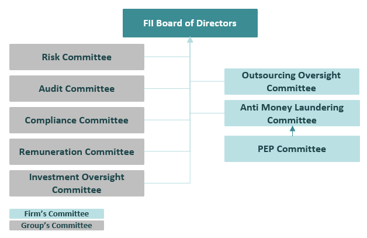
The Firm has a separate Risk Committee, that met 4 times during 2025.
Directorships held by Management Body
The total number of Directorships held by the members of the Board of Directors is 24 (of which 4 is external to the Fisher Group Directorship).
The Firm recognizes the importance of having a diverse composition of its Board of Directors including diversity of skills, experience and gender.
The Fisher Group has developed a program that communicates a stated commitment to fostering an inclusive culture, actively developing and supporting diversity, where all feel welcomed and supported, and embodying these values across the Fisher Group as fundamental to long-term success. Diversity and Inclusion (“D&I”) is also addressed through the Firm’s Employee Handbook.
RISK MANAGEMENT OBJECTIVES AND POLICIES
The FII Board has ultimate responsibility for the effectiveness of risk management within FII, and to fulfil its obligations has delegated the development of a Risk Management Framework (”RMF”) to the Risk function.
The RMF forms part of the overall risk governance infrastructure of FII, which uses a hierarchy of committees with responsibilities delegated down from the Board as appropriate, with roles and responsibilities allocated in accordance with the risk management industry standard, three Lines of Defense model. The governance and oversight structure within FII aims to ensure that risk management activities are implemented and operated effectively, and will continually evolve as the business evolves.
The Board as the ultimate decision-making body within FII, is responsible for approving the RMF and Risk Appetite statements, and Capital assessments as part of the Internal Capital Adequacy and Risk Assessment Process (“ICARA”), setting the tone from the top on the Firms risk culture, challenge and oversight of risks identified in FII.
In line with the prescriptions of the IFR, the Firm is exposed to two separate risk categories from a Pillar 1 perspective: risk to client and liquidity risk.
Risk to Client
K-AUM (Assets under management)
Being authorized for the provision of investment advice and portfolio management services, the Firm is subjected to the applicability of the K-AUM risk from a regulatory perspective.
Risk to Client addresses risks carried by an investment firm during the undertaking of its services, actions or responsibilities, which could negatively impact clients.
The Firm’s has a structured approach to ensure that its clients receive investment services that are in line with the applicable regulatory prescriptions. To this extent, prior to providing clients with investment recommendations, a comprehensive suitability assessment is conducted to identify the appropriate way to align the clients’ business goal with the investment strategy of the Firm.
The portfolio management function is outsourced to Fisher Investment’s Investment Portfolio Committee ("IPC"), a team of 5 senior level investment professionals collectively serving as portfolio managers, who make the day-to-day investment decisions for client accounts.
Additionally, the Firm is part of the Fisher’s Joint Investment Oversight Committee, which is responsible for overseeing the suitability of advice to clients and prospective clients, overseeing outsourced investment sub-management functions, and the Firm’s product governance policy.
The Firm has a comprehensive system of internal controls, policies and procedures that are evaluated for adequacy and effectiveness.
Liquidity Risk
Responsibility for liquidity management rests with FII’s Board of Directors. The Board of Directors is also responsible to ensure the liquidity review process is completed, review for material events, and approve any amendments to the framework.
Monitoring FII’s liquidity position is performed by the Finance team. The primary objectives of effective liquidity management are to ensure that the firm’s core businesses can operate and support client needs, meet contractual and contingent obligations through normal economic cycles and during stress events, to ensure funding mix optimization and ensure availability of liquidity sources.
In accordance with Article 13(1) of the IFR, the Firm should hold liquid assets equivalent to at least one third of the fixed overhead requirement.
As of 31 December 2025, FII met its liquidity requirement in full.
REMUNERATION
FII’s Remuneration Policy was developed and implemented by FII’s Remuneration Committee.
FII’s Remuneration Committee includes at least two individuals from the Fisher group of companies (the “Fisher Group”), at least one of whom is a member of the Board of Directors. The Remuneration Committee is responsible for all aspects of the Remuneration Policy, assessing both the Remuneration Policy and the structure and amount of remuneration on at least an annual basis, and overseeing the determination of remuneration paid to staff.
FII’s Remuneration Code Staff includes those employees, agents and outsourced personnel who are members of administrative or management bodies at FII or whose professional activities have a material impact on FII’s risk profile.
Remuneration Code Staff who are employees of FII receive a fixed salary, as well as benefits including a pension or equivalent arrangements and private health insurance. In addition, Remuneration Code Staff who are managers or otherwise responsible for a business unit(s), are eligible for variable remuneration based on metrics designed to encourage the development of a successful team in the business unit for which the Remuneration Code Staff is responsible and take into account the measurable performance of the relevant business unit employees. Bonuses are designed to encourage meeting ongoing measurable targets and are therefore paid out in cash upon attaining targets.
The Firm has in place an appropriate ratio between the variable and the fixed component of the total remuneration in the Remuneration Policy.
FII’s Remuneration Policy splits the variable remuneration from the advice process. Specifically, whether to recommend discretionary asset management services, and the recommended asset allocation, is determined by employees who do not earn commissions or formula-bases bonuses. Further, employees and agents who are eligible to receive variable commissions and/or formula-based bonuses also receive either a fixed salary or call fees that are not contingent upon a client hiring FII, which forms a substantial portion of their overall remuneration, as appropriate for their roles.
In the event of reasonable evidence of employee or agent misbehavior or material error (which may include failure to follow any of FII’s policies and procedures or for conduct exposing FII to undue conduct or other risk), the Remuneration Committee will determine the extent to which variable remuneration should be reduced.
The Firm benefits from a derogation laid down in Article 32(4) of IFD.
The aggregate remuneration paid to all Remuneration Identified Staff in 2025 was €6.1M. Of total remuneration, €2.9M was fixed remuneration and €3.2M was variable remuneration. The total number of all Remuneration Identified Staff was twenty-five. During 2025, the Firm paid €10k in guaranteed variable remuneration. There was €193K of Severance payments (ex-Gratia) awarded during the period to Identified Staff.
OWN FUNDS
A strong capital position is essential to the Firm’s business strategy and competitive position. The Firm’s capital strategy focuses on long-term stability, which enables it to continue to build and invest in business activities through normal and stressed environments. The Firm’s capital management objectives are achieved through ongoing monthly monitoring of its capital positions with reporting of this to the Firm’s Board of Directors quarterly, periodic stress testing and adequate updates to the Firm’s ICARA to ensure appropriate capital planning.
The Firm's own funds requirements are the highest of the three items outlined below, in line with Art. 11 of the IFR as of 31 December 2025.
|
Item |
Amount (EUR) |
Regulatory Reference |
|---|---|---|
|
Permanent minimum capital requirement |
75,000 |
Art. 9.2 of IFD |
|
Fixed overhead requirement |
6,741,647 |
Art. 13 of IFR |
|
Total K-Factor Requirement |
615,791 |
Art. 17 of IFR |
|
Own Funds requirement |
6,741,647 |
Art. 11 of IFR |
Therefore, the Firm’s capital requirement as of 31 December 2025 is €6,741,647 based on the Firm’s fixed overhead requirement. The Firm’s fixed overhead requirement for 2026, based on the Firm’s 2025 financial statements is €9,275,908
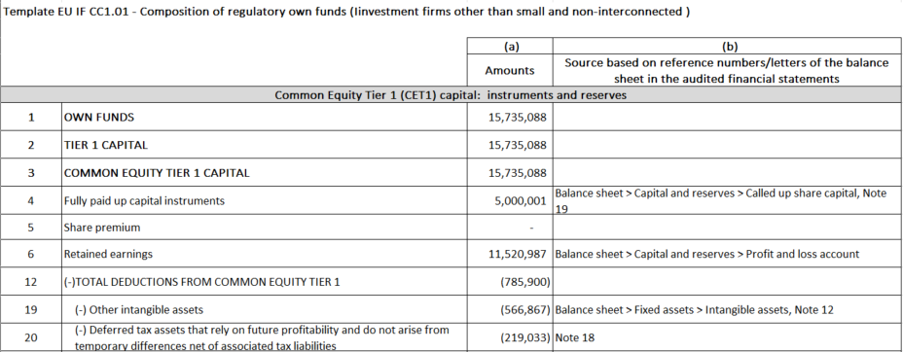
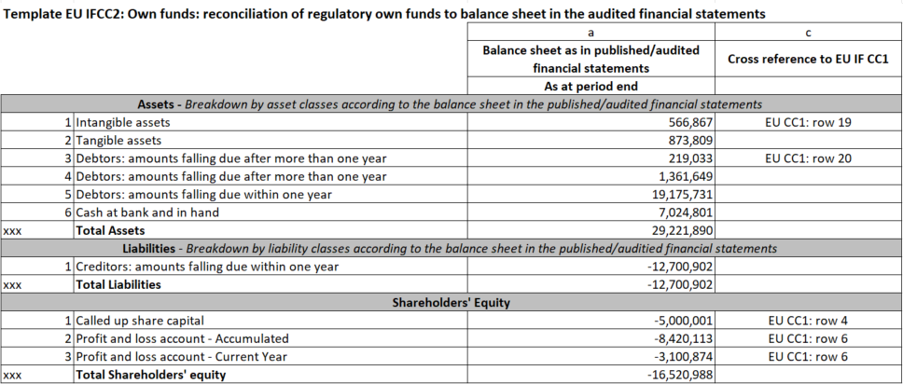
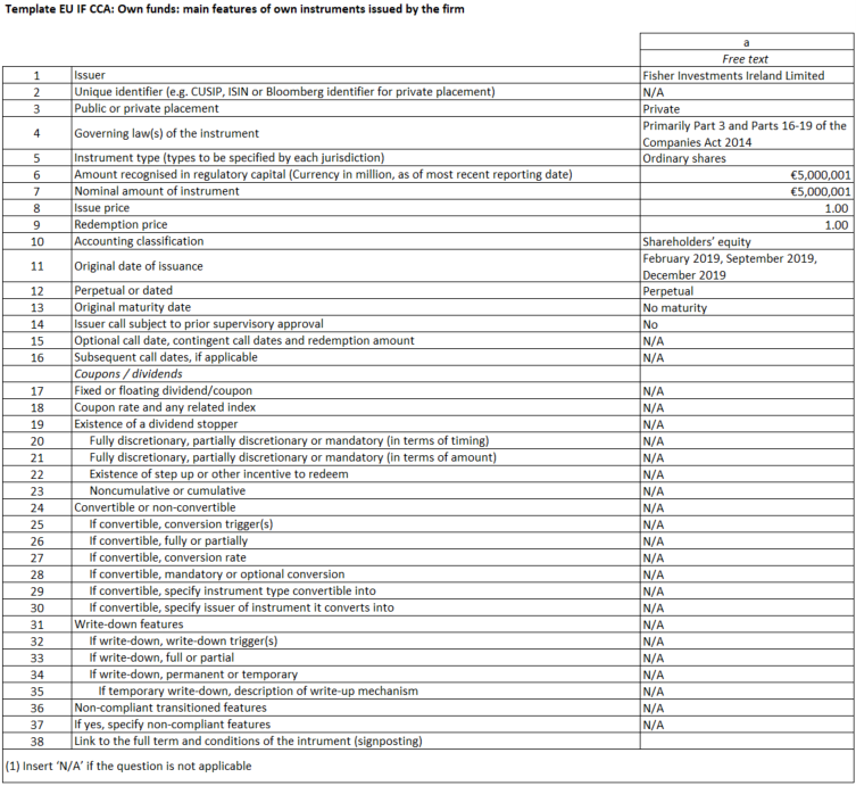
The Firm’s capital as presented in the 2024 financial statements and deductions from capital are presented below, in line with Art. 49 of IFR and the prescriptions of the Implementing Technical Standard for supervisory reporting and disclosures of investments firms3 (“ ITS 2021/2284”).
Given that the Firm’s capital resources, fully composed by Common Equity Tier 1 capital ( the Firm has no Additional Tier 1 or Tier 2 capital) of €15,735,088, are well in excess of the capital resource requirement of €9,275,908 being the Firm’s fixed overhead requirement for 2026; it is the Firm’s view its capital is sufficient for both regulatory needs and business objectives.
1 Regulation (EU) 2019/2033 of the European Parliament and of the Council of 27 November 2019 on the prudential requirements of investment firms
2 Directive (EU) 2019/2034 of the European Parliament and of the Council of 27 November 2019 on the prudential supervision of investment firms
3 COMMISSION IMPLEMENTING REGULATION (EU) 2021/2284 of 10 December 2021 laying down implementing technical standards for the application of Regulation (EU) 2019/2033 of the European Parliament and of the Council with regard to supervisory reporting and disclosures of investment firms