


Are you ready to start your journey to a better financial future?
Personal Wealth Management / Market Analysis
Will Data Center Slowdown Slow Stocks?
The data-center buildout isn’t the market’s only support.

Will slowing data center spending imperil US business investment? Many think political backlash following midterms will brake economic growth and markets. While slowing investment may prove a Tech headwind, the bull market is broader than that and doesn’t depend on a single sector’s prospects.
AI policy risk was a concern going into midterms as local and national candidates campaigned on data center crackdowns. Some feared a “blue wave” would drive increased AI oversight and stricter regulation … cooling data center construction. After Democrats’ big wins at the national and local level, those pre-election concerns have picked up.
For example, newly elected governors in Ohio, Georgia, Michigan, New Mexico and Texas all pledged to stop (or slow) their states’ data center construction.[i] Incoming governors in Iowa and Nevada said they would end AI tax breaks.[ii] In Ohio, 11 towns passed total or near-bans on data center construction.[iii] According to climate and energy consultancy Relae, 70 data center projects were “blocked, withdrawn or stalled since 2024,” with 16 projects stopped in Q3 alone due to community opposition.[iv] And that was with state and local governments that were nominally friendlier to the industry than incoming leadership.
Against this political backdrop, some analysts predict data-center buildout headwinds will hurt economic growth and render corporate earnings projections too lofty, hurting stocks. The logic: The market pre-priced businesses’ high projected capital expenditures (capex), which would theoretically yield strong, lofty returns down the road. Canceled capex could upend this thesis—which allegedly contributes to recent market volatility.
We agree AI spending has been a big growth driver in recent years. Per the Federal Reserve Bank of St. Louis, going into this year, AI spending already contributed more to 2025 GDP than the dot-com boom did to 2000 GDP.[v] But AI spending isn’t business investment’s sole support. As one demonstration, Exhibit 1 shows information processing equipment as a share of total private investment. It is up sharply over the past two yars, likely reflecting a large influence from AI. Yet the level itself isn’t historically high compared to, say, the 1990s—when a similar level persisted a while. While information processing equipment makes up over 15% of total private investment now, that means around 85% is elsewhere. Some of that is probably in data center infrastructure, cooling and the like. But a lot isn’t.
Exhibit 1: Information Processing Equipment’s Share of US Private Investment
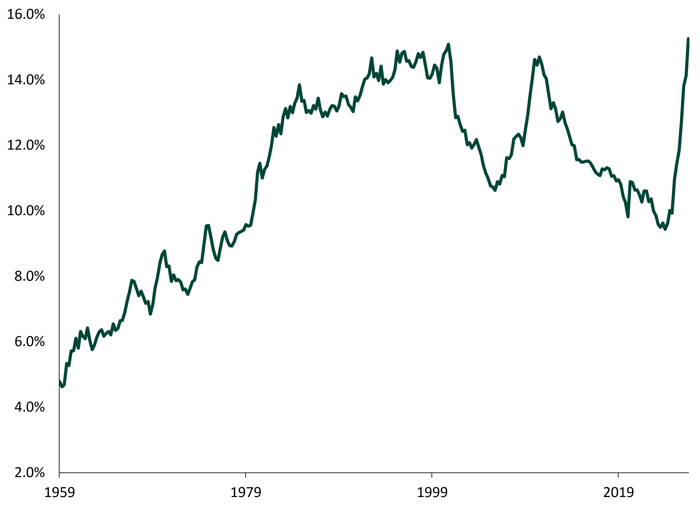
Source: Bureau of Economic Analysis, as of 11/20/2026.
As for capex and earnings, the thinking underpinning the worries is sensible from a high level. If forward-looking markets projected big investment returns based on data-center buildouts—and those buildouts don’t happen—the resulting disappointment can knock stocks. However, this presumes data center delays and slowdowns are a big, negative, unexpected surprise. Yet data center opposition isn’t sneaking up on anyone. Last year, the Brookings Institution pointed out the difficulties in obtaining state and local permits, and community groups (e.g., in Northern Virginia) organized to stop construction.[vi] Recent market volatility seems to us like sentiment overemphasizing the latest news while ignoring these pre-existing trends.
Following the midterms, data centers remain a hot political issue. Increased local government pushback receives national attention. The White House is adding to the fire, with President Donald Trump threatening a “tremendous tax” on Tech companies that build data centers outside the US. This is likely noise, but it could have contributed to rocky markets Friday, considering sentiment was already a bit edgy. Now, if restrictions build, those rules may slow growth. But as mentioned above, local permitting delays have been happening—they aren’t a surprise. For their part, Tech companies have responded to some of the critiques, pledging to make their projects more of a visible net benefit for local communities (e.g., limiting their water use and generating tax revenue).[vii]
Increased regulation can be a headwind for Tech—one reason, alongside elevated expectations, we don’t expect Tech to lead. But critically for investors, this is a headwind getting heaps of attention. Wherever markets go from here, up or down, will probably have more to do with things people aren’t talking as much about.
[i] Some 40% of US Planned Data Center Capacity Is in States Wanting to Hit Pause,” Kyle Stock and Miquéla V. Thornton, Bloomberg, 11/5/2026.
[ii] Ibid.
[iii] Ibid.
[iv] “Data Center Cancellations in Q3 Double: Relae,” Lamar Johnson, ESG Dive, 11/19/2026. Accessed via Yahoo Finance.
[v] “Tracking AI’s Contribution to GDP Growth,” Hannah Rubinton and Bontu Ankit Patro, Federal Reserve Bank of St. Louis, 1/12/2026.
[vi] “The Future of Data Centers,” Nicol Turner Lee and Darrell M. West, The Brookings Institution, 11/5/2025.
[vii] “Voters Rejected Data Centers. Many Will Be Built Anyway,” Karen Weise, The New York Times, 11/12/2026.
If you would like to contact the editors responsible for this article, please message MarketMinder directly.
*The content contained in this article represents only the opinions and viewpoints of the Fisher Investments editorial staff.
Get a weekly roundup of our market insights.
Sign up for our weekly email newsletter.

You Imagine Your Future. We Help You Get There.

Where Might the Market Go Next?
Confidently tackle the market’s ups and downs with independent research and analysis that tells you where we think stocks are headed—and why.
