


Personal Wealth Management / Economics
A May Global Economic Check-In
Pockets of strength and weakness in May purchasing managers’ indexes show growth, overall, is still better than expected.

Last Thursday’s May flash purchasing managers’ index (PMI) releases provided a timely snapshot of developed market economic conditions in mid-Q2, with some high-profile wobbles renewing recession jitters. Yet in aggregate, these surveys tallying growth’s breadth mostly confirm what markets already knew—and priced. While global growth has its soft patches, particularly in Europe, that isn’t new or abnormal. The global economy almost always has pockets of strength and weakness, and stronger regions typically pull weaker ones along. A mostly growing, mixed-bag global economy is a fine thing for stocks when recession fears flare.
Exhibit 1 shows May’s results in the context of this year’s trends. Among the highlights: ongoing business expansion in the US and Japan with composite (combining services and manufacturing) PMIs above 50, indicating a majority of firms reported growth. America’s services sector saw a slightly slimmer majority expanding, while Japan’s was right on the line between growth and contraction, implying an even split among reporting firms. Note here that although PMIs reflect the sector’s breadth of growth, they don’t capture how much firms grew or contracted, just the net percentage of how many businesses experienced expansion.
Exhibit 1: Developed Market PMIs Outside Europe Remain Growthy
Source: FactSet, as of 5/21/2026. May’s flash PMI readings (italicized) are preliminary results estimated from around 80% to 90% of the month’s total responses.
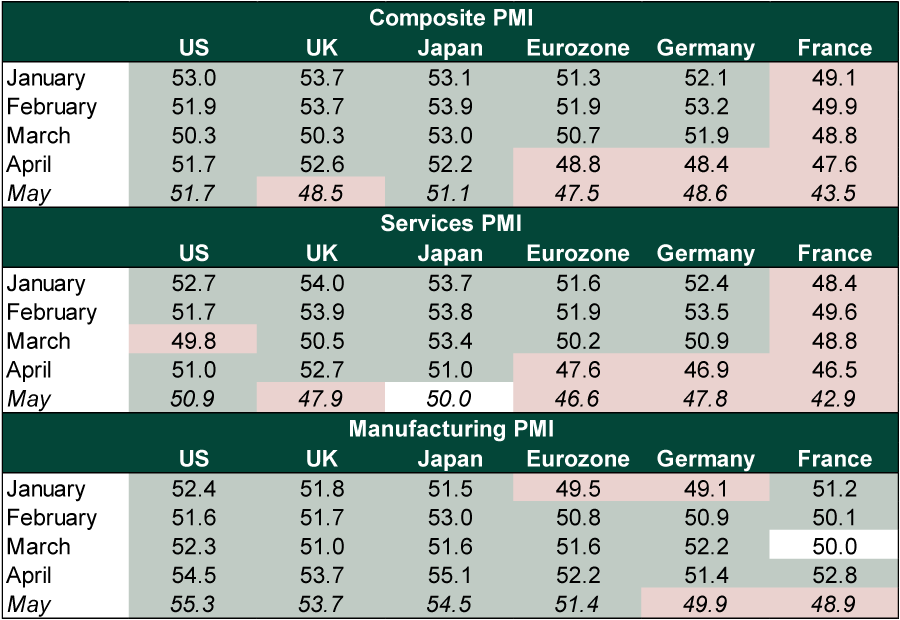
Notably, growth was more widespread in America’s and Japan’s manufacturing sectors. S&P Global’s PMI releases indicated this was largely stockpiling due to supply-chain worries. To us, that suggests increased resilience, as anticipation is mitigation. The future may be uncertain, but businesses are preparing for it. And outside of that, both countries’ output measures and new orders remained expansionary, too. End market demand is holding up.
However, Exhibit 1 also shows the second straight month of sub-50 eurozone PMIs, with the UK now joining the fray in May. While we don’t dismiss this and are watching for trouble, weak PMIs alone don’t guarantee recession. France is particularly instructive here. Its composite PMI was below 50 almost all last year, bottoming at 45.1 in February 2025, yet GDP grew every quarter then.[i] France experienced even weaker PMI readings in 2023, with the composite hitting 44.1 that September and staying in the 44 range through January 2024. Again, GDP grew.
This year, France’s composite PMI was sub-50 in Q1 and GDP was flat. And with even bigger drops in Q2 many fear the worst. May’s 42.9 services reading points to widespread contraction. As France’s PMI report put it:
“The steepest contraction since late 2020 was a consequence of the war in the Middle East, according to firms, who frequently cited fuel and energy cost pressures, as well as general economic angst, as reasons for lower output. ... On balance, firms were pessimistic towards the outlook—the first time this has been the case since November 2024—and the degree of negativity was its greatest since the initial outbreak of the COVID-19 pandemic in April 2020.”[ii]
Energy costs are probably less of a factor for services businesses, which aren’t resource intensive, but sometimes uncertainty freezes business decisions as people wait to get the lay of the land. Uncertainty eventually fades, though, or businesses get used to it and move on.
And here, too, PMI surveys—like all surveys—may not be the most reliable economic indicators. Late 2020’s “steepest contraction,” for example, coincided with a slight -0.1% q/q French dip in Q4 2020 GDP, but that occurred during a monster recovery—the tiniest pullback after Q3 2020’s 15.3% reopening rebound—with growth that followed.[iii] France’s Q2 GDP may yet dip, as it has occasionally post-pandemic (like in Q1 2022 and Q4 2024), but those proved to be one-off incidents, not lasting downturns. We doubt it will be different this time given regional conflict doesn’t smother growth as much as many think (see Ukraine) and Iran’s conflict likely ends sooner rather than later.
Similarly, UK services’ 47.9 May reading (48.5 composite) flipped to its most contractionary in five years—and lowest in a decade outside the pandemic—due to war uncertainty, but also ramping political uncertainty as well. Again though, such sentiment-driven swings rarely render recession, even for Britain’s heavily services-dominant economy. Then too, like France, the UK is no stranger to occasional services and composite PMI dips below 50. The last occurred April 2025 (49.0 services, 48.4 composite) in Liberation Day’s wake.[iv] Another occurred in August – October 2023 (49.3 services and 48.5 composite at their lowest levels that September). But although those coincided with weak monthly GDP—and even a shallow two-quarter “technical” recession in late 2023—neither caused prolonged contraction despite persistent grumbling.
Meanwhile, eurozone manufacturing stayed expansionary in May, French and German contractions notwithstanding. This indicates conditions are better elsewhere in the bloc. The economy isn’t universally bad—pockets of resilience, if not strength, remain.
And that is what matters for markets: Overall and on average, global economic growth is weathering well-known Middle East headwinds better than expected. This doesn’t mean every country and all their sectors are immune, as those dim France and UK services readings show. But those aren’t coming out of the blue—or shocking stocks—judging by the litany of grim headlines the last few months.
For investors, May’s flash PMIs are still backward looking to stocks, which look forward 3 – 30 months and pre-price economic conditions affecting earnings in advance. They confirm what markets already priced: uneven growth that has downshifted with the war, but not anything approaching global recession many fear. Yes, the Iran conflict is weighing somewhat on Q2 growth as uncertainty keeps some businesses in wait-and-see mode—and more on outlooks ahead as pundits predict worst-case scenarios unfolding—but reality, so far, keeps proving them wrong, and it need only muddle through like in May to exceed expectations. Against a backdrop of far warmer sentiment in the US, even that could spur non-US leadership anew. With such a low bar to clear, stay bullish.
If you would like to contact the editors responsible for this article, please message MarketMinder directly.
*The content contained in this article represents only the opinions and viewpoints of the Fisher Investments editorial staff.
Get a weekly roundup of our market insights
Sign up for our weekly e-mail newsletter.

You Imagine Your Future. We Help You Get There.
Are you ready to start your journey to a better financial future?
Where Might the Market Go Next?
Confidently tackle the market’s ups and downs with independent research and analysis that tells you where we think stocks are headed—and why.
Related Resources
-
Weekly Wrap-Up Fisher Investments Reviews: Last Week in Markets — October 5 - October 92026-10-12
-
Politics Context for the Noisy Congress to Come2026-10-09
-
Expert Commentary This Week in Review | S&P 500 Record High, Fed Minutes, Spain Election
 2026-10-09
 -
Interesting Market History Notes on a Bear Market Anniversary2026-10-09




Learn More
Learn why 210,000 clients trust us to manage their money and how Fisher Investments and its affiliates may be able to help you achieve your financial goals.
As of 9/30/2026
New to Fisher? Call Us.
Contact Us Today