


Personal Wealth Management / Financial Planning
A Reminder Primer: How Dividends Really Work
Return of your investment is different than return on your investment.

Editor’s Note: This article references individual stocks in order to help illustrate a broader point. MarketMinder doesn’t make individual security recommendations and nothing here should be construed as such.
Whenever market volatility surges, a flood of articles and ads touting investments offering “safety” and “stability” usually follows. This time, in the wake of March’s slide, there was a lot of chatter about low-volatility ETFs and other gimmicky, complex tools. But something more traditional also gained fanfare: high-dividend stocks. For weeks, we have seen a steady drip of pieces hyping high-paying stocks to own “for life,” casting them as lifetime annuities shelling out “free money.” We aren’t against high-dividend stocks, but those portrayals just aren’t true.
High-dividend stocks aren’t special. Their price rises and falls like their lower-paying peers. They aren’t immune to volatility. While high-dividend stocks didn’t fall as much as the MSCI World Index during the mini-correction following the war’s outbreak, they came close with a -7.6% peak-to-trough decline.[i] A wee bit shallower and shorter than the MSCI World’s -8.9%, but still jarring.[ii] And while global stocks regained all-time highs in mid-April, high-dividend stocks are well off that mark and seesawing sideways over the last month.
We can hear the rebuttal to this now: Yah, but you are ignoring the real benefit—the payout! Well, some things about that. For one, dividends aren’t guaranteed. Companies can cut them at any time … and do, usually when times are tough. When markets are down and the books don’t look good, cutting a dividend is an easy way to shore up the balance sheet. That means you risk losing the payout when you might most covet it.
But there are also crucial conceptual errors here. People equate dividends with interest payments, largely because they are both expressed in percentage terms and classified as investment income. But an interest payment is something that you reap on top of your principal. You buy a bond, get the interest payments during its lifetime, then get your principal back at maturity.
Not so with dividends. They aren’t free money. The Wall Street Journal’s Spencer Jakab hammered this point home today in a pithy piece warning folks to think long and hard before falling for the handful of stocks with eye-popping yields today: “Investor surveys show that many incorrectly view dividends as free money. Any cash paid out instantly reduces a company’s value, though. High dividend yielders might be doing the right thing by being so generous, but it also means they have little reason to invest in themselves.”[iii]
Yes and amen! This is a point we have made many, many times over the years. A dividend is not a return on your investment. It is a return of your investment. This is why, whenever a company pays a dividend, its stock price drops by the exact dollar-per-share amount. Volatility can make that hard to see. But it is, by definition, true. Sometimes, when companies pay large, one-off dividends, it is easier to see. Exhibit 1 shows this using Microsoft’s initial and subsequent special dividends in 2004. As shown, price return diverges wildly from total return. It is the same stock. Other companies retain earnings to invest later in future projects to drive their long-term growth. High dividend payers elect to return cash to you to reinvest elsewhere, which is subtracted from the share price.
Exhibit 1: How Dividends Work—Illustrated!
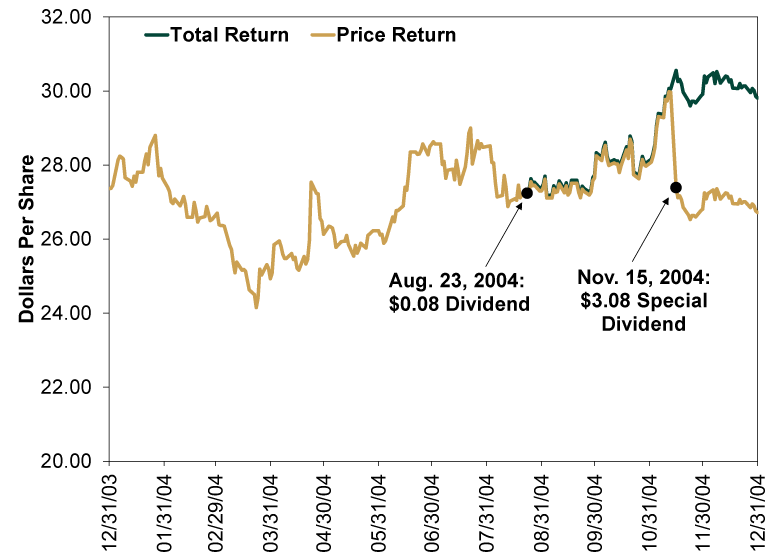
Source: FactSet, as of 5/7/2026. Microsoft price and total return, 12/31/2003 – 12/31/2004 with dividends annotated.
All investments have risks and tradeoffs. If all you do is focus on a stock’s high dividend yield, you risk fooling yourself into overlooking the broader list of pros and cons. And if you focus only on the dividend yield, you lose sight of what ultimately determines an investment’s success: its total return, which is price appreciation (or decline) plus dividends. Your portfolio’s total return is what will determine whether you reach your investment goals.
Besides, when you focus on dividends, you turn a blind eye to a key factor: diversification. Very often, high payers will cluster by industry into things like Financials, Real Estate or Utilities. Those are all fine—nothing against those sectors! But a dividend-focused portfolio can be too tilted in their direction, obscuring opportunities in lower-paying sectors like Tech and Communication Services, which have cumulatively led markets over the preceding decade.
Again, we aren’t against high-dividend stocks. They can do quite well at times, and everything has its day in the sun and the rain. But you should consider all the things that factor into that—not just company-specific fundamentals, but also high payers’ tendency to concentrate in certain categories. And keep total return first in mind.
[i] Source: FactSet, as of 5/7/2026. MSCI World High-Dividend Yield Index return with net dividends, 2/27/2026 – 3/20/2026.
[ii] Ibid. MSCI World Index return with net dividends, 2/25/2026 – 3/30/2026.
[iii] “These Juicy Dividend Payouts Might Be a Trap,” Spencer Jakab, The Wall Street Journal, 5/7/2026.
If you would like to contact the editors responsible for this article, please message MarketMinder directly.
*The content contained in this article represents only the opinions and viewpoints of the Fisher Investments editorial staff.
Get a weekly roundup of our market insights
Sign up for our weekly e-mail newsletter.

You Imagine Your Future. We Help You Get There.
Are you ready to start your journey to a better financial future?
Where Might the Market Go Next?
Confidently tackle the market’s ups and downs with independent research and analysis that tells you where we think stocks are headed—and why.
Related Resources
-
Market Analysis The Sentiment Cooldown Unfolding2026-10-26
-
Weekly Wrap-Up Fisher Investments Reviews: Last Week in Markets — October 19 - October 232026-10-26
-
Expert Commentary This Week in Review | AI Debt, French Bond Yields, Oil Prices
 2026-10-23
 -
Behavioral Finance The Risk in Seeking ‘Safety’2026-10-22




Learn More
Learn why 210,000 clients trust us to manage their money and how Fisher Investments and its affiliates may be able to help you achieve your financial goals.
As of 9/30/2026
New to Fisher? Call Us.
Contact Us Today