


Personal Wealth Management / Market Analysis
Are World Oil Reserves Dangerously Low?
While reserves are down, ramping production likely keeps a lid on prices.

Are the world’s oil reserves running dry? Recently, headlines have begun warning that earlier drawdowns of official reserves mean depleted oil inventories set the stage for another oil shock this summer if the Strait of Hormuz remains restricted. With all due respect, we doubt it. The dip in global oil supplies doesn’t seem alarming—it was expected. Markets likely priced it almost immediately after conflict commenced in late February, or at least when moves to tap reserves were unveiled. Meanwhile, a burgeoning supply response should mitigate further disruption.
Reportedly, oil in storage is “dangerously low,” and if depletion continues through June, Brent crude prices around $95 a barrel today could spike to $150 or $160, above their April 7 zenith of $137.[i] So how dire are oil inventories? In America, Exhibit 1 shows crude stockpiles are, understandably, down. But they are still above 2023 levels. That may seem like cold comfort—especially for those paying more at the pump—but thin inventories a few years ago didn’t lead to spiking prices, even when the government began gradually refilling them. Crude prices drifted lower from $96 at September 2023’s close—inventories’ low—to $61 at 2025’s end.[ii]
Exhibit 1: US Oil Inventories Tight but With Some Commercial Leeway
Source: FactSet, as of 6/5/2026.
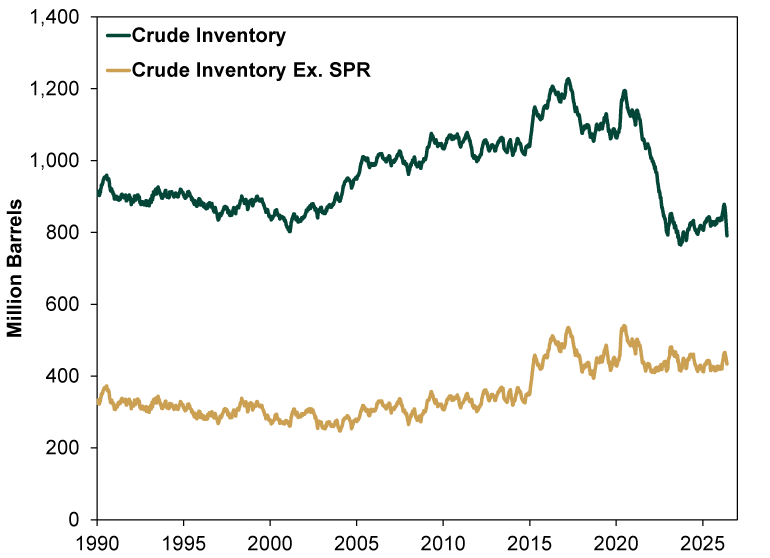
After 2022’s steep drawdown in the wake of Russia’s Ukraine invasion—and global oil supply disruptions—America’s strategic petroleum reserve (SPR) was never fully replenished. The latest SPR release, to date, mostly gives back what little was refilled since. But note how that has been offset partially by commercial inventories, which remain ample historically. Now, while the Energy Information Administration (EIA) gives a comprehensive assessment of onshore oil stockpiles—i.e., in US tanks, pipelines, refineries and bulk terminals—it doesn’t capture all barrels, e.g., those floating offshore or sailing en route to America. So that inventory reading may understate reality.
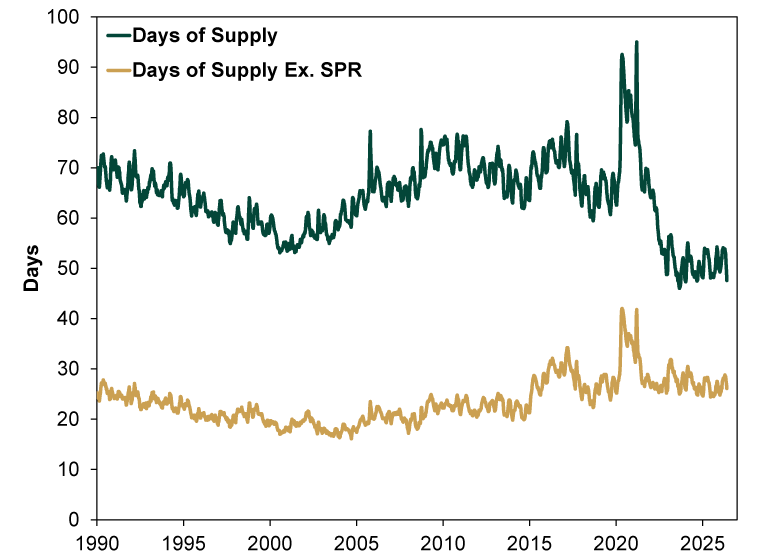
Still, if production stopped tomorrow (it won’t), the US would have approximately 47.6 days of crude oil supplies based on current consumption rates at May’s end. (Exhibit 2) While not unprecedented, that is at the low end of the range since 2022, though again commercial stocks help meet demand.
Exhibit 2: Less Than 50 Days of US Oil Inventories
Source: FactSet, as of 6/5/2026.
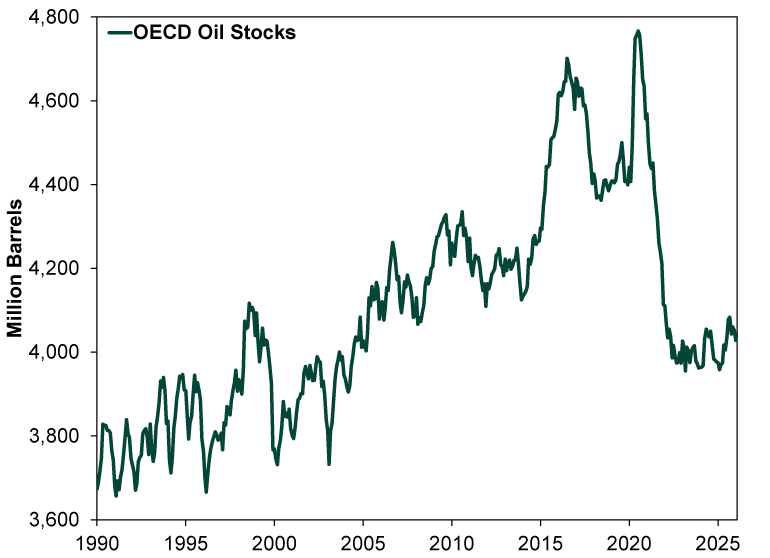
Globally, the 38-member Organization for Economic Cooperation and Development (OECD), including America and the bulk of the developed world, had just over four billion barrels on hand at February’s end, the latest available data. (Exhibit 3) There is likely less now, given coordinated releases, but the International Energy Agency’s May report still put the OECD’s supply—or “days of forward demand coverage”—at 64.4 days through March, above average for the 5 years through 2025. Going forward, the EIA expects “OECD inventories to fall to a low of 50 days by the end of 2026, which would be the fewest days of future demand cover since January 2003, when our dataset begins.”[iii] Low, yes—but 50 days’ coverage with no production doesn’t seem crisis-inducing.
Exhibit 3: Developed Countries Globally Face Similar Situation
Source: FactSet, as of 6/5/2026.
Perhaps markets see and appreciate that, even if headlines and pundits can’t. For one, this is inventories’ intended use—as a cushion when supply pinches. That happened very, very publicly, with drawdowns announced by the US and other G7 nations shortly after fighting began. Markets know reserves are supposed to be drawn down during disruptions. Declining inventories just show them working as intended. They also know they will need replenishing eventually. And they know inventories have limits eventually, even if those are far off now.
Then too, markets look forward—and futures markets, while still signaling some stress, indicate much less disruption than a few months ago. The futures curve for oil markets, from next-month contracts to six months out (and longer), is still in “backwardation,” meaning spot prices are higher for immediate delivery than further out in time. Now, as oil prices eased from their peaks, backwardation also cooled. Why? The UAE, Canada, Norway, Brazil and Venezuela, among others, are looking to produce and ship more over the next year to ease the strain—and take advantage of elevated prices. And more oil tankers, aided by the US military, are apparently exiting the Strait. Gulf tanker loadings in countries excluding Iran have climbed from near zero in mid-May to over 2.5 million barrels per day now.[iv]
Then there is America, the world’s largest oil supplier and swing producer. US production is hovering around record highs at just under 14 million barrels per day (mbpd), with oil exports accompanying this output surge also at all-time highs. This looks to go even higher in the near term with rig counts rising, oil field equipment utilization soaring and new export terminals in the southern US coming online.[v] The EIA’s June Short-Term Energy Outlook (STEO) revised average US oil output upward to 13.72 million barrels per day (mbpd) in 2026 from 13.65 mbpd in May’s STEO.[vi] Then for 2027, it projects a record-setting 14.15 mbpd, revised higher from 14.10 mbpd last month.
All this contributes to the EIA’s global oil production projection of 109.3 mbpd next year, a 10.4% increase from 99.0 mbpd expected this year. Forecasts are only ever opinions, but the STEO’s aligns with easing backwardation. When in doubt, trust markets to incorporate all available information. Today, they aren’t signaling inventory depletion is a real threat to this bull market.
[i] “Global Oil Inventories Depleted, Next Price Spike Could Roil Economies, Markets,” Georgina McCartney and Laura Matthews, Reuters, 6/5/2026.
[ii] Source: FactSet, as of 6/10/2026.
[iii] “Short-Term Energy Outlook,” Staff, EIA, June 2026.
[iv] “Hormuz Tracker, Day 103,” Henri Patricot, CFA, UBS, 6/11/2026.
[v] “From Chokepoint to Crisis: The Strait of Hormuz and Global Oil Markets,” Samantha Gross and Ryan Beane, Brookings, 6/8/2026.
[vi] Source: EIA, as of 6/9/2026.
If you would like to contact the editors responsible for this article, please message MarketMinder directly.
*The content contained in this article represents only the opinions and viewpoints of the Fisher Investments editorial staff.
Get a weekly roundup of our market insights
Sign up for our weekly e-mail newsletter.

You Imagine Your Future. We Help You Get There.
Are you ready to start your journey to a better financial future?
Where Might the Market Go Next?
Confidently tackle the market’s ups and downs with independent research and analysis that tells you where we think stocks are headed—and why.
Related Resources
-
Economics Checking in on US Consumers2026-10-08
-
Politics Two Elections in the Americas—and Spain’s Coming Snap Vote2026-10-06
-
Weekly Wrap-Up Fisher Investments Reviews: Last Week in Markets — September 28 - October 22026-10-05
-
Market Analysis Budgeting for French Debt Fears2026-10-05





Learn More
Learn why 210,000 clients trust us to manage their money and how Fisher Investments and its affiliates may be able to help you achieve your financial goals.
As of 9/30/2026
New to Fisher? Call Us.
Contact Us Today