


Personal Wealth Management / Economics
UK and German GDP Teach a Timeless Lesson
Recent GDP data confirm fundamentals supported stocks’ rise last year.

Three weeks into 2026 and geopolitics have understandably dominated most headlines. What has gone overlooked: Some recent data show what stocks moved on last year. The latest UK and German GDP results confirm reality wasn’t as poor as feared in 2025—illustrating a timeless lesson in what moves stocks.
Europe’s Latest “Sick Man” Is on the Mend
While Germany’s Q4 GDP release is a week away, the Federal Statistical Office (aka Destatis) announced full-year growth of 0.3% in 2025. The underlying components were mixed: Household spending (1.4% annual growth) contributed, while gross fixed capital information (-0.5%) and exports (-0.3%) detracted.[i] On a sector basis, manufacturing (-1.3%) fell for a third straight year, but services (e.g., trade, transport, accommodation and food services as well as information and communication) mostly grew.[ii]
But the big story: Destatis announced Germany’s two-year long recession ended last year. If it is news to you that Germany was in recession, you are probably not alone: This is the first official confirmation Germany was in a recession, and it comes as the data show it ended. Perhaps recession seemed obvious from the two straight annual GDP declines from 2023 – 2024, but they were shallow. Headlines would frequently claim Germany was in “recessionary territory,” but consider: Prior to Destatis’s regular annual revision last year, German GDP alternated between growth and contraction every quarter from mid-2022 – mid-2025. Muddy water, indeed. Now the arbiters of German GDP have declared it so, albeit, more than a year since recession ended—a timely reminder the label is backward-looking.
That said, this confirmation isn’t new to forward-looking stocks. They pre-priced the downturn before it occurred, as German stocks endured a bear market from mid-November 2021 through late September 2022—dropping -30.7% in euros (to avoid US dollar skew)—consistent with an anticipated economic soft patch.[iii] In comparison, the MSCI World fell -12.4% in euros over the same timeframe (though it did endure a full, albeit short and shallow, bear market in USD in 2022, the date range of that downturn doesn’t align with Germany’s peak and trough).[iv] Yet a bull market in German stocks began despite recession unspooling over the next two years. (Exhibit 1)
Exhibit 1: German Stocks Moved First
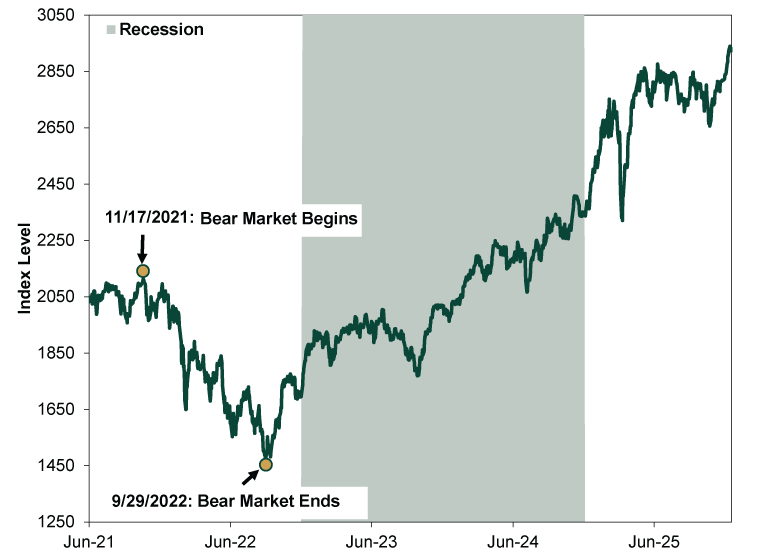
Source: FactSet, as of 1/21/2026. MSCI Germany Investable Market Index returns with gross dividends, 6/30/2021 – 1/16/2026. Presented in euros. Currency fluctuations between the euro and dollar may result in higher or lower investment returns.
Going into 2025, the consensus expectation was flagging growth due to both domestic (restrictive fiscal policies and protracted industrial decline) and international (geopolitical uncertainty) factors. Many presumed Germany’s economy needed a boost, which is why Chancellor Friedrich Merz’s spending program received so much hype. Yet we now know GDP grew last year even though Merz’s spending plan didn’t deliver what so many expected. In our view, this confirms stocks weren’t over their skis, irrationally pricing in fiscal stimulus hopes. Even tepid growth was sufficient to exceed expectations.
UK GDP Also Fared Better Than Anticipated
UK recession chatter wasn’t as prevalent as in Germany, but many worried businesses were struggling—due in part to uncertainty from UK Chancellor Rachel Reeves’s November Budget. The data seemed to confirm late-year weakness, too. In the initial readings, the Office for National Statistics (ONS) reported monthly GDP was flat in August, contracted -0.1% m/m in September and unexpectedly fell again (-0.1%) in October.[v] Many presumed Budget-related uncertainty was discouraging spending and investment and that the streak would continue into November.
Against that backdrop, November GDP surprised with 0.3% m/m growth.[vi] For all the warnings about Budget headwinds, business activity didn’t dry up. Now, some of November’s growth reflected a major automaker coming back online after a late-summer cyberattack derailed production. Manufacture of motor vehicles, trailers and semi-trailers did jump 25.5% m/m in November following October’s 9.6% climb and September’s -29.6% plunge.[vii] While that is skewing November data up, it was also a one-off that dragged the prior months’ down.
Meanwhile, services—the main driver of UK GDP—grew 0.3% m/m after October’s -0.3% dip, and interestingly, Budget uncertainty may have boosted some businesses.[viii] For instance, the accounting, bookkeeping and auditing activities and tax consultancy industry rose 4.6% m/m, likely benefiting from all the Budget speculation and unknown implications for household finances.[ix]
Looking at the bigger picture, the ONS also upwardly revised its September initial estimate from a -0.1% m/m dip to 0.1% growth.[x] For those of you scoring at home, UK GDP went from two monthly contractions—with another dip supposedly a given in November—to expansion in two out of those three months (with the quickest rate in November). Hence, the latest data seemingly confirm UK growth held up in the back half of the year—indicating UK stocks’ 8.5% climb in pounds since September, beating the MSCI World’s 7.0% in pounds over the same timeframe, was based on better-than-recognized fundamentals.[xi]
These data illustrate a point we often make: Markets are efficient discounters of widely known information, meaning they pre-price all the analyses, discussion and conversation about perceived negatives and positives that matter to stocks. While stocks can move for any (or no) reason in a day, week or even month, fundamentals matter more over the longer term—and they move most on the gap between expectations and reality.
For instance, if the consensus thinks a nation or region will experience a deep, extended recession, even a shallow downturn can surprise to the upside. This was the case with Germany after 2022, when many presumed Europe’s energy crisis would drive a deep, prolonged economic downturn. Yet reality—a shallow recession, sprinkled with some quarters of weak growth—wasn’t nearly as dire.
Most importantly for investors, markets don’t wait for official confirmation of economic weakness or recovery. In the case of Germany, it is now 2026, and we just got official acknowledgment Germany’s economy was in recession from 2023 – 2024. Over a shorter timeframe, many thought the UK economy would stumble last year because of the Budget. Some soft patches aside, UK GDP kept growing. If you wait for the supposed negatives to clear before starting to invest, those potentially missed bull market returns can be costly for long-term investors.
[i] Source: Federal Statistical Office, as of 1/21/2026.
[ii] Ibid.
[iii] Source: FactSet, as of 1/21/2026. MSCI Germany IMI returns with gross dividends, 11/17/2021 – 9/29/2022. Presented in euros. Currency fluctuations between the euro and dollar may result in higher or lower investment returns.
[iv] Source: FactSet, as of 1/21/2026. MSCI World Index returns with net dividends, 11/17/2021 – 9/29/2022. Presented in euros. Currency fluctuations between the euro and dollar may result in higher or lower investment returns.
[v] Source: Office for National Statistics, as of 1/21/2026.
[vi] Ibid.
[vii] Ibid.
[viii] Ibid.
[ix] Ibid.
[x] Ibid.
[xi] Source: FactSet, as of 1/21/2026. MSCI United Kingdom IMI returns with gross dividends and MSCI World returns with net dividends, 8/31/2025 – 12/31/2025. Presented in British pounds. Currency fluctuations between the pound and dollar may result in higher or lower investment returns.
If you would like to contact the editors responsible for this article, please message MarketMinder directly.
*The content contained in this article represents only the opinions and viewpoints of the Fisher Investments editorial staff.
Get a weekly roundup of our market insights
Sign up for our weekly e-mail newsletter.

You Imagine Your Future. We Help You Get There.
Are you ready to start your journey to a better financial future?
Where Might the Market Go Next?
Confidently tackle the market’s ups and downs with independent research and analysis that tells you where we think stocks are headed—and why.
Related Resources
-
Behavioral Finance The Risk in Seeking ‘Safety’2026-10-22
-
In The News October ScamWatch2026-10-21
-
Market Analysis A Mid-October US Economic Scorecard2026-10-20
-
Weekly Wrap-Up Fisher Investments Reviews: Last Week in Markets — October 12 - October 162026-10-19





Learn More
Learn why 210,000 clients trust us to manage their money and how Fisher Investments and its affiliates may be able to help you achieve your financial goals.
As of 9/30/2026
New to Fisher? Call Us.
Contact Us Today