


Personal Wealth Management / Market Analysis
Digging Into Delayed US GDP Data
The data contained in Q3’s delayed release.

In the economic equivalent of an archaeological dig, the US Bureau of Economic Analysis (BEA) released its first estimate of Q3 2025 gross domestic product (GDP, a government-produced measure of economic output) Tuesday. Yep—the first estimate of growth from July through September came this week, delayed by America’s autumn government shutdown. When the statisticians sifted through the sand, they uncovered much healthier-than-expected headline growth … with some caveats we think are worth noting. Now, we don’t think these dusty numbers mean much for markets now, but walking through them may help illustrate trends entering the current quarter.
At a headline level, US GDP growth accelerated to 4.3% annualised, up from Q2’s 3.8% and far exceeding estimates projecting a slowdown to 3.0%.[i] Key to growth was accelerating consumer spending, which grew 3.5% annualised, up from Q2’s 2.5% and Q1’s 0.6%.[ii] That strong spending helped offset a slowdown in business investment (from 7.3% annualised to 2.8%) and another decline in residential real estate investment (-5.1% for the second straight quarter).[iii]
In our view, though, business investment’s slowdown is worth noting. For years, commentators we follow have spilled oodles of pixels on consumer spending’s importance, given it is 68% of US GDP.[iv] But according to our research, it tends to be far more stable than business investment—consumption rarely swings the economic cycle.[v] Investment is different, and it may be that tariff uncertainty is cooling this now. We will be watching.
Still, we think data in Q3 were overall fine, but not as robust as some publications we follow suggested. Headline GDP growth’s acceleration is garnering most attention from commentators we follow. But combining consumer spending, business investment and real estate shows growth little changed from Q2. (Exhibit 1)
Exhibit 1: Good Growth Persisted
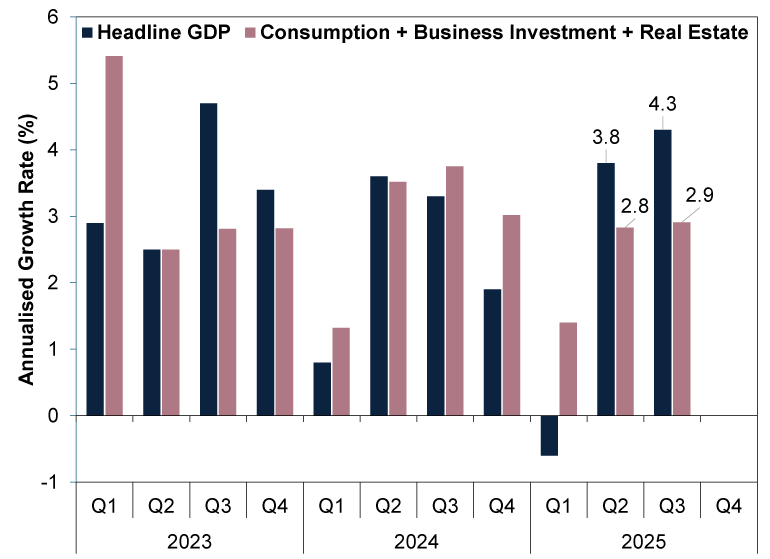
Source: BEA, as of 23/12/2025. Headline GDP and the sum of contributions from Personal Consumption Expenditures, Nonresidential Fixed Investment and Residential Real Estate Investment.
Like in Q2, the sum of these three core categories lags headline growth. Why? Well, in Q3, government spending ticked up, adding 0.4 percentage point to headline growth.[vi] Maybe that seems surprising, given America’s extended government shutdown. But this was almost entirely national defence spending plus state and local spending.[vii] The economic effects of government spending are debatable, hence why we think it is important to strip that out.
But the bigger factor, and one subject to heavy skew this year: trade. In Q3, US exports rose 8.8% annualised, adding 0.9 percentage point to GDP’s growth rate.[viii] Meanwhile, imports fell. GDP’s mathematics employ net trade—exports minus imports—to tally the category’s effects. Hence, imports’ fall boosts trade’s overall contribution to GDP to 1.6 percentage point.
Normally, we find this calculation is disconnected from economic reality: Falling imports could point to weak domestic demand. But our research shows American firms have spent most of 2025 grappling with an ever-changing tariff landscape. When the Trump administration took office, talk of tariffs—much of it negative speculation, in our experience—garnered headlines we follow.[ix] Even before 2 April’s Liberation Day announcements of sweeping global tariffs, on-again, off-again tariffs on Canada, China and Mexico spurred uncertainty, based on our observations of financial news.[x]
So businesses did what we find they usually do: They front ran implementation of tariffs in Q1, boosting inventories. Imports soared 38% annualised in Q1.[xi] Inventories boomed, adding 2.6 percentage points to growth that quarter. In the two quarters since, imports and inventories have fallen. To us, businesses appear to be drawing down inventories they boosted to sidestep taxes. Whilst Q3’s GDP data show less influence from this, it wasn’t zero.
Now, that perhaps isn’t earthshattering news. Thing is, we don’t think anything in Tuesday’s release is news to stocks. In our view, their swift recovery and rise this year foretold that economic reality was unlikely to prove as bad as widely expected.[xii] We think data, however delayed and mummified, continue supporting that.
[i] Source: BEA, as of 23/12/2025. Annualised growth refers to the rate at which GDP would grow or contract over a full year if the reported quarter’s growth rate persisted for four quarters. GDP data are adjusted for inflation, or broad price changes economywide.
[ii] Ibid.
[iii] Ibid.
[iv] Ibid.
[v] Ibid. Statement based on personal consumption expenditures and business investment’s respective contributions to headline GDP, Q4 1947 – Q3 2025.
[vi] Ibid.
[vii] Ibid.
[viii] Ibid.
[ix] “Trump’s Massive Tariffs Shake Markets, Spark Recession Fears,” John Towfighi, CNN, 3/4/2025.
[x] “Trump Imposes New Tariffs on Imports from Mexico, Canada and China in New Phase of Trade War,” Scott Horsley and Joe Hernandez, NPR, 2/2/2025
[xi] See note i.
[xii] Source: FactSet, as of 23/12/2025. MSCI World Index with net dividends in GBP, 2/4/2025 – 22/12/2025.
Get a weekly roundup of our market insights.
Sign up for our weekly e-mail newsletter.

You Imagine Your Future. We Help You Get There.
Are you ready to start your journey to a better financial future?

Markets Are Always Changing—What Can You Do About It?
Get tips for enhancing your strategy, advice for buying and selling and see where we think the market is headed next.
Related Resources
-
Macro Insights Assessing Private Credit Risks and Exposures2026-06-09
-
Macro Insights SpaceX IPO and Rising Equity Supply2026-06-09
-
In The News Trump’s tariff turmoil isn’t just delayed – it’s never coming2026-06-08
-
Macro Insights Brazil Review & Outlook2026-06-04



Contact Us
Learn why 200,000 clients trust Fisher Investments and its affiliates to manage their money and find out how we may be able to help you achieve your financial goals.
As of 31/03/2026. Includes Fisher Investments and its affiliates.
New to Fisher? Call Us.
Contact Us Today