


Personal Wealth Management / Economics
What November PMIs Say
The timeliest data show global growth chugging along.

Monthly purchasing managers’ indexes (PMIs) tallying firms’ expansion are amongst the timeliest economic indicators.[i] Whilst not perfect reflections of health, these surveys presently show business activity expanding broadly worldwide.[ii] And although backward looking for forward-looking stocks, we think they help round out the economic picture stocks have been pricing in.
Exhibit 1 rounds up PMIs from major developed nations worldwide. As shown, anyone feeling information-starved by America’s data dearth during its government shutdown can take heart: November PMIs continued registering solid growth in the US’s vast services sector, which represents 73% of gross domestic product (GDP).[iii] S&P Global’s US services PMI remained comfortably above 50—signalling most firms surveyed see expansion—despite a slight dip to 54.1.
Exhibit 1: Global PMIs Show Broad—but Not Universal—Expansion
Source: FactSet, as of 3/12/2025. All figures are S&P Global PMIs except the Institute for Supply Management’s US figures.
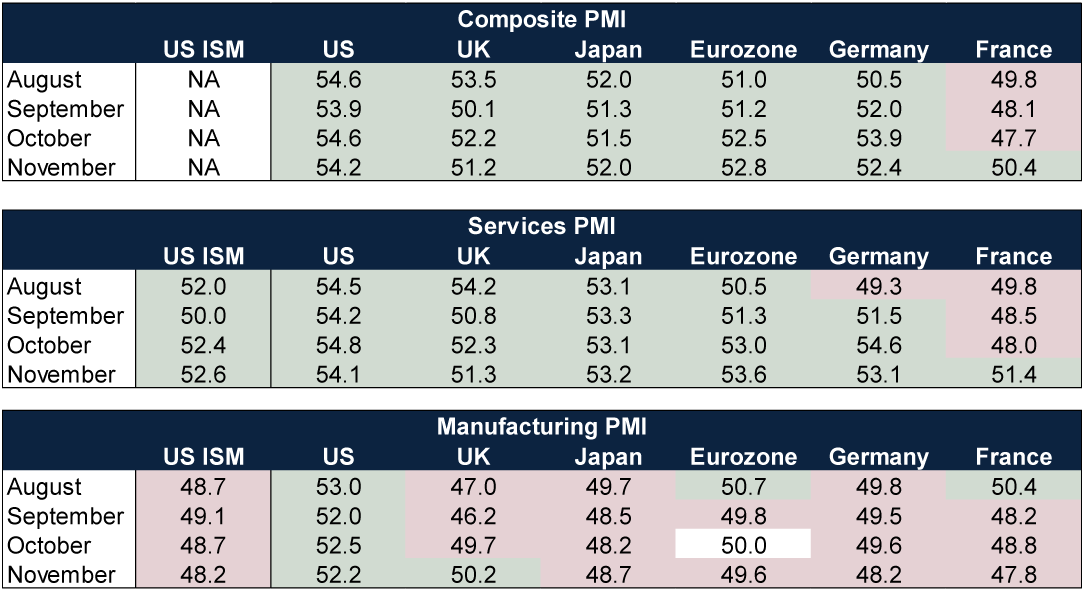
Separately, America’s older Institute for Supply Management (ISM) services PMI rose a couple notches in November, but to a lower 52.6 level. ISM services’ new orders subcomponent slipped -3.3 points but remained expansionary at 52.9.[iv] So not only are most services firms—the bulk of the US economy—growing, but orders are too, and today’s orders are tomorrow’s output. However, the employment subindex was sub-50 again, showing contraction for the sixth month straight, although November’s result was the highest of those six.[v] Firms still seem reluctant to hire, in part due to lingering effects from “the government shutdown and customs impacts related to changing tariffs.”[vi] But to us that is a well-worn, backward-looking view at this point and none too relevant for markets.
Manufacturing—about 16% of US GDP—was more of a mixed bag.[vii] Whilst S&P Global’s US manufacturing PMI showed expansion, ISM’s fell further into contraction at 48.2. Explaining the apparent discrepancy: S&P Global’s larger panel size (approximately 1,200 firms) encompasses smaller and domestically focussed firms whilst ISM draws from its own members (around 800), which tend to be larger and cluster in traditional heavy industries with more potential tariff exposure.[viii] Stocks, though, spied this divergence (which isn’t new) long ago, given our research finds they discount widely known information efficiently. And regardless of either US manufacturing PMI read, the evidence paints a broad picture of broader economic growth to us.
Globally, we find similar trends hold. Take France. Though its manufacturing PMI contracted further in November, its services PMI jumped 3.4 points, topping 50 for the first time since August 2024, which also brought the composite reading into expansion.[ix] Whilst S&P Global’s comments about the one-month improvement seemed tentative, encouragingly, “a fresh increase in new business inflows spurred activity levels higher.”[x] And with new orders driving growth: “Expectations of a rise in client numbers, new product launches and plans to increase headcounts were given as reasons to be positive towards the outlook.”[xi] Notably, this sentiment improvement came even as France’s budget crisis dragged on, showing businesses are perhaps starting to move on.[xii]
Besides, even with France’s composite PMI sub-50 through October, its GDP has grown—and accelerated—every quarter this year through Q3.[xiii] This shows that how many firms are growing doesn’t necessarily equate to how much the overall economy is. We find the bigger picture matters more to stocks, one reason the MSCI France Index’s 13.5% year-to-date return in euros and 19.8% in pounds is leading the MSCI World Index.[xiv] We think markets are looking further ahead, and the growth they pre-priced appears to be following suit—the data just confirm the path French stocks already forged. By the same token, our research shows economic and market cycles tend to be global, and global factors swamp local, which is why the story is similar for the rest of the eurozone, the UK and Japan.
Now, improvement isn’t uniform. Manufacturing continues struggling, with all S&P Global PMIs in the red except America’s and the UK’s, the latter of which eked out a 50.2 in November after 13 straight contractionary reads.[xv] But most of November’s PMI measures are so close to 50 that they cannot determine conclusively whether actual output fell, according to our analysis of their historical relationship. Indeed, that seems to be the case in Japan for September and October, at least, with month-over-month manufacturing output rising despite sub-50 manufacturing PMIs.[xvi] We shall see about November.
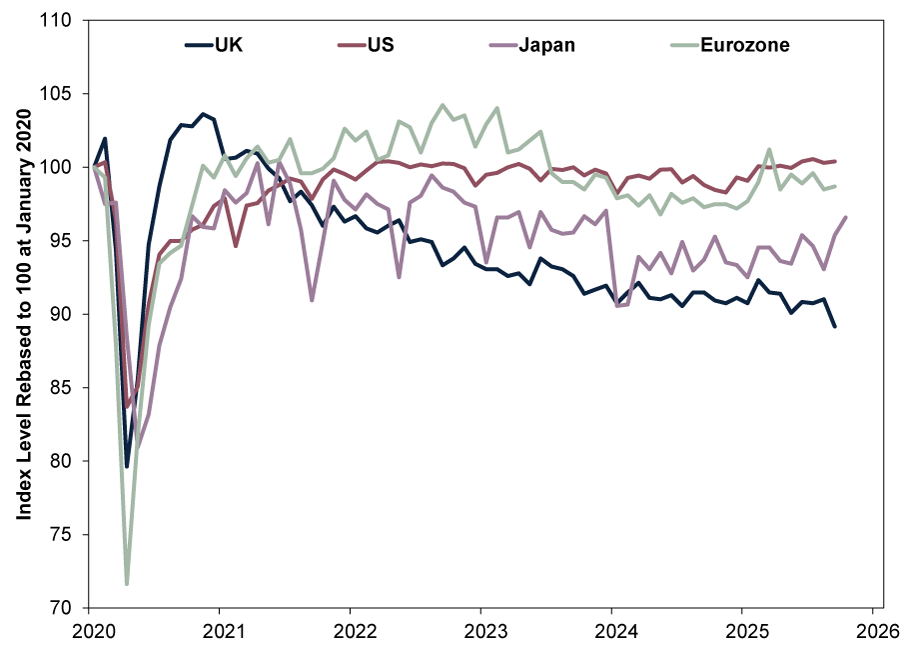
Regardless, though, we don’t think global manufacturing’s soft patch is new news. As Exhibit 2 shows, industrial production has been flat to lower for years after an initial surge in goods demand during the COVID lockdowns. It appears to us as though locking economies down—which hammered services firms—pulled forward demand for goods, leaving a pothole in its wake.
Exhibit 2: Industrial Production Broadly Flat Across Developed World
Source: FactSet, as of 3/12/2025. UK, US and eurozone industrial production, January 2020 – September 2025, Japan industrial production, January 2020 – October 2025.
But like in America, services make up a far larger share of developed economies in Europe and Asia—and this dominant sector is rising across the board.[xvii] Even French and UK services reads, the narrowest growth of the lot, may not be a harbinger of weakness ahead. Both nations endured bruising budget battles the past few months, which could have weighed on sentiment and activity. For example, as S&P Global’s report describes its UK respondents: “A number of firms noted that uncertainty ahead of the Budget had resulted in delayed investment decisions and cautious spending patterns.”[xviii] But with that in the rearview now, uncertainty seems set to fade. That may suggest even these slightly expansionary reads could see improvement ahead.
So overall, with services expanding and largely faring fine globally, we see Q4 growth—and beyond—as likely to continue.
[i] Source: FactSet, as of 5/12/2025.
[ii] Ibid.
[iii] Source: US Bureau of Economic Analysis, as of 25/9/2025. GDP is a government measure of economic putput.
[iv] Source: ISM, as of 3/12/2025.
[v] Ibid.
[vi] “November 2025 ISM Services PMI Report,” Steve Miller, ISM, 3/12/2025.
[vii] Source: Bureau of Economic Analysis, as of 25/9/2025.
[viii] “PMI vs. S&P PMI: Why Manufacturing Surveys Diverge and What It Means for Steel Prices and Industry Outlook,” Staff, Steel Industry News, 5/11/2025.
[ix] Source: ISM, as of 3/12/2025.
[x] “HCOB France Services PMI,” Jonas Feldhusen, S&P Global, 3/12/2025.
[xi] Ibid.
[xii] “French PM Warns of 'Loss of Control' Over Social Security Spending,” Staff, Reuters, 4/12/2025. Accessed via MSN.
[xiii] Source: FactSet, as of 5/12/2025.
[xiv] Source: FactSet, as of 5/12/2025. MSCI France returns with gross dividends and MSCI World returns with net dividends, 31/12/2024 – 4/12/2025.
[xv] Source: FactSet, as of 5/12/2025.
[xvi] Ibid.
[xvii] Source: World Bank, as of 5/12/2025.
[xviii] “S&P Global UK Services PMI,” Tim Moore, S&P Global, 3/12/2025.
Get a weekly roundup of our market insights.
Sign up for our weekly e-mail newsletter.

You Imagine Your Future. We Help You Get There.
Are you ready to start your journey to a better financial future?

Markets Are Always Changing—What Can You Do About It?
Get tips for enhancing your strategy, advice for buying and selling and see where we think the market is headed next.
Related Resources
-
Market Analysis A Market Perspective on Iran Truce Talks2026-06-17
-
Market Analysis Gold Fails the Safe Haven Test Again2026-06-17
-
Macro Insights Japanese Equity Outperformance & Why It's Poised to Continue2026-06-15
-
Macro Insights Assessing Private Credit Risks and Exposures2026-06-09



Contact Us
Learn why 200,000 clients trust Fisher Investments and its affiliates to manage their money and find out how we may be able to help you achieve your financial goals.
As of 31/03/2026. Includes Fisher Investments and its affiliates.
New to Fisher? Call Us.
Contact Us Today