


Personal Wealth Management / Politics
A Market Lesson From Trump’s Credit Card Proposals
All of this looks like typical midterm politicking.

Editors’ Note: MarketMinder is politically agnostic. We prefer no political party nor any politician and assess developments for their potential economic and market effects only. Also, MarketMinder doesn’t make individual security recommendations. Any reference here is coincident to our highlighting a broader theme.
Last week, President Donald Trump announced support for two credit card-related measures aimed at providing some relief for cost-of-living issues seemingly dogging his approval rating. As with most modern political happenings, headlines were divided in their assessment. But stocks’ verdict was clear, as related pockets of the Financials sector dipped on the news. Still, we see several reasons not to overrate the likelihood of any of these measures materializing. Overall, this chatter strikes us as typical midterm-year politicking, which can stoke volatility early. But it also creates room for stocks to rise as gridlock becomes apparent, alleviating worries around sharp legislation.
In a Truth Social post, Trump first called for a 10% ceiling on credit card annual percentage rates (APRs), starting this week and holding the cap for one year. With Americans’ average credit card interest rate sitting around 22.5%, he argues these companies are “ripping off” consumers and suggested capping rates would help mitigate this.[i]
A few days later, he endorsed the Credit Card Competition Act (CCCA), a bipartisan bill first floated in 2023. This aims to break up America’s credit card network duopoly, which rides on interchange “swipe” fees charged to merchants. Most eyeballs are on a provision requiring large banks (those with $100 billion plus in assets) to enable at least two unaffiliated networks on each credit card—at least one not being Visa or Mastercard. Proponents argue this would give merchants agency over who routes their credit card transactions and force big issuers to compete by lowering their swipe fees. Opponents say this benefits big merchants’ profits and could present cybersecurity issues.
Whatever your opinion, stocks reacted near instantly. Shares of several major card networks and issuers—not just Visa and Mastercard—dipped on the news, as markets rapidly priced fears these measures would curb credit card access and hit Financials’ profits. And not because high APRs are pure profit margin. Issuing banks employ their interest income first to fund operating costs and interest expenses (since banks borrow short term to fund loans), then to bolster reserves against credit losses. Only the leftovers are profit.
Capping interest rates would effectively prevent banks from being compensated for the heightened risk of lending to unsecured borrowers, likely reducing credit availability—especially for those with lower credit scores. It may mean rejected applications. It may mean reduced credit lines. It could also force fee hikes, on the cards themselves or elsewhere in the business. Interchange fees are another revenue source for issuers, so forcibly striking or lowering them would cut profits further. And this source funds rewards and cash rebates, which many consumers like.
Markets, as always, seemed to price the worst-case scenario—in this case, rapid implementation of these measures that wouldn’t give these companies sufficient time to prepare and adjust their business models. To us, this is simply markets doing their job, pricing the implications of potential major changes. Stocks don’t wait for policy implementation—they move beforehand. As we saw with tariffs last year, markets tend to price scenarios’ potential negatives instantly. That, then, creates room for a recovery if reality surprises to the upside. And there are reasons to believe that is likely now.
Namely, talk is cheap. Importantly, both proposals require Congressional approval. Capping interest rates would change banks’ legal lending terms, requiring legislation—a point Trump’s comments Wednesday pointed to, stating he is “… asking Congress to cap credit card interest rates at 10% for one year.”[ii] Similarly, the CCCA would change card networks’ and large banks’ operations and transaction methods, also requiring federal law amendment through legislation—not executive orders or agency rulemaking.[iii]
Yet these measures lack broad support in Washington, making them unlikely to pass.[iv] Yes, some politicians from both sides have openly voiced their support. Yet opposition among Republican leadership—including Majority Leader John Thune, House Speaker Mike Johnson and several members of the Senate Banking and House Financial Services Committees—makes it a tall order. These changes must first pass through the latter panels (requiring a U-turn from committee leaders), receive hearing approvals from Congressional leaders and committee chairs (more U-turns) and then pass through Congress via a left-right populist bloc—despite most Republicans being against them.
To us, these proposals look more like typical midterm trial balloons than actual policy positions—typical politicking ahead of November’s vote. For one, legislators typically don’t pass much during midterm years. Passing a law puts you on the hook for potentially negative consequences. And “solving a problem” like this loses politicians a wedge issue. It gives them fewer “solutions” to propose to their constituents in the runup, which can show up at the ballot box or in fundraising.
Like in 2018, when Trump proposed a “major tax cut for middle income people” of “about 10 percent” and raising the earned income tax credit.[v] Neither materialized. Similarly, in 2022, former President Joe Biden proposed a three-month federal gas tax holiday. Yet Congressional opposition quashed it. Politicians are famous for raising these ideas to rally voters, and these proposals look strikingly similar.
Heck, these probably won’t be the last balloons we see before November. Altogether, these reasons suggest stocks’ initial reaction was overegged. Which isn’t atypical in a midterm year. This kind of extreme talk, used to motivate the party’s base, contributes to the uncertainty that tends to spur volatility in the runup to midterms. This doesn’t necessarily mean bad or negative returns early, just that average gains in the three quarters pre-vote are lower, with more frequent chop. Yet, historically, the president’s party tends to lose seats, promoting bullish gridlock. Exhibit 1 shows this, charting average S&P 500 price returns in midterm years and the ensuing year since 1926.
Exhibit 1: Midterm Grind
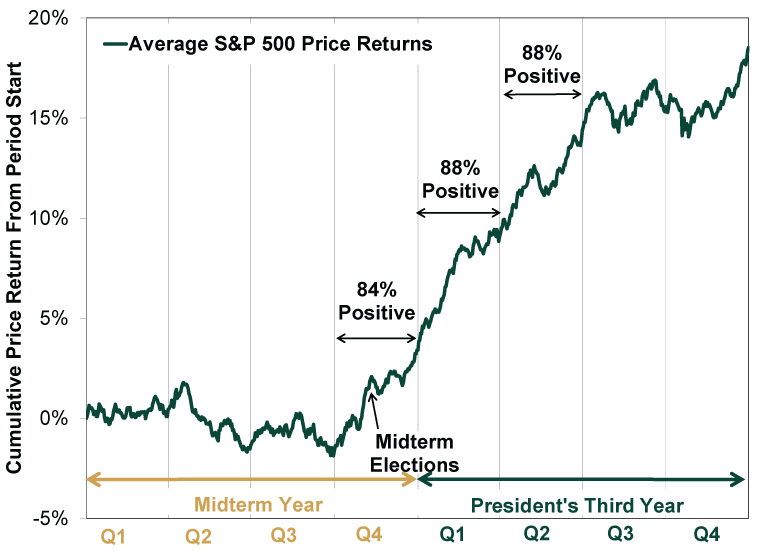
Source: FactSet, as of 1/14/2026. S&P 500 average price return, quarterly, Q4 1925 – Q4 2025.
Don’t get us wrong. This is only an average and there are plenty of fine pre-midterm years. But it does show choppiness is common in the runup as markets weigh potential legislative shifts in the incoming Congress—trial balloons are a key influence here. Yet as uncertainty fades and gridlock becomes clear, stocks tend to flourish.
Our broader point? Neither policy is close to guaranteed, nor is Financials’ downturn assured to last. Consider this when weighing stocks’ jolted reaction—now and amid future proposals.
[i] Source: Federal Reserve, as of 1/14/2026.
[ii] “Trump Looks to Congress to Cap Credit Card Rates at 10%,” Paige Smith, Bloomberg, 1/21/2026.
[iii] Source: US Congress, as of 1/14/2026. S.1838 - Credit Card Competition Act of 2023 and S.381 - 10 Percent Credit Card Interest Rate Cap Act.
[iv] “The Biggest Hurdle to Trump’s Credit Card Proposals? His Own Party.” Aiden Reiter, Katherine Hapgood and Jordain Carney, Politico, 1/13/2026.
[v] “Trump’s Tax Push to Help Middle Class Could Help Top Earners Too,” Laura Davison, Bloomberg, 10/23/2018.
If you would like to contact the editors responsible for this article, please message MarketMinder directly.
*The content contained in this article represents only the opinions and viewpoints of the Fisher Investments editorial staff.
Get a weekly roundup of our market insights
Sign up for our weekly e-mail newsletter.

You Imagine Your Future. We Help You Get There.
Are you ready to start your journey to a better financial future?
Where Might the Market Go Next?
Confidently tackle the market’s ups and downs with independent research and analysis that tells you where we think stocks are headed—and why.
Related Resources
-
Expert Commentary This Week in Review | Bull Market Birthday, Q3 Earnings, US Inflation
 2026-10-16
 -
Market Analysis Gradually Then Suddenly, UK Budget Clarity Is Coming2026-10-15
-
Market Analysis On September Inflation, Look Beyond the Headlines2026-10-14
-
Politics Is Canada Building a Stronger Bull Market?2026-10-13



Learn More
Learn why 210,000 clients trust us to manage their money and how Fisher Investments and its affiliates may be able to help you achieve your financial goals.
As of 9/30/2026
New to Fisher? Call Us.
Contact Us Today