


Personal Wealth Management / Market Analysis
A Market Lesson in Pre-Pricing From Britain’s ‘Windfall’ Tax
Markets saw this week’s bad news coming.

Here are two things you might logically think are related: Two big UK Energy firms announced this week the country’s windfall profits tax wrecked their Q2 earnings and curtailed North Sea investment plans accordingly, and UK stocks’ bad month has put them back near correction territory when measured in pounds. Thus, here is something that might surprise you: UK Energy stocks are up month to date, albeit with some sharp volatility along the way. We think this is a pretty striking reminder of how markets deal with bad news well in advance.
The tax, introduced in May 2022, added a 25% surtax on Energy firms’ profits—on top of the headline 40% rate, bringing the total to 65%. The goal? Redistribute profits that stemmed from a factor outside businesses’ control (in this case, spiking oil and natural gas prices following Vladimir Putin’s Ukraine invasion) to the households affected by said energy prices.[i] Knowing high taxes discourage investment, the government sought to blunt the impact by including an 80% investment allowance, which the Treasury described as “a 91p tax saving for every £1 [firms] invest.”[ii] In November, the government announced the windfall tax rate would jump to 35% on January 1, 2023—bringing the total marginal rate to 75%—and sunset in 2028 rather than 2025. The investment allowance remained, though, at the same cash value.
At the time, it wasn’t clear what the tax hit would be and whether the allowances were enough to preserve investment despite the apparent disincentive. Some large global firms said, anecdotally, that it was impacting their plans, but it was all rather speculative. Until this week, when one of the country’s largest domestic producers announcing it booked a post-tax loss in 2023’s first half, with its effective tax rate reaching 102% once currency moves were factored in. Another producer announced it was writing down assets and canceling planned investments due to the tax. Now there are mounting concerns that as companies write down the value of their North Sea leases, bank funding will dry up, causing a vicious cycle of lower production and lower investment.
Energy represents over 12% of MSCI UK IMI market cap—far larger than global stocks’ sub-5% weight—which is a big reason UK stocks were among the world’s best performers last year.[iii] And Energy, which lagged hard earlier this year, also had a lot to do with the initial throes of the UK’s 2023 correction. Yet this doesn’t seem tied to the windfall tax—global oil prices seem a much likelier culprit. Brent crude oil prices’ -17.3% plunge between March 6 and March 17 coincided with a -7.5% drop in UK stocks, driven by UK Energy’s -14.5% plunge.[iv] Then the two rebounded with oil throughout April, and UK Energy has mostly tracked oil since. With UK Energy stocks up a smidge this month, British stocks’ sour returns seem more tied to the global market pullback than anything local.
Logically, we wouldn’t expect the tax to have much effect on returns this year, even with the recent run of bad news. Markets are too forward-looking for that. Exhibit 1 shows broad UK market and UK Energy returns since the end of April 2022. You will see Energy had a rough ride after the tax hit the wires that May, then enjoyed a lovely summer and autumn. Volatility surrounded the tax increase in November, but it didn’t prevent UK Energy stocks from galloping to new highs in February—by which time it was well known that companies were rejiggering plans in response to the tax.
Exhibit 1: Markets Pre-Priced Nasty Taxes
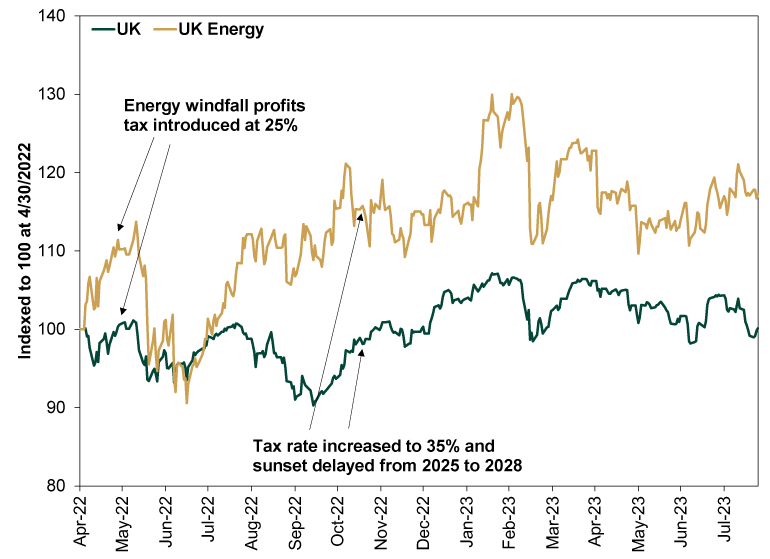
Source: FactSet, as of 8/25/2023. MSCI UK IMI and MSCI UK Energy IMI total returns in GBP, 4/30/2022 – 8/24/2023. Presented in pounds to remove currency skew and give a clearer look at returns.
Exhibit 2 presents an alternate way to see the pre-pricing mechanism at work. It shows UK Energy’s returns relative to global Energy stocks. As you will see, UK Energy underperformed, for the most part, between the windfall profits tax’s introduction and increase. Yet several months of outperformance followed, and UK and global Energy stocks are mostly even steven month to date.
Exhibit 2: Markets Pre-Priced Nasty Taxes, Alternate View
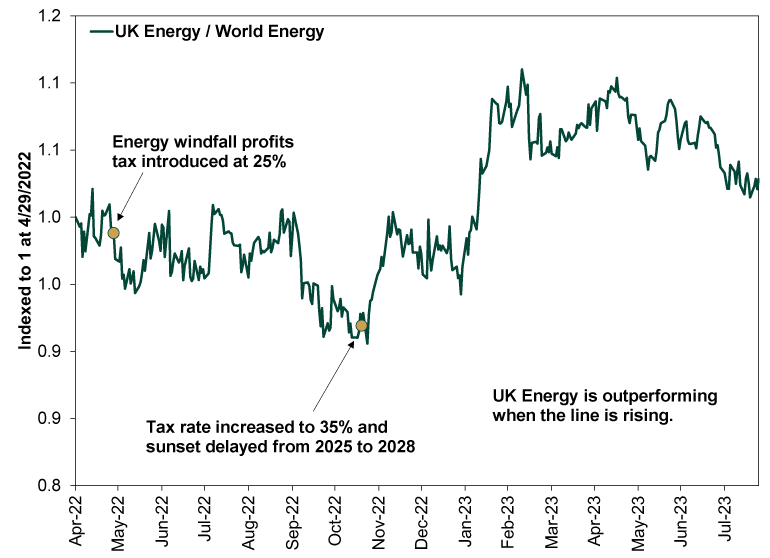
Source: FactSet, as of 8/25/2023. MSCI UK IMI total returns and MSCI UK Energy returns with net dividends in GBP, 4/30/2022 – 8/24/2023. Presented in pounds to remove currency skew and give a clearer look at returns.
Draconian taxes aren’t great, and we suspect UK markets would be better off without this one. But they are also only one variable affecting profitability. For UK Energy firms, other factors include oil and gas prices, obviously, as well as currency swings (since oil is priced in dollars), hedging costs and exploration and drilling costs, just to name a few. Interest rates also matter given the amount of leverage in the industry. This is rather a lot of headwinds at the moment, in our view, and it may be that companies are perhaps exaggerating the tax’s impact a wee bit to save face—much as firms will sometimes pin bad reports on currency or the weather.
At any rate, we think the preceding charts indicate markets didn’t wait for this week’s bad news to incorporate the tax in stock prices. Markets’ core job is evaluating potential profits 3 – 30 months out, and they are pretty good at doing that math … and at moving on once they have done said math. We doubt this time is different.
[i] Of course, there are always factors in every business that are beyond their control, rendering this “logic” dubious to say the least.
[ii] “Energy Profits Levy Factsheet – 26 May 2022,” HM Treasury, 5/26/2022.
[iii] Source: FactSet, as of 8/25/2023. MSCI World Index and MSCI UK IMI Index Energy sector weights.
[iv] Source: FactSet, as of 8/25/2023. Brent crude oil price and MSCI UK IMI and MSCI UK IMI Energy total returns in GBP, 3/6/2023 – 3/17/2023.
If you would like to contact the editors responsible for this article, please message MarketMinder directly.
*The content contained in this article represents only the opinions and viewpoints of the Fisher Investments editorial staff.
Get a weekly roundup of our market insights
Sign up for our weekly e-mail newsletter.

You Imagine Your Future. We Help You Get There.
Are you ready to start your journey to a better financial future?

Where Might the Market Go Next?
Confidently tackle the market’s ups and downs with independent research and analysis that tells you where we think stocks are headed—and why.
Related Resources
-
In The News Bourse : pourquoi l’impact de la guerre en Iran sera moins important que prévu – par Ken Fisher2026-04-01
-
Market Analysis Countertrends and Corrections: Banks in 2026’s Early Selloff2026-04-01
-
Market Volatility Some Timeless Counsel After March’s Volatility2026-04-01
-
Market Analysis What the Latest Global Flash PMIs Reveal2026-03-31





Learn More
Learn why 200,000 clients trust us to manage their money and how Fisher Investments and its affiliates may be able to help you achieve your financial goals.
As of 4/1/2026
New to Fisher? Call Us.
Contact Us Today