


Personal Wealth Management / Market Analysis
Countertrends and Corrections: Banks in 2026’s Early Selloff
A rally’s leaders regularly turn into a pullback’s laggards.

Before the Iran war, as stocks enjoyed a robust two months to start 2026, global banks were extending last year’s leadership, with the industry up 4.7% through February 25 and outpacing the MSCI World’s 3.5%.[i] When war broke out, though, that reversed: In the near-correction since, the MSCI World Banks industry group is down -8.9%, exceeding the world’s -6.8%.[ii] Predictably, this now fuels an array of headlines declaring Banks’ bull run kaput. In our view, this is excessive. Countertrends—brief reversals in market leadership—often accompany corrections and sentiment-driven selloffs. Banks’ drop looks like normal volatility, not the start of a new dismal era and not a call to action.
To date, global markets haven’t yet reached the -10% correction threshold, but it has come close (-8.9% at the nadir) and this rough patch looks correction-like to us. It is steep and sharp, coming suddenly off an all-time high. Bear markets (deeper, longer declines of -20% or worse) tend to start gradually. The main cause is widespread fear over the war in Iran and its effect on oil and natural gas prices—a rapid spike in fear. Bear markets, by contrast, tend to have stealthy fundamental causes that aren’t apparent to most until late in the game, and sentiment is often hopeful early on. And country-level returns reflect the big scary story, with nations perceived as most reliant on Middle Eastern oil and liquefied natural gas (LNG) falling hardest.
Accordingly, we should expect this pullback to create countertrends. They are part of the sentiment reset that corrections typically bring. And we are seeing them. Non-US stocks led on the way up and have lagged on the way down. US Tech lagged the S&P 500 year to date through February, then outperformed in March, falling less than the headline index. Not every trend has reversed—Energy stocks led before and since the war, rising initially on war tensions and continuing to outperform on further spiking oil and LNG prices since, as those boost margins. But many countertrends have emerged.
Banks’ rough March falls squarely in this. Consider Exhibits 1 and 2, which show US and European banks, respectively, relative to US and European stocks. When the lines are rising, banks are outperforming. It is very, very easy to see they led in the good times and lagged in the bad.
Exhibit 1: A Longer Look at US Banks
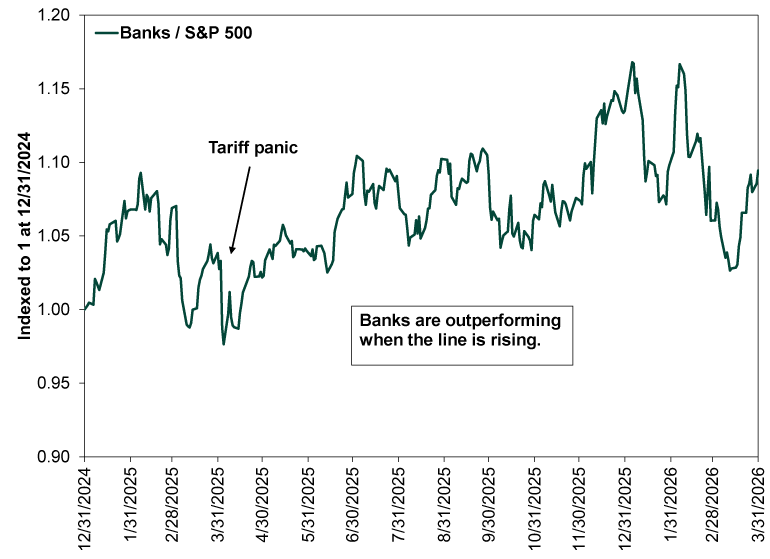
Source: FactSet, as of 4/1/2026. S&P 500 and S&P 500 Banks total returns, 12/31/2024 – 3/31/2025.
Exhibit 2: A Longer Look at European Banks
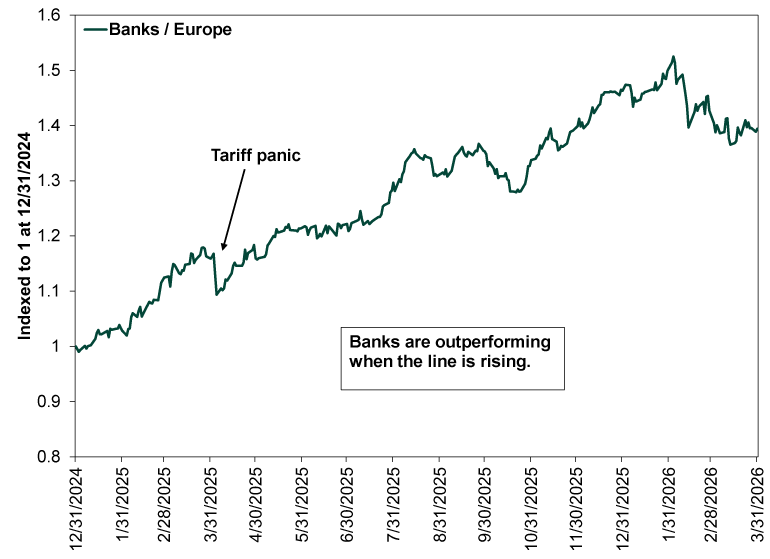
Source: FactSet, as of 4/1/2026. MSCI Europe and MSCI Europe Banks returns in USD with net dividends, 12/31/2024 – 3/31/2025.
With this context, the stories searching for meaning in Banks’ declines start making less sense. In Europe, pundits argue the war rapidly shifted Banks’ fundamentals by rendering Europe’s outlook suddenly unclear … as if this is the first time Europe’s economic outlook has faced any uncertainty since 2020. We are pretty sure 2022 would disagree, as would 2023 with its lingering energy shortage fears and widespread recession worries. And 2024, with its weak-Germany fears. And 2025, with its abundant tariff fears. Today’s jitters seem in line with that trend, looking mostly like a sentiment reset that rebuilds the industry’s wall of worry—one of corrections’ main benefits.
The same applies to US banks, which are allegedly down because of private credit’s ongoing woes—not just because they may have some loan losses yet to come, but because the whole kerfuffle could cost banks business as they pull back from the sector. We see two glaring problems with this. One, none of the private credit fears are new. All have swirled for several months, long predating US banks’ stumble. And two, to the extent banks do shy away from lending to business development companies and private credit funds, the Fed has proposed easing the rules that led to private credit’s mushrooming in the first place, creating room for banks to fill more of that lending void. It looks to us like banks would merely shift their attention, not cut back lending.
We don’t think anything drastically changed with banks’ fundamentals over the last month. Global yield curves are still steep (long rates nicely exceed short), which enables broad, profitable lending, as banks borrow short term to fund long-term loans. As wartime jitters ease, loan demand should be strong as businesses seek to grow with new projects and product lines. Central banks’ overreacting to high energy prices with steep rate hikes is a risk to watch, but that doesn’t appear to be imminent. And as the market moves on from the war, old sector and industry trends should return, just as they did after last year’s tariff panic.
Falling prey to countertrends amid a correction is one of many behavioral mistakes people make. It extrapolates a recent shift in performance forward without weighing the fundamentals that drove the broader trend. In our view, the recent flood of headlines are no help in this regard. We counsel patience and taking the broader view, lest one fall prey to making rash decisions in a rocky, but likely fleeting, time.
If you would like to contact the editors responsible for this article, please message MarketMinder directly.
*The content contained in this article represents only the opinions and viewpoints of the Fisher Investments editorial staff.
Get a weekly roundup of our market insights
Sign up for our weekly e-mail newsletter.

You Imagine Your Future. We Help You Get There.
Are you ready to start your journey to a better financial future?
Where Might the Market Go Next?
Confidently tackle the market’s ups and downs with independent research and analysis that tells you where we think stocks are headed—and why.
Related Resources
-
Market Analysis May US CPI: Headline Acceleration Hides Monthly Cooldown2026-06-10
-
Market Analysis Latest Tariff Threats Lack Terror for Markets2026-06-08
-
Expert Commentary 3 Things You Need to Know This Week | US Inflation, Global Trade, ECB Meeting
 2026-06-08
 -
Weekly Wrap-Up Fisher Investments Reviews: Last Week in Markets—June 1 - June 52026-06-08




Learn More
Learn why 200,000 clients trust us to manage their money and how Fisher Investments and its affiliates may be able to help you achieve your financial goals.
As of 3/31/2026
New to Fisher? Call Us.
Contact Us Today