


Personal Wealth Management / Market Analysis
The Investment Implications of Record-Low Consumer Sentiment
Consumers are feeling extremely down—what, if anything, does that mean for markets?

Last week, the University of Michigan reported its long-running (since 1952) Consumer Sentiment Index hit a record low in May, undercutting 2022’s weakest-ever reading. Much of the coverage sweated this foretells bad things for America’s economy and stocks. We doubt it. While everyone is entitled to their emotions, surveys of consumers’ feelings tell you little about actual economic activity going forward.
First, the facts: May’s 48.2 follows April’s then-record 49.8, which breached June 2022’s 50.0. (Exhibit 1) But that prior trough occurred well into 2022’s shallow bear market. It didn’t set off the downturn—and a bull market began that October, with sentiment still historically low. The “why” here is instructive for investors today. Myriad fears weighed on stocks, including soaring inflation, Russia’s (still ongoing) Ukraine war, energy price spikes, supply-chain chaos and global rate hikes. All these culminated in near-universal recession expectations and sour sentiment. Yet recession didn’t happen—reality beat expectations, which is all stocks need.
Exhibit 1: Consumers Feeling Really, Really Low
Source: FactSet, as of 5/15/2026.
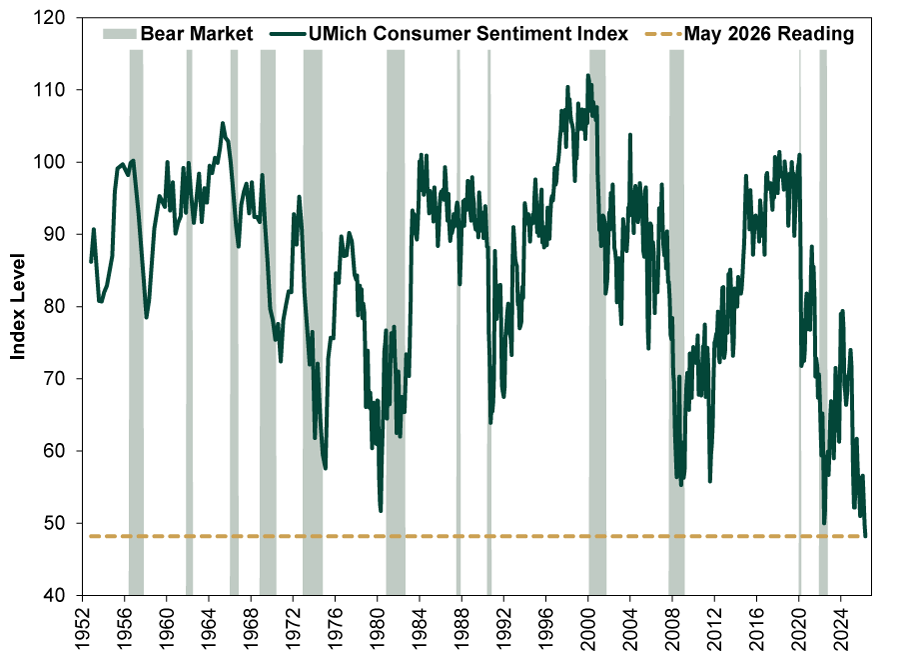
Record-low sentiment four years ago shows historic pessimism isn’t telling for the economy or stocks. As Exhibit 1 makes clear, consumer sentiment typically plunges after bear markets are mostly over. Of the last 12 bear markets since 1952, only 1 (1980 – 1982’s) saw sentiment plunge beforehand, and that was largely influenced by white-hot inflation, like in 2022. This highlights how sentiment usually lags—it reflects people’s reactions to past economic and market conditions. Downtrodden surveys just mean folks on average feel lousy—for all manner of reasons.
But that also means the conditions contributing to their dejection aren’t a surprise, which is what moves markets most. Forward-looking stocks pre-priced them. Take your pick: war, gas prices, politics. None of that is new or anything stocks haven’t heard before.
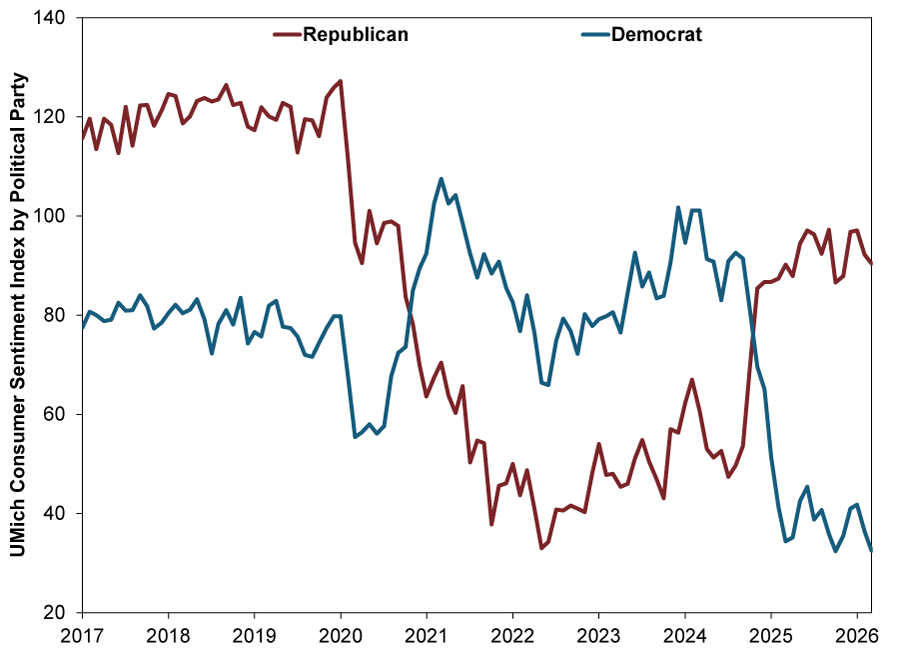
Consider politics. Exhibit 2 shows Democrats’ outlook is currently somber—seldom worse—but that seems tied to the party in the White House. Notice it basically matches where Republicans’ feelings were four years ago. Partisan views (or war or gas prices) didn’t drive recession then. This time is unlikely to prove any different. What matters for markets aren’t feelings, but whether economic and earnings reality 3 to 30 months from now goes better or worse than present expectations. Right now, that is a very low bar.
Exhibit 2: Partisan Leaning Influences Perception
Source: FactSet, as of 5/15/2026.
Why don’t bad attitudes automatically imply the economy is shaky? Another survey helps shed some light: While only 26% of people rate the economy favorably, 73% say their own finances are doing ok or they are living comfortably.[i] No doubt real wages are getting pinched, to varying degrees. The more your paycheck is eaten at the pump, the less you have for discretionary purchases—dampening moods. But overall, despite recent wrinkles, households are in better shape than feared. The pace of household debt becoming newly delinquent and entering serious delinquency (over 90 days past due) mostly fell in Q1, according to the New York Fed’s latest Household Debt and Credit Report. By and large, people aren’t having to choose between filling the tank and paying the mortgage. Which makes sense: Gasoline spending is generally a pretty small sliver of the total.
Meanwhile, the bulk of consumer spending is non-discretionary anyway. Most folks pay rent, healthcare, insurance and utilities regardless. These don’t tend to shift much quarter to quarter. The economy’s main swing factor? Business investment. And that is growing at a healthy clip. Economic growth is on firm footing.
Many may not appreciate just how resilient business activity is proving, but stocks do. Far from ignoring risks as many headlines claim, markets have more clarity on matters than the press thinks. As the ultimate leading indicator, stocks see a brighter future ahead. While the prevailing fear today is that markets are over their skis, the truth is far simpler: Reality just exceeds sentiment.
If you would like to contact the editors responsible for this article, please message MarketMinder directly.
*The content contained in this article represents only the opinions and viewpoints of the Fisher Investments editorial staff.
Get a weekly roundup of our market insights
Sign up for our weekly e-mail newsletter.

You Imagine Your Future. We Help You Get There.
Are you ready to start your journey to a better financial future?
Where Might the Market Go Next?
Confidently tackle the market’s ups and downs with independent research and analysis that tells you where we think stocks are headed—and why.
Related Resources
-
Weekly Wrap-Up Fisher Investments Reviews: Last Week in Markets — October 5 - October 92026-10-12
-
Politics Context for the Noisy Congress to Come2026-10-09
-
Expert Commentary This Week in Review | S&P 500 Record High, Fed Minutes, Spain Election
 2026-10-09
 -
Interesting Market History Notes on a Bear Market Anniversary2026-10-09




Learn More
Learn why 210,000 clients trust us to manage their money and how Fisher Investments and its affiliates may be able to help you achieve your financial goals.
As of 9/30/2026
New to Fisher? Call Us.
Contact Us Today