


Personal Wealth Management / Economics
Q1 GDP Reveals America on Firm Footing
US economic growth isn’t gangbusters, but it seems steady as she goes.

Amid all the handwringing over the war in Iran, Q1 US GDP accelerated. Though war affected only March—and Strait of Hormuz traffic remains constricted—ongoing growth and less conflict since then should help quell fears it is having an outsized effect on the economy’s functioning. We think stocks see this, too, and didn’t wait for confirmation.
As Exhibit 1 shows, headline GDP (green bars) accelerated to 2.0% annualized from Q4’s government shutdown-depressed (and downwardly revised) 0.5%. Notably, goods imports, which feed into domestic demand, surged 25.8% annualized in Q1 after declining for three quarters in Liberation Day’s wake a year ago.[i] In Q2 2025, they plunged -35.0% annualized (after Q1 2025’s 52.0% front-running jump), then continued dipping at single-digit rates last Q3 and Q4. It seems with tariff uncertainty fading, stockpiled inventories dwindling—and more deals and workarounds in place—businesses are fulfilling pent-up demand for imported items.
Exhibit 1: Private Sector Demand Growth Steadier Under the Hood
Source: FactSet, as of 4/30/2026.
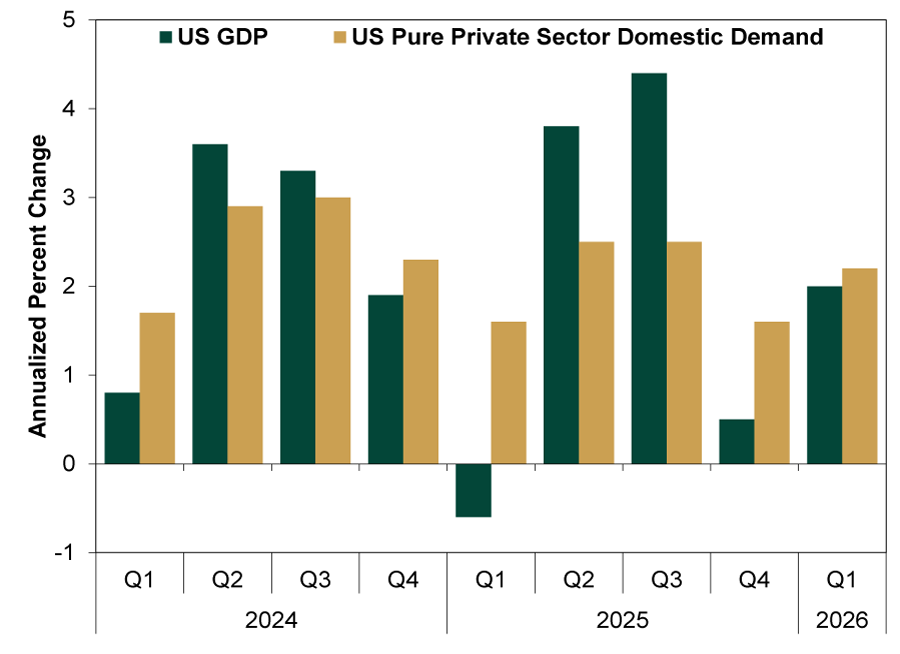
But looking at America’s private sector components (gold bars)—the sum of consumer spending, business investment and residential investment—reveals steadier growth under the hood. In Q1, this “core” GDP sped from Q4’s 1.6% to 2.2% annualized, the middle of its range over the last two years. The trend persists.
What underpins these core components’ growth? Headlines hype AI and data center capital expenditures, with information processing equipment outlays booming 43.4% annualized after Q4’s 37.0% and software speeding to 22.6% from 4.8%.[ii] Outside technology hardware, industrial equipment rose 3.9% annualized, rebounding from Q4’s -3.6% dip, while “other” (e.g., construction, agricultural, oil services, office, retail, hospitality, healthcare) equipment gained 10.9%, flip-flopping with declines over the last six quarters.[iii]
Transportation equipment dropped -9.2% annualized, contracting further from Q4’s -28.5% plunge and Q3’s -4.2%.[iv] This three-quarter contraction coincides with the Trump administration’s tariffs on light vehicles and parts last spring and on heavy commercial vehicles (and parts) last fall—perhaps alongside the expiration of electric vehicle tax credits. Both are well-known headwinds, not sneaking up on stocks.
Despite weak spots, sum all this and total Q1 business investment climbed 10.4% annualized after Q4’s 2.4%, its fastest clip since Q2 2023, adding 1.1 percentage points to headline GDP growth.[v] That just happened to match consumer spending’s Q1 GDP contribution, as it rose 1.6% annualized, a slight slowdown from Q4’s 1.9%.
Residential investment contracted -8.0% annualized in Q1, but because of its small 3% GDP weight, it subtracted only -0.3 percentage points from headline growth.[vi] And this weakness isn’t new. Residential investment has shrunk in seven of the last eight quarters—without derailing broader economic expansion.
Put it all together and the economy is on firmer footing than many think. Consumer spending—mainly services (think healthcare, rent, insurance and utilities)—is mostly non-discretionary; it tends not to change much quarter to quarter. In March, real (inflation-adjusted) personal consumption expenditures (PCE) rose 0.2% m/m, matching the monthly average since January 2022 despite a 0.7% surge in the headline PCE price index, the biggest jump since June 2022 amid rampant supply shocks.[vii]
The price driver (or dagger) last month? Prices at the pump spiked 21.5% m/m.[viii] (See our March CPI story for more.) Outside this, core PCE prices (excluding food and energy) rose just 0.3% m/m, slowing from February’s 0.4%. Fear of higher energy costs bleeding into other goods doesn’t show in data. And it likely won’t. Oil spikes drive substitution, chiefly—not inflation. But echoing March retail sales, PCE shows higher gas prices haven’t prompted much substitution, either. Perhaps they eventually show in weaker discretionary spending, but all spending adds to GDP. And even in that scenario, the effect probably wouldn’t be huge.
To see this, consider the other side of the ledger: disposable personal income (DPI), which rose 0.6% m/m in March.[ix] Now, that means real DPI fell -0.1% m/m last month, but the overall trend shows DPI keeping up with inflation, rising 0.2% on average, again since January 2022—matching real PCE gains. $4 gas garners lots of attention, but don’t overrate it. It amounts to 1.7% of overall spending. Large as gas’s effects feel at the pump, and as hard as it can be for lower-income households (which we don’t dismiss), for the broad US economy, substitution probably won’t bite other categories hard.
Big picture: Overall and on average, personal income growth continues supporting consumer spending. Although Q1 data are all in the past, they indicate America’s economy wasn’t on shaky footing pre-war. That doesn’t appear to have changed since.
[i] Source: FactSet, as of 4/30/2026.
[ii] Source: FactSet, as of 4/30/2026.
[iii] Source: FactSet, as of 4/30/2026.
[iv] Source: FactSet, as of 4/30/2026.
[v] Source: FactSet, as of 4/30/2026.
[vi] Source: FactSet, as of 4/30/2026.
[vii] Source: FactSet, as of 4/30/2026.
[viii] Source: FactSet, as of 4/30/2026.
[ix] Source: FactSet, as of 4/30/2026.
If you would like to contact the editors responsible for this article, please message MarketMinder directly.
*The content contained in this article represents only the opinions and viewpoints of the Fisher Investments editorial staff.
Get a weekly roundup of our market insights
Sign up for our weekly e-mail newsletter.

You Imagine Your Future. We Help You Get There.
Are you ready to start your journey to a better financial future?

Where Might the Market Go Next?
Confidently tackle the market’s ups and downs with independent research and analysis that tells you where we think stocks are headed—and why.
Related Resources
-
Weekly Wrap-Up Fisher Investments Reviews: Last Week in Markets — October 5 - October 92026-10-12
-
Politics Context for the Noisy Congress to Come2026-10-09
-
Expert Commentary This Week in Review | S&P 500 Record High, Fed Minutes, Spain Election
 2026-10-09
 -
Interesting Market History Notes on a Bear Market Anniversary2026-10-09




Learn More
Learn why 210,000 clients trust us to manage their money and how Fisher Investments and its affiliates may be able to help you achieve your financial goals.
As of 9/30/2026
New to Fisher? Call Us.
Contact Us Today