


Personal Wealth Management / Market Analysis
The Missing Perspective on March’s US Inflation ‘Surge’
Markets are looking to a benign-inflation future.

March’s US Consumer Price Index (CPI) report hit the wires Friday, offering the first look at how higher oil and gas prices affected inflation. And it wasn’t pleasant: Headline CPI jumped 3.3% y/y, leading to a surge in headlines’ use of the word “surge” as gas prices jumped 18.9%.[i] The general presumption: This is just the tip of the iceberg as higher oil prices work their way through all categories where transit and petrochemical feedstocks factor in. But this seems far too hasty. The conditions for resurgent hot inflation don’t look present to us, and market-based indicators imply it should remain at bay. Inflation seems like a brick in stocks’ wall of worry.
To us, March’s report had some encouraging notes. Despite headlines’ nonstop warnings that higher diesel prices would jack up fresh food costs (since refrigerated trucks need more energy), food prices were basically flat. Fresh fruits and vegetables did rise 1.4% m/m, but dairy and the meats, poultry, fish and eggs catchall each fell -0.6%.[ii] And while headline CPI jumped, core—which excludes food and energy—ticked up slightly from 2.5% y/y in February to 2.6%.[iii] Core inflation’s month-over-month rate was just 0.2%, matching February and December (January, the outlier, hit 0.3%).[iv] So far, there is minimal (if any) pass-through of higher feedstock costs in the many consumer goods using oil and gas as building blocks.
That pain is what headlines warn awaits, along with sky-high airfares and consumer delivery fees as businesses pass on higher diesel and jet fuel costs. Food, they warn, will soar as higher natural gas prices raise fertilizer costs. Lipstick and other cosmetics will allegedly jump as mineral oil—a petroleum derivative—jumps. Semiconductors risk getting more expensive as helium—a natural gas byproduct necessary for chip production—becomes scarce and expensive. Anything with plastic, synthetic rubber, polyester or ordinary everyday compounds derived from oil will also soar.
Hold your horses. This isn’t 2022, when an oil and gas spike coincided with hot inflation. That era had a key ingredient missing today: a preceding money supply spike. The Fed jacked up broad money supply (M4) more than 30% y/y during COVID lockdowns, and other central banks acted similarly.[v] That “surge” came as lockdowns hampered production of goods and services. This created the classic inflation recipe: too much money chasing too few goods and services. That excess cash is what allowed companies to pass rising costs to consumers. People had the money and were willing to pay up. They didn’t have to forgo a new pair of shoes because gas rose. They could buy both, which gave companies pricing power.
Today, companies largely lack that privilege. US M4 grew 5.8% y/y in February, the latest figure available, matching prepandemic trends … which weren’t inflationary.[vi] We don’t put it past central banks to do something silly to heat that up, but for now there is no sign of this, and even if they did err, such moves tend to work through the system at a lag. The mid-2020 COVID monetary boom took about 18 months to render 2022’s hot inflation.
We also think it is a mistake to presume today’s higher energy prices must affect related consumer prices down the line. One, oil and natural gas are already down from late-March’s highs. Two, companies often hedge input prices, including oil and gas, to keep costs predictable. Many are still living off pre-existing derivatives contracts, muting a temporary spike’s power. Three, we sadly have a long history of regional conflict in energy hubs. In them, oil prices typically rise initially, then fall much faster than anyone expects. (Exhibit 1) They often fall below pre-war prices, pricing out the uncertainty that lifts oil when the eventual warring parties are merely saber rattling.
Exhibit 1: Oil Doesn’t Spike for Long During Energy-Centric Regional Conflicts
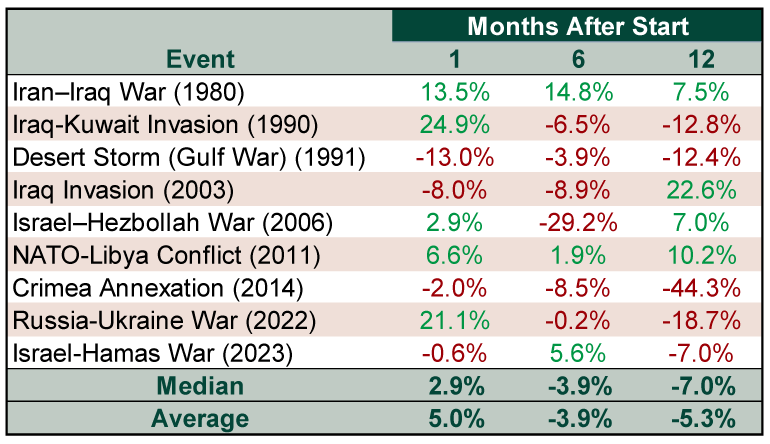
Source: FactSet, as of 4/10/2026. Brent crude oil price following selected conflicts feared to have potential oil implications since 1980.
Some will inevitably say this time is different because none of these involved the Strait of Hormuz’s closure creating a major energy bottleneck. But as we covered Wednesday, the oil and gas industry is already adapting and finding workarounds. And when in doubt, trust the market. While 10-year US Treasury yields initially jumped during the conflict, rising from 3.96% at February’s end to 4.43% on March 27, they are now down to 4.29%.[vii] That doesn’t look like a market anticipating lasting, white-hot inflation. Market-based indicators like TIPS spreads are also benign. The 5-year breakeven inflation rate is currently 2.6%, in line with 2025’s range.[viii] The 10-year rate is lower, 2.34%, in the middle of its range since 2023.[ix] The market is telling you this will pass.
Lastly, bear in mind inflation itself didn’t cause 2022’s short, shallow bear market. Inflation was one of several fears stinging investors, alongside the Ukraine war, oil, supply chain chaos, unexpected steep rate hikes, an active legislature and more. We aren’t seeing that same sentiment backdrop today. Instead, we see stocks’ rocky March resetting sentiment and rebuilding some wall of worry, with markets starting to move on. Take your cues from markets, not headlines.
If you would like to contact the editors responsible for this article, please message MarketMinder directly.
*The content contained in this article represents only the opinions and viewpoints of the Fisher Investments editorial staff.
Get a weekly roundup of our market insights
Sign up for our weekly e-mail newsletter.

You Imagine Your Future. We Help You Get There.
Are you ready to start your journey to a better financial future?
Where Might the Market Go Next?
Confidently tackle the market’s ups and downs with independent research and analysis that tells you where we think stocks are headed—and why.
Related Resources
-
Politics Context for the Noisy Congress to Come2026-10-09
-
Interesting Market History Notes on a Bear Market Anniversary2026-10-09
-
Economics Checking in on US Consumers2026-10-08
-
Politics Two Elections in the Americas—and Spain’s Coming Snap Vote2026-10-06





Learn More
Learn why 210,000 clients trust us to manage their money and how Fisher Investments and its affiliates may be able to help you achieve your financial goals.
As of 9/30/2026
New to Fisher? Call Us.
Contact Us Today