


Personal Wealth Management / Market Analysis
CPI Sheds Light on Britain’s Price ‘Cap’ Conundrum
The UK’s household energy policies are skewing inflation. Again.

UK April inflation hit the wires Wednesday, and an odd thing happened: It slowed … with household energy prices the main driver. We will forgive those readers reacting to that sentence with a tawdry, “What the heck!?!?” Because this cuts against the US Consumer Price Index (CPI), oil and natural gas prices and pretty much every other indicator out there. But the UK’s bizarre energy price cap also cuts against these things, and it explains the outlying result. It also foretells a summertime inflation jump regardless of how the Strait of Hormuz and energy prices progress in the meantime. Markets are familiar with all of this and moved on from UK energy market intervention long ago, but it is worth revisiting and understanding the mechanics.
The UK has several inflation measures, and they all slowed. The Office for National Statistics’ preferred gauge, CPIH (which includes owner-occupiers’ housing costs), slowed from 3.4% y/y in March to 3.0%.[i] Plain old CPI, which the Bank of England (BoE) and most media outlets zero in on, eased rather markedly, from 3.3% y/y to 2.8%.[ii] The antiquated Retail Price Index, which determines inflation-linked Gilts’ payouts, slipped from 4.1% y/y to 3.0%, offering a reprieve to those fearing inflation will jack up His Majesty’s debt service costs.[iii] CPI and CPIH’s core measures, which exclude energy, food, alcohol and tobacco also slowed, to 2.5% y/y and 2.8%, respectively.[iv]
Core inflation’s slowdown shows household energy costs weren’t the only factor tugging down the inflation rate, but they were a major driver. If you aren’t well versed in how UK energy prices work, you will probably find this weird considering European natural gas prices jumped 42.3% in the 12 months through April.[v] But UK energy prices don’t fluctuate with power providers’ wholesale costs in real time. In 2015, then-Labour Party leader Ed Miliband included a household energy price cap in the party’s general election manifesto. The Conservative Party and then-Prime Minister David Cameron opposed it and won the election, seemingly putting the idea to bed. But his successor, Theresa May, proved bad policy is bipartisan and made it a Conservative pledge in 2017’s contest. It became the law of the land in July 2018, and energy regulator Ofgem’s cap took effect in January 2019.
At which time Brits learned again that price caps don’t cap prices. If providers were never allowed to raise rates, they would all go out of business when wholesale power prices (which are based on natural gas’s market price) rose above retail rates. To accommodate this, the legislation let Ofgem reset the cap every six months, resulting in giant stair-step price increases as natural gas spiked during the Ukraine war in 2022. When natural gas prices eased later that year, households grew understandably frustrated that their bills remained sky-high while they waited for the official reset, leading Parliament to reduce the review periods from six months to three. So now, every three months, Brits wait on tenterhooks to learn how much energy costs will rise or fall.
April’s reset cut the annual rate from £1,758 to £1,641, giving folks a small reprieve. While that veers from natural gas prices’ rise after the Iran war began, this is purely a function of timing: Ofgem announces the cap about five weeks in advance, based on natural gas prices over the preceding three months. That means April’s reset reflects natural gas prices as of mid-February. Pre-war. July’s reset gets announced next week, and energy consultancy Cornwall Insight estimates it will push the annual rate to £1,850, a nearly 13% increase.[vi] Should that hold, this is what UK CPI’s household electricity component will look like through September.
Exhibit 1: The UK’s Energy Price Cap Isn’t Capping Prices
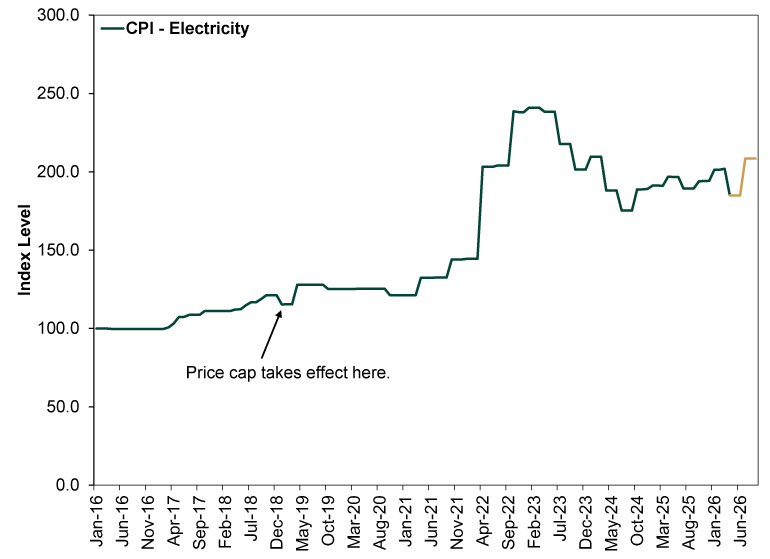
Source: Office for National Statistics, as of 5/19/2026. UK CPI’s Household Electricity component, January 2016 – April 2026. Projected price levels for May 2026 – September 2026 based on Ofgem’s price cap and Cornwall Insights’ projected price cap.
As a result, the war’s main price effects probably won’t start showing in UK CPI until July. They are there a little bit now, courtesy of gasoline and airfares, but motor fuel prices’ 23.0% y/y April rise didn’t weight heavily enough in CPI to move the needle. Meanwhile, housing and household services, which includes electricity, shaved half a percentage point off the CPI inflation rate between March and April. That suggests a big upward bump looms when the cap resets again. And if natural gas prices are down even more by then, it will probably add insult to injury.
Reading this, you would logically think the UK government understands price caps don’t work—that all they do is shield folks temporarily from market price movement, whack them with it at a delay and make them wait a few months extra for relief when prices fall. But governments are made of politicians, and politicians aren’t logical, so UK Chancellor of the Exchequer Rachel Reeves isn’t set to announce the price cap’s end when she unveils a cost-of-living package aimed at helping households Thursday. On the bright side, however, one policy trial balloon making the rounds Tuesday already appears to have popped: supermarket price caps.
Yes, even when confronted with compelling evidence that price caps don’t keep inflation or living costs low, the Treasury floated a plan to rope grocery stores into voluntary price caps on 20 “essential” items. Their reward for doing so would be a temporary holiday on some small taxes, like the levy on packaging. The blowback was predictably harsh and swift, with supermarkets and economists warning it wouldn’t work. The capped items would face shortages as demand soared (and, therefore, higher prices once the cap ended), and grocers would logically hike prices elsewhere to protect margins. Unsurprisingly, by Wednesday, The Guardian reported the proposal had bitten the dust, noting “Treasury ministers on Wednesday barely bothered to defend their proposal.”[vii]
Interestingly, while headlines freaked over Tuesday’s proposal, markets didn’t. UK Consumer Staples stocks rose a bit in pounds Tuesday and slipped slightly Wednesday. That is a non-reaction if we ever saw one. Seems to us efficient markets got the lay of the land instantaneously, realizing the policy was a nonstarter and nothingburger before the Treasury did. Perhaps the supermarket price cap plans in semi-autonomous Scotland will meet a similarly swift end.
Maybe this is the positive upshot of the feckless energy price cap? Perhaps it helped society get wise to price caps’ ills even if politicians didn’t, creating backlash that (at least for now) keeps bad policy from spreading? Hard to say, but even diminishing all of this to a sideshow for stocks is a nice victory.
[i] Source: Office for National Statistics, as of 5/20/2026.
[ii] Ibid.
[iii] Ibid.
[iv] Ibid.
[v] Source: FactSet, as of 5/20/2026. Dutch TTF gas prices, 4/30/2025 – 4/30/2026.
[vi] “Energy Bills Will Rise by £209 a Year to £1,850 From July, Forecaster Says,” Jillian Ambrose, The Guardian, 5/19/2026.
[vii] “The Treasury’s Supermarket Food Price Cap Wheeze Was Bananas,” Nils Pratley, The Guardian, 5/20/2026.
If you would like to contact the editors responsible for this article, please message MarketMinder directly.
*The content contained in this article represents only the opinions and viewpoints of the Fisher Investments editorial staff.
Get a weekly roundup of our market insights
Sign up for our weekly e-mail newsletter.

You Imagine Your Future. We Help You Get There.
Are you ready to start your journey to a better financial future?
Where Might the Market Go Next?
Confidently tackle the market’s ups and downs with independent research and analysis that tells you where we think stocks are headed—and why.
Related Resources
-
Market Volatility By the Numbers: 2026’s ‘Volatility’2026-06-12
-
Expert Commentary This Week in Review | IPOs, US Inflation, ECB Rate Hike
 2026-06-12
 -
Market Analysis Are World Oil Reserves Dangerously Low?2026-06-11
-
Expert Commentary Think Twice Before Buying an IPO
 2026-06-11



Learn More
Learn why 200,000 clients trust us to manage their money and how Fisher Investments and its affiliates may be able to help you achieve your financial goals.
As of 3/31/2026
New to Fisher? Call Us.
Contact Us Today