


Personal Wealth Management / Market Volatility
How Investors Should Think About the Ceasefire
Markets don’t wait for all-clears.

President Donald Trump announced a ceasefire in the Iran war late Tuesday, and markets reacted Wednesday as you would probably expect: Stocks jumped and Brent crude oil and European natural gas prices plunged on news Iran would reopen the Strait of Hormuz as part of the deal. We see some key takeaways for investors here, and they probably will surprise you.
First, crucially: Markets didn’t wait for an all-clear (and this news isn’t assured to be one, which we will get to). Yes, Wednesday’s moves in stocks, oil and European natural gas were huge. But all started improving before the ceasefire announcement, as Exhibits 1 and 2 show.
Exhibit 1: Stocks Moved Before the Ceasefire
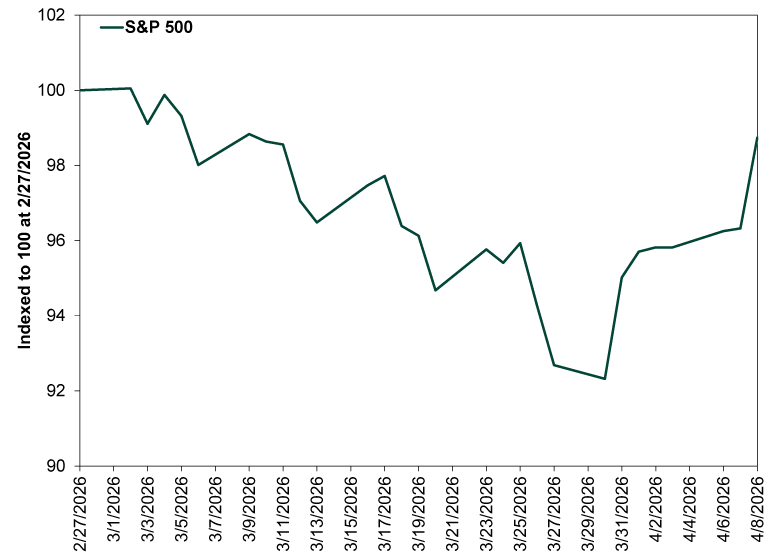
Source: FactSet, as of 4/8/2026. S&P 500 total return index, 2/27/2026 – 4/8/2026. Indexed to 100 at 2/27/2026.
Exhibit 2: So Did Oil and Natural Gas
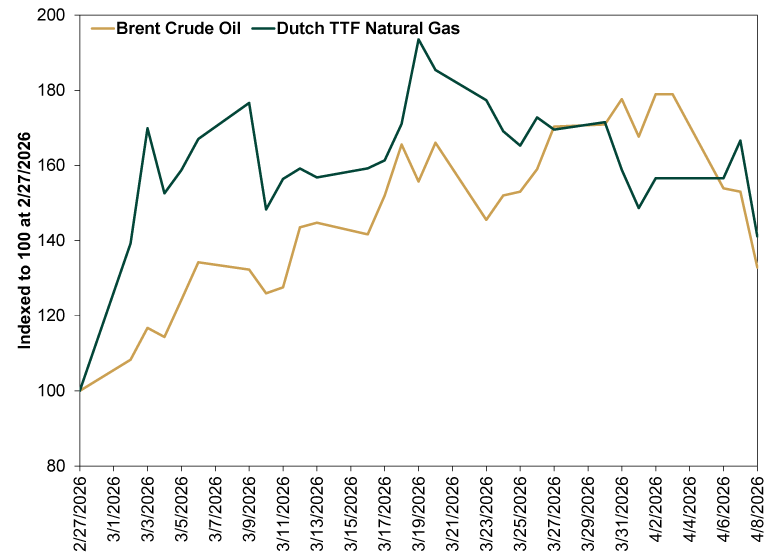
Source: FactSet, as of 4/8/2026. Brent crude oil and Dutch TTF natural gas, 2/27/2026 – 4/8/2026. Indexed to 100 at 2/27/2026.
Second: Markets don’t demand perfection and don’t hinge on minute-by-minute happenings. We know this, because despite all the promising announcements Tuesday evening, it isn’t clear anything has changed. All indications Wednesday were that the Strait remains “closed,” with Iran regulating traffic to a trickle of toll-paying tankers it deems friendly. Western-flagged ships didn’t transit en masse. Insurers and maritime risk management pros haven’t given the green light, and the Strait reportedly remains mined. Yet news of all this didn’t cause crude oil’s slide to reverse sharply. Nor did Iran’s announcement that the Strait is “closed” again after Israeli attacks on its Lebanese proxy, Hezbollah. Nor did reports of drone strikes on Saudi Arabia’s East-West pipeline, which producers are using to reroute oil from the Strait to the port of Yanbu. Instead, oil ticked up just a bit from intraday lows, while the S&P 500 barely blinked. It seems markets are looking forward, not at the ever-changing headlines.
All of this speaks to the importance of lengthening your focus. If you allow headlines’ short-termism to sweep you up, it creates this false sense of urgency. You start setting deadlines for things to improve. You identify catalysts and benchmarks the news has to hit for you to own stocks. You feel the powerful urge to just do something with your portfolio in order to seize control from world events you have no influence over. You bog yourself down trying to pick—and chase after—winners while avoiding losers. It is a recipe for chasing your tail and getting whipsawed—buying or selling right before the market moves against you.
In the short term, the news can hit hard. This is partly because fast-changing sentiment makes people react rashly, driven by fear and greed, and partly because there is a whole class of professional traders whose job it is to capture quick price movements or manage futures contracts for businesses heavily exposed to exchange rates or commodity prices. All of this feeds into markets’ short term (over)reactions. But these moves are usually fleeting as markets do their primary job of looking 3 – 30 months ahead and weighing investors’ consensus view of how reality will unfold relative to expectations over the longer term. Said another way, investors and traders/speculators are always battling over market control and pricing. Traders and speculators can win out in the short term. But over time, the collective decisions of millions of investors in it for the long haul win out. This is why the legendary Ben Graham preached that markets are a voting machine in the short term but a weighing machine in the long run.
Investing—managing a portfolio for a long-term set of goals—isn’t always about trading. It is about building, making tactical decisions when warranted and, a lot of time, holding. Resisting the temptation to react. Traders and speculators react. Computerized trading platforms react. Investors do best when they make deliberate, well-reasoned, probabilities-based decisions about what is likely to happen in the medium and longer term. Reacting to what just happened is the antithesis of that. Said simply, active investing isn’t reactive. It is forward-looking, aiming to position to capture the larger, longer-term trends you can identify. Reacting is by nature backward-looking.
We aren’t telling you to ignore the news. That would be unrealistic, and it clearly isn’t something we practice. But we urge you to work hard to mute the signals you get from the news—the fear and greed telling you the news warrants portfolio action. When you get the urge, remember who you are: If you are reading MarketMinder, you probably aren’t a speculator or professional (or semipro) short-term trader. You are probably an investor aiming to achieve the long-term returns you need to fund your goals. When you place this first in mind, it emphasizes that you own stocks (and maybe some bonds) for a reason. Then you can ask the critical questions: Has that reason changed? Not just for stocks, but for various sectors and regions? Absent a change to your goals or a change in stocks’ fundamental conditions and outlook, the right move will often be to sit tight.
To us, the Iran-related volatility shows this well. Thus far, it has been fleeting. Should March 30 prove to be the low, it will have ended much faster than anyone expected. If there is more downside from here, we reckon it will illustrate the flaws of interpreting big, good news as an automatic all clear. Looking under the hood, we can also see these principles in Energy stocks, whose massive wartime outperformance started reversing as oil prices eased over the last week. And in geographic returns: US stocks outperformed on the way down as energy disruption fears hit the most exposed regions hardest. But non-US stocks have led again since late March.
Since the war broke out, we counseled staying cool and thinking long-term. We still do. The reason to be bullish now isn’t that the Strait is maybe open and missile and drone strikes will maybe stop. We think the reason to be bullish is that, with or without a ceasefire holding this week, the economic and political factors supporting corporate earnings over the next 3 – 30 months remain intact. Steep global yield curves enable more lending, but not enough to spike money supply to the degree necessary to reignite hot inflation. Corporate earnings are growing and expected to strengthen this year. Political gridlock keeps legislative risk low around the developed world, a factor US midterms look set to turbocharge late this year.
Look to these longer-term factors to drive returns, not day-by-day events in one tiny waterway.
If you would like to contact the editors responsible for this article, please message MarketMinder directly.
*The content contained in this article represents only the opinions and viewpoints of the Fisher Investments editorial staff.
Get a weekly roundup of our market insights
Sign up for our weekly e-mail newsletter.

You Imagine Your Future. We Help You Get There.
Are you ready to start your journey to a better financial future?
Where Might the Market Go Next?
Confidently tackle the market’s ups and downs with independent research and analysis that tells you where we think stocks are headed—and why.
Related Resources
-
In The News Will France’s Protests Disrupt Growth?2026-10-26
-
Market Analysis The Sentiment Cooldown Unfolding2026-10-26
-
Market Analysis Earnings Ghost Stories2026-10-26
-
Weekly Wrap-Up Fisher Investments Reviews: Last Week in Markets — October 19 - October 232026-10-26





Learn More
Learn why 210,000 clients trust us to manage their money and how Fisher Investments and its affiliates may be able to help you achieve your financial goals.
As of 9/30/2026
New to Fisher? Call Us.
Contact Us Today