


Personal Wealth Management / Economics
Q4 US GDP Beyond the Shutdown
America’s private sector continued chugging along to close out 2025.

Amid a busy news stretch on Friday, the Bureau of Economic Analysis (BEA) released its government shutdown-delayed advance estimate of Q4 US GDP. Many focused on weak points, including government consumption and investment as well as net exports. But GDP’s private sector components indicate economic output remains largely in line with its healthy, longer-term growth trend. While backward-looking, this further confirms the US economy ended 2025 on solid ground—useful perspective given today’s skepticism.
Q4 real GDP growth slowed from Q3’s 4.4% annualized to 1.4%, missing expectations of 1.9%.[i] Looking at some of the primary underlying components, personal consumption expenditures decelerated (to 2.4% annualized from Q3’s 3.5%) due to durable goods’ -0.9% contraction, while business investment accelerated slightly to 3.7% from 3.2% thanks to equipment and intellectual property products spending.[ii] On international trade, both exports (-0.9% annualized) and imports (-1.3%) slipped.[iii]
The headliner, though, was last year’s federal government shutdown. President Donald Trump claimed the shutdown—which lasted a record 43 days, from October 1 – November 12—cost the country “at least two points in GDP.”[iv] While the BEA said it couldn’t fully quantify the partial shutdown’s economic effects, it estimated the reduction in federal government services subtracted about -1.0 percentage point from Q4 growth.[v] Fair enough, though the shutdown focus highlights one of our gripes with GDP: It treats government spending as an automatic positive and reductions an assured negative (i.e., rising government spending and investment adds to GDP).
Mind you, we aren’t inherently against government spending. We just think its economic influence is overstated and that GDP’s math hides the risks of misallocated spending. On the former, the federal government generated 6.4% of 2025 GDP—behind state and local governments’ 10.8% and the private sector’s 82.9%.[vi] On the latter, government spending and investment also don’t create new activity. Rather, the government redistributes tax revenue to areas where it sees fit (i.e., Uncle Sam chooses winners and losers). Some of this spending may be immediately productive. Some may have to recirculate a few times before finding its optimal use. In our view, the private sector is a more efficient allocator of resources and capital because the incentives require it to be.
Moreover, since stocks are publicly traded companies, we think investors benefit most from focusing on GDP’s private sector components, specifically, consumer spending, business investment and residential real estate. These components, “private sector” GDP, rose 2.0% annualized.[vii] Some argue AI-related investment is doing much of the heavy lifting, which has some merit. Information processing equipment and software investment contributed 4.65 percentage points to Q4 business investment, offsetting declines in structures spending and transportation equipment.[viii] These tech-related categories have driven business investment growth since Q4 2023, while private fixed investment in structures has detracted since Q1 2024.[ix] Yet this development is also well-known and helps reduce expectations for other parts of the economy, extending the wall of worry. Most coverage cites it as a risk. Even a report that seemingly tried to dismiss it as a source of growth did so by arguing most of the investment is going overseas via imported semiconductors, a pretty dour take, in our view.
Looking at the bigger picture, Q4 private sector GDP growth remains in line with its recent trend. (Exhibit 1) While headline GDP expanded as quickly as 4.7% annualized (Q3 2023) and contracted as much as -1.0% (Q1 2022) over the past three years, private sector GDP chugged along, averaging 2.2% annualized growth over the past 16 quarters.[x] America’s primary growth engine closed out last year in fine fettle.
Exhibit 1: US GDP Over the Past Three Years
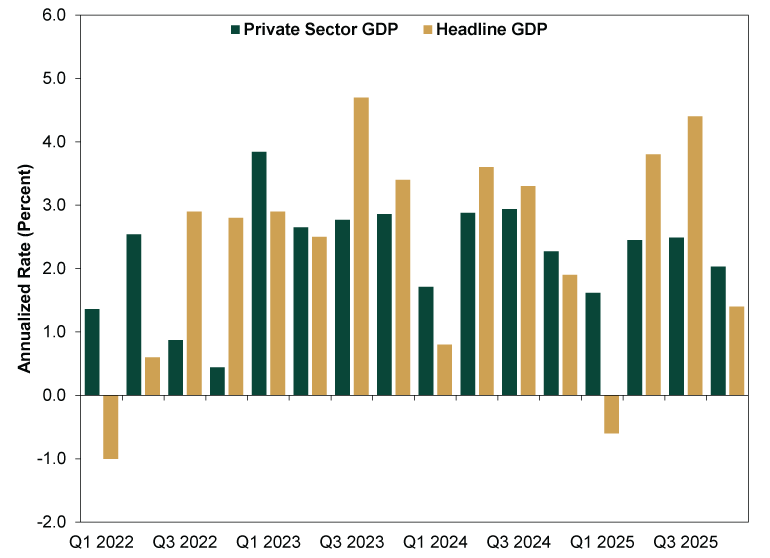
Source: Bureau of Economic Analysis, as of 2/20/2026.
The broad reaction to America’s Q4 GDP report echoes analyses of other recent data. As we pointed out last week, sentiment has cooled this year, with serious optimism giving way to some renewed fear. Most coverage zeroed in on the government shutdown’s real-but-overstated hit to headline growth despite the private sector’s ongoing expansion. S&P Global’s flash February US purchasing managers’ index (PMI) garnered a similar reaction. Despite a composite PMI reading of 52.3, indicating expansion, businesses fretted over tariffs, rising prices and political uncertainty.[xi] Interestingly, one headline noted “US Business Activity Growth Slows as Europe Picks Up Pace”—even though America’s February reading was better than the eurozone’s 51.9![xii]
While the data aren’t telling a new story—US growth isn’t gangbusters, but it is holding up just fine—the interpretations of the numbers have turned more dour. The return of some false fears adds more bricks in the proverbial wall of worry bull markets climb, a bullish development for stocks.
[i] Source: Bureau of Economic Analysis and FactSet, as of 2/20/2026.
[ii] Source: Bureau of Economic Analysis, as of 2/20/2026.
[iii] Ibid.
[iv] “Trump Previewed Weak GDP on Truth Social Ahead of Official Data Release,” Kevin Breuninger, CNBC, 2/20/2026.
[v] “GDP (Advance Estimate), 4th Quarter and Year 2025,” Staff, Bureau of Economic Analysis, 2/20/2026.
[vi] See note ii. Also, doesn’t sum due to rounding.
[vii] Ibid.
[viii] Ibid.
[ix] Ibid.
[x] Ibid.
[xi] Source: FactSet, as of 2/23/2026.
[xii] “US Business Activity Growth Slows as Europe Picks Up Pace,” Don Nico Forbes, The Wall Street Journal, 2/23/2026.
If you would like to contact the editors responsible for this article, please message MarketMinder directly.
*The content contained in this article represents only the opinions and viewpoints of the Fisher Investments editorial staff.
Get a weekly roundup of our market insights
Sign up for our weekly e-mail newsletter.

You Imagine Your Future. We Help You Get There.
Are you ready to start your journey to a better financial future?

Where Might the Market Go Next?
Confidently tackle the market’s ups and downs with independent research and analysis that tells you where we think stocks are headed—and why.
Related Resources
-
Politics Context for the Noisy Congress to Come2026-10-09
-
Expert Commentary This Week in Review | S&P 500 Record High, Fed Minutes, Spain Election
 2026-10-09
 -
Interesting Market History Notes on a Bear Market Anniversary2026-10-09
-
Economics Checking in on US Consumers2026-10-08




Learn More
Learn why 210,000 clients trust us to manage their money and how Fisher Investments and its affiliates may be able to help you achieve your financial goals.
As of 9/30/2026
New to Fisher? Call Us.
Contact Us Today