


Personal Wealth Management / Market Analysis
Beyond Iran: A Non-Conflict March Mailbag Q&A
Need a break from scary headlines? We have you covered.

Spring is here! The sun is out, the seeds are sprouting, the birds are chirping and our mailbag is full. Given the war in the Middle East remains prominent in our normal coverage, we will take a break from that here to keep things fresh. Please enjoy.
What is the correlation between the stock market and the Fed’s balance sheet?
On a monthly basis, the correlation between the two is -0.20 since January 2003.[i] For those whose memory of Stats 101 is a little fuzzy, a correlation of 1.00 means two variables always move in the same direction, 0.00 means no relationship and -1.00 means they always move opposite. So -0.20 means they move in different directions a little more often than not.
But we suspect you are really asking this question not for the correlation coefficient, but because of a chart that was really popular in the early- and mid-2010s, which showed the S&P 500 rising with the Fed’s balance sheet and flatlining as the balance sheet stayed steady. This allegedly supported the popular view that all the money from the Fed’s quantitative easing program ended up in the stock market … and that without Fed support, stocks would go splat. Exhibit 1 recreates this for your viewing pleasure.
Exhibit 1: An Old Popular Chart
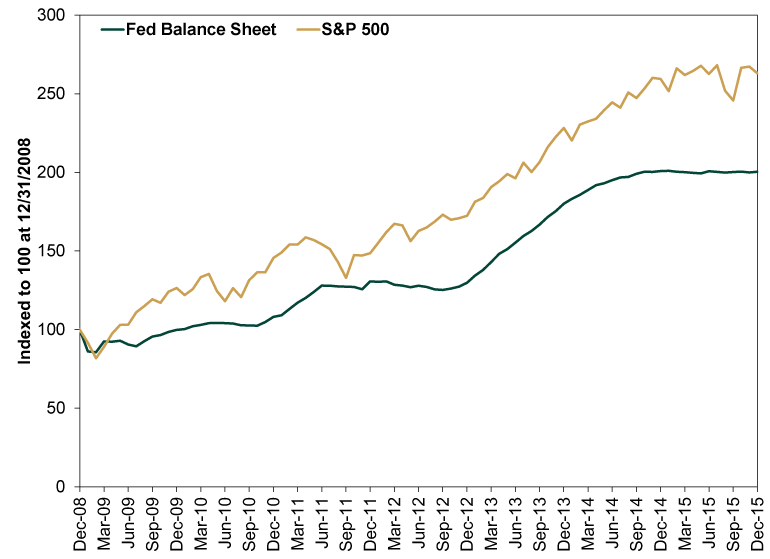
Source: FactSet and St. Louis Federal Reserve, as of 3/18/2026. Federal Reserve Assets and S&P 500 total return index, monthly, 12/31/2009 – 12/31/2015.
Back then, this caused a lot of fear. But reality disproved it. Stocks soared in the late 2010s, as the Fed began shrinking its balance sheet, and did the same in 2023, 2024 and 2025. The earlier correlation was coincidental, not causal, as banks didn’t use Fed liquidity to back aggressive new lending. Mostly, they built capital buffers. And now the chart looks like this.
Exhibit 2: An Old Popular Chart, Updated
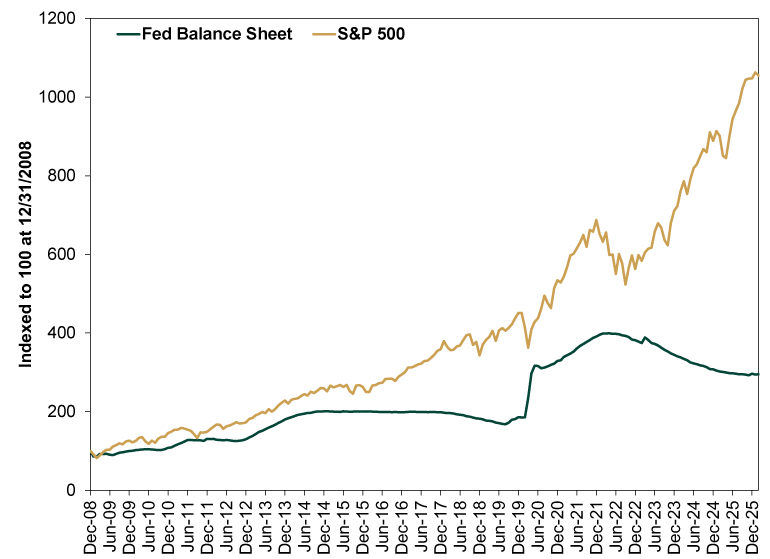
Source: FactSet and St. Louis Federal Reserve, as of 3/18/2026. Federal Reserve Assets and S&P 500 total return index, monthly, 12/31/2009 – 2/28/2026.
As we wrote way back then and since, the Fed doesn’t dictate markets’ direction. Not via rate decisions. Not via its balance sheet. Can it err and influence the economy? Sure, but it is a mistake to see such a move around every corner. The Fed simply isn’t that powerful.
Are you concerned about the implications of low birth rates in South Korea and other countries for their economies and markets?
No. These demographic issues are important societally, but they are too well-known and slow-moving to affect markets. Lower birthrates also tend to feature in richer, more advanced economies (which South Korea is despite its Emerging Markets status), while the highest birthrates tend to be in less-developed countries with higher infant mortality rates, shorter lifespans and more poverty. And among developed nations, stocks in countries with “better” demographics outperform sometimes and underperform sometimes. It just isn’t a factor.
If I have cryptocurrency and it gets stolen, could the government hack the thieves to get it back?
There is no official hacking program that we are aware of, and the concept gives us the heebie jeebies. But Uncle Sam has occasionally been able to recover stolen bitcoins via civil asset forfeiture when it busts a scammer, and it has reunited the victims with their crypto. We suggest not counting on this, though, and employing every cyber security precaution you can.
Do you think the dollar is fairly valued today?
We don’t think there is such a thing as a correct or “fair” value when it comes to the dollar or any currency or asset. That is, there is no magic threshold where anything becomes over- or under-valued, no specific level the dollar “should” be trading at.
At the same time, we are tempted to answer this with a “yes,” because liquid markets are the best pricing mechanisms in town, reflecting the aggregate wisdom of the millions of folks buying and selling. A liquid asset is always worth what people are willing to pay for it. Any liquid asset. (Yes, even gold.) So wherever the dollar sits when you read this, given it is the product of a free market, its value is generally fair/correct/whatever for that moment. And wherever the dollar sits tomorrow, it will be the same.
Is the dollar declining because other countries aren’t buying US Treasurys?
This question predates the events in the Middle East—the dollar has strengthened during the conflict, as it often does when investors get jittery and want a safe haven. But we kept it because we thought the general principle is worth commenting: Does the dollar depend on foreign investors (including governments) raising their US Treasury holdings?
No. While the dollar famously weakened last year, foreign holdings of US Treasurys rose from about $8.6 trillion in January 2025 to just over $9.3 trillion in January 2026.[ii] All else equal, money tends to flow to the highest-yielding asset. Rate hikes in Japan and elsewhere gave currency speculators more options, contributing to the falling dollar. Also, fun fact, the buck tends to decline early in Republican presidents’ terms, and the greenback last year looked a lot like it did in 2017, year one of President Donald Trump’s first term. We really wouldn’t read into it.
Can you recommend an unbiased media outlet?
Alas, sorry, we can’t. Not because we are meanies, but because there is no such thing and never has been. All outlets, whether or not they incorporate it into their marketing, have their own editorial slant. Cable news obviously does, but so does broadcast. Ditto national papers, local papers, online-only outlets, all of them. It is unavoidable. You also get a lot of opinion leaking from the Editorial and Op-Ed pieces into news articles, often via “news analysis” or explainers.
So when you read the news, understand what the publisher or writer’s biases are. Not to automatically agree or disagree with them, but to make it easier to parse the statements of opinion from statements of fact. Sometimes the writer will make this easy on you, outright stating it is an opinion. But often it takes some critical reading comprehension to suss it out.
We also suggest casting a wide net. Don’t stay in an ideological echo chamber—read sources you are inclined to agree with as well as sources you are inclined to disagree with. In our experience, both will cherry-pick facts that fit their narrative and omit those that don’t. This is classic confirmation bias, and it is easiest to see and correct if you see both sides doing it. Also, you might soon discover you have something to learn from people you used to dismiss.
You might have noticed in our daily “What We’re Reading” section that we cover outlets that traditionally lean left and those that lean right. Among US papers, you will see The New York Times (generally left) and The Wall Street Journal (generally right) featured a lot. With UK papers, we spend a lot of time with The Guardian (left) and The Telegraph (right). All have fine reporting, and on the opinion/analysis side, we have featured insightful, sensible pieces from all four … and some howlers from all four. It really is all about filtering and thinking critically.
If you would like to contact the editors responsible for this article, please message MarketMinder directly.
*The content contained in this article represents only the opinions and viewpoints of the Fisher Investments editorial staff.
Get a weekly roundup of our market insights
Sign up for our weekly e-mail newsletter.

You Imagine Your Future. We Help You Get There.
Are you ready to start your journey to a better financial future?
Where Might the Market Go Next?
Confidently tackle the market’s ups and downs with independent research and analysis that tells you where we think stocks are headed—and why.
Related Resources
-
In The News Around the World in Tax Policy Talk2026-05-15
-
Market Analysis Reader Mailbag: May 20262026-05-14
-
Politics The UK’s Political Ructions Hide a Better-Than-Feared Economy2026-05-14
-
Macro Insights Q1 2026 Global Markets Review & Outlook2026-05-12




Learn More
Learn why 200,000 clients trust us to manage their money and how Fisher Investments and its affiliates may be able to help you achieve your financial goals.
As of 3/31/2026
New to Fisher? Call Us.
Contact Us Today