


Personal Wealth Management / Politics
Britain’s New Budget Is on the Hunt for Business Investment
The new Chancellor tries to cushion a tax hike.

Editors’ Note: MarketMinder is politically agnostic, favoring no party nor any politician. We assess developments for their potential economic and market impact only.
March 15, as Shakespeare taught us, is a day for political betrayal and misfortune … so it is a bit surprising that UK Chancellor of the Exchequer Jeremy Hunt chose today to release his Spring Budget—the semiannual fiscal policy package. Given how much opposition some of his plans face within his Conservative Party, you might think he would beware the ides of March. Perhaps he figured there was enough there to win over critics? At any rate, we think the UK’s twice-a-year tinkering with spending and tax rates goes a long way toward showing why stocks prefer gridlock. Inactive legislatures tend to keep fiscal policy relatively static, making it easier for businesses to calculate return on investment. In the UK, it is a moving target, which we think helps explain why, regardless of whether business taxes rise or fall, investment growth’s long-term trend doesn’t change much. People often deride what they call low-investment Britain, but on the bright side, history suggests the latest tax hikes shouldn’t be some massive negative for stocks.
The Spring Budget, according to most coverage, was a damp squib. No major tax hike reversals. Household energy subsidies will now drop in July instead of April, in hopes of wholesale electricity costs falling below the subsidy ceiling by then. Income tax bands won’t rise—leaving people with higher bills as wage growth lags inflation—but the government claims new spending on childcare and other social initiatives will leave households better off. That program, along with pension changes, aims to get more people in the labor force, on the (in our view, flawed) theory that this will raise economic growth. Meanwhile, the corporate tax rate will rise from 19% to 25% next month as scheduled, but it will come with new investment deductions and other incentives. Some coverage has pointed out that, all together, the tax burden will soon be the highest since World War II. Yet Hunt claims this is “the most pro-business, pro-enterprise regime anywhere.”
To us, it is a typical fiscal policy package. Giveaways for some. Penalties for others. Rhetorical gymnastics. Posturing. Careful deliberation of what to include now, knowing the next election isn’t until January 2025 and you will want to save the best for last. All just business as usual. In sum, it is probably more political fodder than economic driver.
At the same time, businesses are frustrated, leading to much talk of the corporate tax changes making it harder for the UK to avoid recession this year. After all, the more you tax something, the less you get of it—in this case, profits, which are the fruit of investment. Hence, many warn the higher rates will discourage investment, dooming the country to slow growth indefinitely.
Hunt seemed prepared for this criticism, which we suspect is why the Spring Budget included a raft of new investment incentives. Presuming it passes Parliament as written, for the next three years businesses will be able to write off every pound of investment against their tax bill. “Research-intensive” businesses will also get an “enhanced credit” of £27 for every £100 invested. Lastly, the Budget creates 12 new “investment zones” where businesses can compete for grants and subsidies to build new research hubs and other facilities centered around universities.
So, will it work? Will businesses rate the tax deductions and other sweeteners higher than the tax rate? That is impossible to know, but we think their handling of the Energy windfall profits tax might provide some clues. Last year, the government slapped a 25% rate on oil and gas companies’ profits, arguing it was a windfall they didn’t earn due to circumstances outside their control (the war in Ukraine), and raised it to 35% in November. Officials claimed it wouldn’t discourage oil drilling—leading to shortages and even higher prices later—because they allowed companies to write off 91 pennies of every £1 invested in new oil and gas drilling. Almost as generous as the investment allowance offered today. But several major drillers cut their UK investments anyway. It seems the prospect of sudden tax changes was just too much.
The oil and gas industry has its own unique drivers, though. New wells have high up-front costs, and their eventual revenues are hard to predict since prices fluctuate on the market. The windfall tax is therefore an important part of companies’ calculations, but we doubt it is the only variable. So perhaps companies outside Energy will find the new system more favorable. Maybe they will see that at 25%, the corporate tax rate will still be lower than at any point before David Cameron’s coalition government started cutting it from 28% in 2010.[i] Maybe all those new deductions and investment zones will actually incentivize investment. But prior efforts to boost business spending with “super deductions” and “levelling up” plans for Northern England didn’t really bear fruit, making it hard to see why this time would be different.
That is the thing about business investment. Despite the tax rate cuts and deduction monkeying of the last decade-plus, it didn’t surge. Post-2010 trends didn’t look much different than pre-2010 trends, perhaps because businesses know that what governments giveth, governments can taketh away. We suspect businesses have long presumed they were just one change in government away from higher rates. Exhibit 1 illustrates this, showing quarterly business investment growth and corporate tax rates since 1997, when the investment data begin.
Exhibit 1: Corporate Tax Rates Didn’t Much Influence Investment
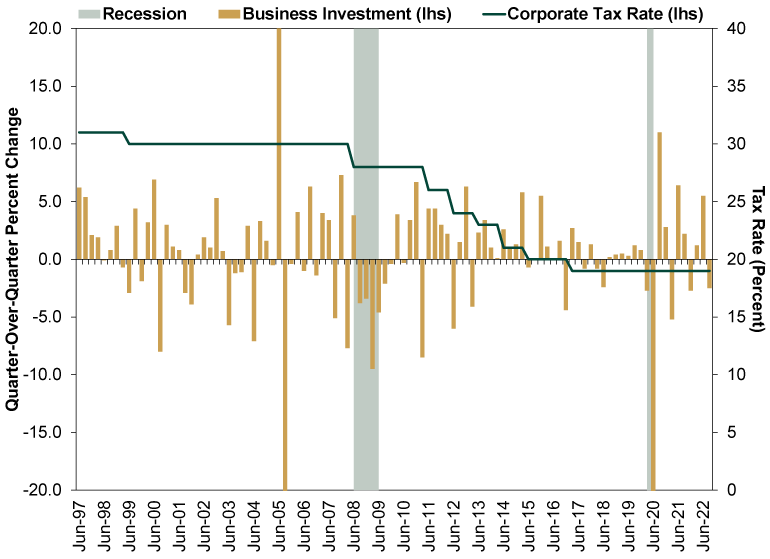
Source: FactSet and HMRC, as of 3/15/2023. Investment y-axis truncated for visibility so that one-time events wouldn’t skew the picture.
The other changes making headlines Wednesday surround pensions. As the country returned to work following COVID lockdowns, there was a notable drop in labor force participation among the over-50 set. Many had the financial flexibility to retire early, and the pension system all but encouraged it via stripping most of the tax benefits once a pension pot reached £1,073,000. Once a defined-contribution plan reached that value through saving and investment, funds above that amount would get taxed at either 55% or the saver’s income tax rate plus 25 percentage points, depending on whether it was taken as a lump sum or via gradual distributions. Many have argued this discouraged highly paid workers from working until retirement age, pulling doctors and other folks out of the labor force.
So, in hopes of reversing this and encouraging savings, Hunt announced the government will abolish the lifetime allowance cap and raise annual tax-deferred contribution limits from £40,000 to £60,000, encouraging work and saving in one go. And hey, maybe! But much like the corporate tax world, this change is but a partial offset to individuals’ increasingly high tax burdens. With tax bands not indexed to inflation and personal allowance phasing out as incomes rise, the effective marginal rate on incomes between £100,000 and £125,000 is 60%.[ii] Will pension sweeteners be enough to offset this and draw people back to work? Only time will tell, but either way, remember hiring follows economic growth, not the other way around.
Overall, this Budget—like all fiscal policy changes—creates winners and losers. Our hunch is that they mostly average out, as is typical with packages like this. Mostly, we think the sheer complexity and ever-changing nature of the UK’s tax system is probably a headwind. To navigate and keep up with it costs significant resources—resources that could probably be deployed more productively elsewhere. Yet it is a status quo that the UK economy and stocks have learned to live with, so we doubt another round is a material negative, especially when there were no big, sudden surprises. The corporate tax hike has been scheduled for nearly two years now, making it very unlikely stocks have yet to price it in. If they aren’t hung up on it, we doubt investors should be, either.
If you would like to contact the editors responsible for this article, please message MarketMinder directly.
*The content contained in this article represents only the opinions and viewpoints of the Fisher Investments editorial staff.
Get a weekly roundup of our market insights
Sign up for our weekly e-mail newsletter.

You Imagine Your Future. We Help You Get There.
Are you ready to start your journey to a better financial future?
Where Might the Market Go Next?
Confidently tackle the market’s ups and downs with independent research and analysis that tells you where we think stocks are headed—and why.
Related Resources
-
In The News Bourse : pourquoi l’impact de la guerre en Iran sera moins important que prévu – par Ken Fisher2026-04-01
-
Market Analysis What the Latest Global Flash PMIs Reveal2026-03-31
-
Market Analysis Beyond Iran: A Non-Conflict March Mailbag Q&A2026-03-30
-
Weekly Wrap-Up Fisher Investments Reviews: Last Week in Markets—March 23 - March 272026-03-30





Learn More
Learn why 195,000 clients trust us to manage their money and how Fisher Investments and its affiliates may be able to help you achieve your financial goals.
As of 12/31/2025
New to Fisher? Call Us.
Contact Us Today