


Personal Wealth Management / Market Analysis
Digging Into America’s Declining Savings Rate
Reviewing the limitations of the personal savings rate.

Is the US economy running out of fuel? Some worry the declining personal savings rate (to 3.5% in November from 4.9% in November 2024) means consumers are tapped out and a big chunk of GDP is about to weaken, removing economic support from stocks.[i] But the savings rate isn’t all it is cracked up to be, rendering its downtick a false fear in this bull market’s remaining wall of worry.
The personal savings rate sounds like a straightforward concept, and the Bureau of Economic Analysis (BEA) uses a formula that looks logical at first—before its oversights become apparent.[ii] First, the BEA subtracts spending (i.e., personal outlays) from after-tax income (i.e., disposable personal income) to determine “personal savings.” That divided by after-tax income yields the personal savings rate.
The issues arise when you dive into the BEA’s methodology. For instance, the BEA’s definition of personal income doesn’t include realized capital gains and losses. This means if someone sells a stock, the proceeds won’t count as income—a weird choice considering capital gains taxes do factor into the calculation (and end up lowering disposable income). Now a lot of folks reinvest realized gains, and we don’t think stocks fund a major portion of consumer spending. But many retirees with taxable investment accounts will use these funds for living expenses, alongside Social Security and their tax-deferred retirement account withdrawals. And spent or not, realized gains do count as money in the kitty, and having that cushion may indirectly affect folks’ spending decisions. From a sentiment angle, we think it is odd that the many who (in our view, wrongly!) buy the “wealth effect”—that asset value movements influence spending—would ignore this.
Relatedly, many folks (especially retirees) use invested savings from tax-advantaged retirement accounts like an IRA or 401(k) or receive payments from employer-sponsored pension plans. These paid-out benefits aren’t counted as income under the BEA’s criteria. Also, since personal contributions to these accounts are made on a pre-tax basis, they won’t count as savings—which lowers post-tax income and further distorts the savings rate.
And what if you are a business owner? If you plow your earnings back into your company this doesn’t qualify as saving—even though the business is included in an owner’s net worth. Debt repayment receives some wonky treatment, too, as it treats money used to pay down mortgages, cars or other obligations as “savings.” The upshot, in our view: The personal savings rate doesn’t accurately reflect how many Americans actually save.
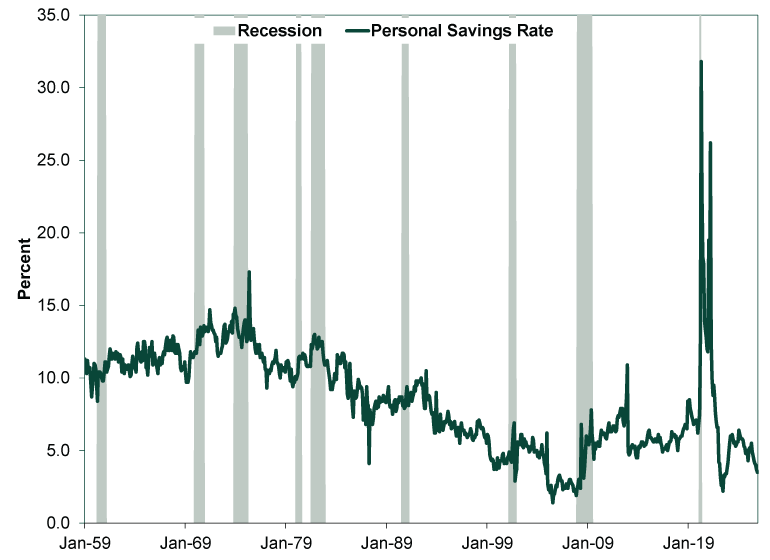
Beyond the theory, the latest concerns—that the savings rate hit 3.5% in November 2025, its lowest level in three years—seem overstated to us.[iii] That time period should give you a hint that a declining savings rate isn’t a massive negative for the economy or markets. Yes, the rate fell from 6.6% in December 2021 to 2.2% in June 2022, as spiking prices took a bite out of savings. From a market perspective, hot inflation fears were one of several stories roiling investor moods that year, driving the rare, sentient-driven bear market featuring multiple drivers. However, the falling savings rate didn’t lead to recession despite many households’ hardships and struggles.
Historically, the savings rate hasn’t shown to be a worrisome canary in the coal mine for the broader economy. Now, there are some examples of when a declining savings rate preceded recession—see the mid-2000s, when concerns of a “consumer crunch” appeared prescient, especially since a deep recession started in December 2007.[iv] But dig a little deeper and the timeline doesn’t match. The savings rate fell to a low of 1.4% in July 2005, more than two years before the downturn began. Personal consumption largely grew until the back half of 2008—when the economy was nearly a year into recession.[v] During that recession, consumption didn’t plummet as sharply as other parts of the economy. Personal consumption expenditures fell from Q3 2008 – Q2 2009, with the sharpest contraction being Q4 2008’s -3.5% annualized drop. In contrast, business investment—the economy’s actual swing factor—plunged over that same stretch, dropping -33.4% annualized in Q4 2008 and -38.3% and -21.3% in Q1 and Q2 2009, respectively.[vi] This highlights a central point: Rather than tapped-out consumers, we believe the primary cause of that recession and bear market was a US accounting rule that decimated banks’ balance sheets alongside the government’s haphazard response to the crisis.
The mid-2000s instance aside, the savings rate actually tends to rise during recessions. (Exhibit 1) That isn’t so strange when you think about what is happening: Tough economic times prompt people to become more diligent with their disposable income. That doesn’t mean consumers stop spending—consumption tends to be pretty stable, even during economic downturns, since the majority of consumer spending goes toward services. (Economists call this inelastic demand, as it doesn’t fluctuate much regardless of conditions.) Most folks won’t cut essential services spending (think housing or health care) even during challenging economic stretches. Instead, they will choose to reduce some discretionary spending, buy cheaper substitutes or, you know, save their income to weather the tough times. Thus, using the savings rate as an economic predictor is backward to us—it is more likely to tell you what US households are doing in reaction to economic conditions.
Exhibit 1: The Personal Savings Rate Since 1959
Source: St. Louis Federal Reserve, as of 1/28/2026.
In our view, recent chatter about tapped-out consumers seems like an offshoot from “K-shaped” economy concerns, which posit that the economy is a house of cards supported only by wealthy households’ spending. We don’t outright dismiss that development. The hot inflation from a few years ago hit those with low, no or fixed income much harder than higher-income households. However, fretting over the savings rate is another way to question the strength of the economy. To us, that indicates optimistic sentiment in the US still features some lingering skepticism—moods remain pre-euphoric, suggesting there is still some wall of worry for US markets.
[i] Source: Bureau of Economic Analysis, as of 1/30/2026.
[ii] “Measuring How Much People save: An Inside Look at the Personal Saving Rate,” Staff, Bureau of Economic Analysis, 8/21/2017.
[iii] Source: St. Louis Federal Reserve, as of 1/28/2026.
[iv] “The Coming Consumer Crunch,” Michael Mandel, NBC News, 11/19/2007.
[v] Source: St. Louis Federal Reserve, as of 1/30/2026.
[vi] Source: Bureau of Economic Analysis, as of 1/30/2026.
If you would like to contact the editors responsible for this article, please message MarketMinder directly.
*The content contained in this article represents only the opinions and viewpoints of the Fisher Investments editorial staff.
Get a weekly roundup of our market insights
Sign up for our weekly e-mail newsletter.

You Imagine Your Future. We Help You Get There.
Are you ready to start your journey to a better financial future?
Where Might the Market Go Next?
Confidently tackle the market’s ups and downs with independent research and analysis that tells you where we think stocks are headed—and why.
Related Resources
-
Expert Commentary This Week in Review | AI Debt, French Bond Yields, Oil Prices
 2026-10-23
 -
Behavioral Finance The Risk in Seeking ‘Safety’2026-10-22
-
In The News October ScamWatch2026-10-21
-
Market Analysis A Mid-October US Economic Scorecard2026-10-20




Learn More
Learn why 210,000 clients trust us to manage their money and how Fisher Investments and its affiliates may be able to help you achieve your financial goals.
As of 9/30/2026
New to Fisher? Call Us.
Contact Us Today