


Personal Wealth Management / Economics
Rising Credit Card Delinquencies in Context
More in-arrear Americans aren’t automatically disastrous for the economy.

US household credit card balances fell to $1.25 trillion in Q1 from Q4 2025’s record $1.28 trillion.[i] But celebrations of Americans’ fiscal rectitude in the quarter didn’t lead headlines. What did? 90-day credit card delinquency rates hit 13.1%, their highest level in 15 years. No doubt more folks are feeling financial stress, and we are sympathetic to their plight. But to gauge market effects, you must look higher level. Put the present situation in perspective, and fears that consumers are tapped out look overwrought.
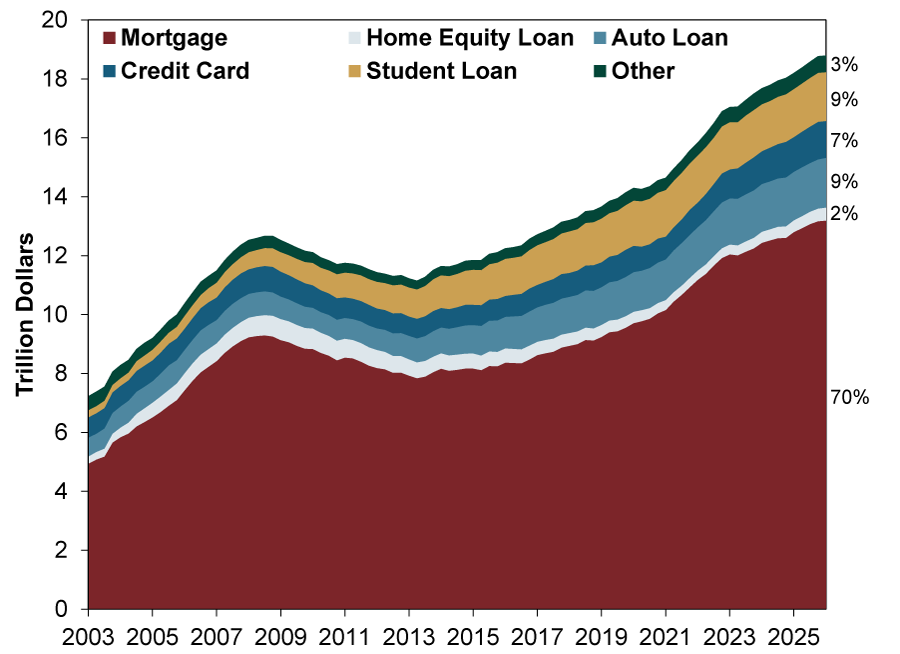
To see why escalating credit card delinquencies aren’t an intractable problem for the economy or markets, it helps to look at how credit cards stack up to total household debt. While a $1.25 trillion national credit card balance may sound unfathomably huge, it is only 7% of what Americans owe—not insignificant, as Exhibit 1 shows, but not bigger than student and auto loans and far smaller than mortgages.
Exhibit 1: Credit Cards Are 7% of Total Household Debt
Source: Federal Reserve Bank of New York, as of 5/12/2026. Quarterly Report on Household Debt and Credit: Total Debt Balance and its Composition, Q1 2003 – Q1 2026.
Then too, when netted against household assets—total, financial or liquid (deposits plus money market funds)—credit card debt is rather miniscule at 0.6%, 0.9% and 6.2%, respectively.[ii] Roll up all Americans’ liabilities and they net out to 11.2%, 15.4% and 104.7%, respectively. That last figure, which shows households’ total liabilities exceeding their liquid assets slightly, might raise some eyebrows. But Exhibit 2 shows how collectively they are in much better shape than two decades ago, when their liabilities were almost twice the amount of cash on hand. This is understandable when you consider, again, that mortgages are the biggest share of credit. The mortgage counts in the numerator, but the house isn’t liquid—and doesn’t count in the denominator.
Exhibit 2: Americans’ Liquid Net Worth Is About Its Best in Three Decades
Source: Federal Reserve Bank of St. Louis, as of 3/19/2026. Households and Nonprofit Organizations Total Liabilities and Deposits Including Money Market Funds, Q1 1945 – Q4 2025.
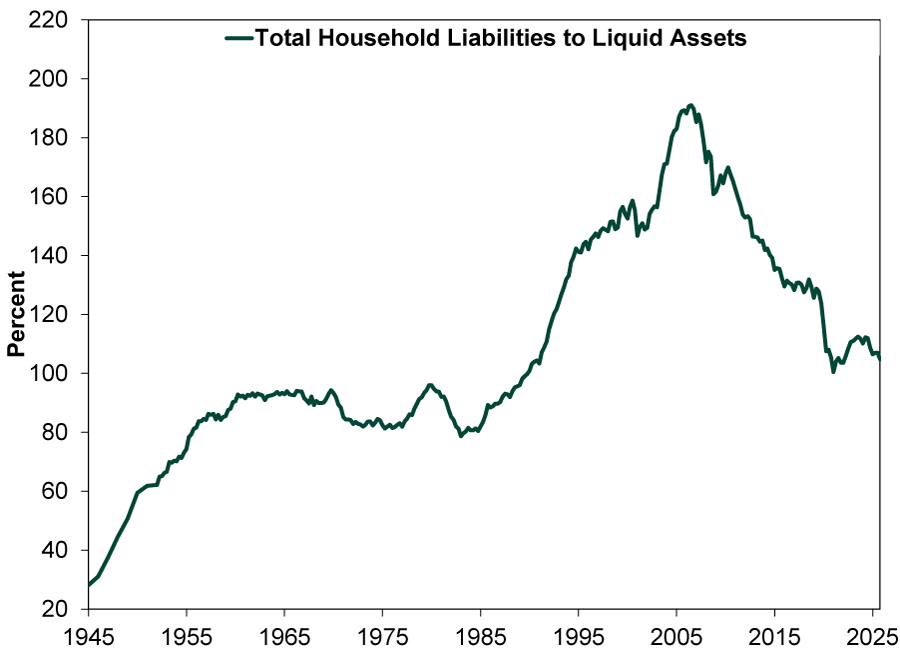
Americans’ liquid net worth is higher than any point prepandemic since the early 1990s. US household finances in aggregate—which markets care about most—are on firm footing. Of course, there is a matching issue: Any particular household’s liquid funds may not cover its liabilities. Rising delinquencies indicate that is indeed the case for some.
So let us dig into the details further. With student and auto loans seeing higher delinquency rates alongside credit cards, just how much are Americans in arrears? As Exhibit 3 shows, the percentage of household debt 90-days delinquent or more is 3.4%, a return to prepandemic levels. Student loans make up the most at 0.9 percentage points of this, followed closely by credit cards. Meanwhile, mortgages are 0.8 percentage points and auto loans half a percentage point.
Exhibit 3: Percentage of Balances at Least 90 Days Delinquent
Source: Federal Reserve Bank of New York, as of 5/12/2026. Quarterly Report on Household Debt and Credit, Q1 2003 – Q1 2026.
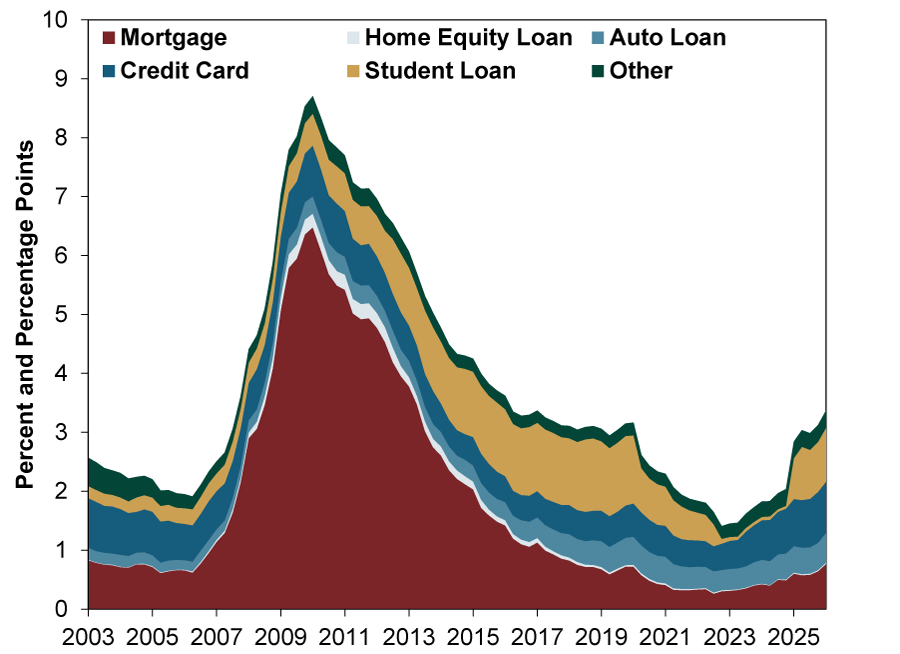
Again, not great, and we don’t dismiss the hardship for those affected. But if 2019 levels (and higher since 2010) weren’t recessionary—or prone to financial crisis—we struggle to see why getting back to that norm would be catastrophic today. Note too, delinquency rates’ apparent 2020 – 2024 reprieve was almost entirely the Biden administration’s moratorium on student loan payments. Their resumption hasn’t resulted in any untoward economic developments we can identify at the macroeconomic level.
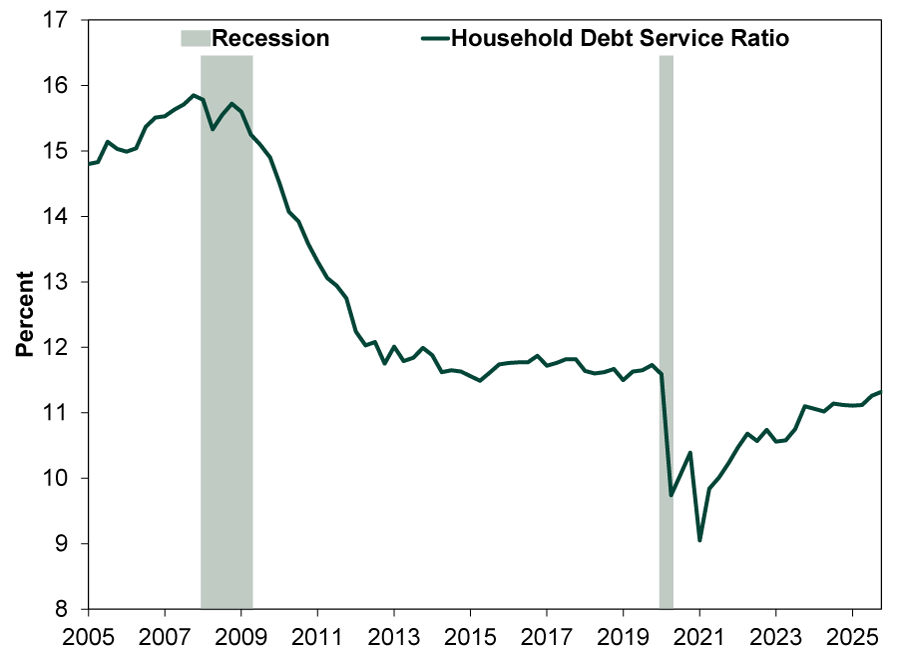
Looking forward, we doubt a household debt catastrophe is forming here. As Exhibit 4 shows, debt service as a percentage of disposable personal income sits below any point prepandemic. Households’ incomes more than cover their debt payments—by a historically high amount. Defaults aren’t about to spike en masse.
Exhibit 4: Households’ Debt Service Load Historically Light
Source: Federal Reserve, as of 3/20/2026. Household Debt Service Ratio, Q1 2005 – Q4 2025.
While specifics will and do vary from household to household, there is little sign of a broad, economy-threatening delinquency crisis forming. The idea of consumers being “tapped out” or “maxed out” is a popular notion today, but that doesn’t mean it is all that accurate.
If you would like to contact the editors responsible for this article, please message MarketMinder directly.
*The content contained in this article represents only the opinions and viewpoints of the Fisher Investments editorial staff.
Get a weekly roundup of our market insights
Sign up for our weekly e-mail newsletter.

You Imagine Your Future. We Help You Get There.
Are you ready to start your journey to a better financial future?

Where Might the Market Go Next?
Confidently tackle the market’s ups and downs with independent research and analysis that tells you where we think stocks are headed—and why.
Related Resources
-
Politics Context for the Noisy Congress to Come2026-10-09
-
Expert Commentary This Week in Review | S&P 500 Record High, Fed Minutes, Spain Election
 2026-10-09
 -
Interesting Market History Notes on a Bear Market Anniversary2026-10-09
-
Economics Checking in on US Consumers2026-10-08



Learn More
Learn why 210,000 clients trust us to manage their money and how Fisher Investments and its affiliates may be able to help you achieve your financial goals.
As of 9/30/2026
New to Fisher? Call Us.
Contact Us Today