


Personal Wealth Management / Market Analysis
Setting the Record Straight: New Fed Chairs Aren’t Auto-Negative
How have stocks really performed under new Fed heads?

Are new Fed heads bad for stocks? If you read coverage of a research report making headlines this week, you might think the answer is yes. Playing a bit fast and loose with a report measuring the S&P 500’s maximum drawdown (don’t worry, we will parse this for you) after a new Fed head takes the reins, headlines gave the impression the research argued new Fed heads triggered selloffs.[i] The report didn’t say this, though. Which is good, because history disagrees with the negativity coverage implied. Let us dive in.
Before we get to what the research report does, we will quickly hit what it doesn’t do: It doesn’t give actual, cumulative S&P 500 returns after a new Fed head takes over.
What is does: It calculates the S&P 500’s biggest peak-to-trough downdraft at any point in the 1, 3, 6 and 12 months after each new Fed head since 1930 took office. So for outgoing Fed head Jerome Powell, for example, Barclays found a -4.0% decline nestled in his first month, a -7.0% decline within the first three months, the same within the first six months, and a nearly -20% move within the first year of his early February 2018 start.[ii] Repeating this across all new Fed heads since daily stock market data start in 1929, it found an average maximum decline of -5.0% during month one, -12.0% in the first three months, -16.0% in the first six and -20.0% in the first year.[iii]
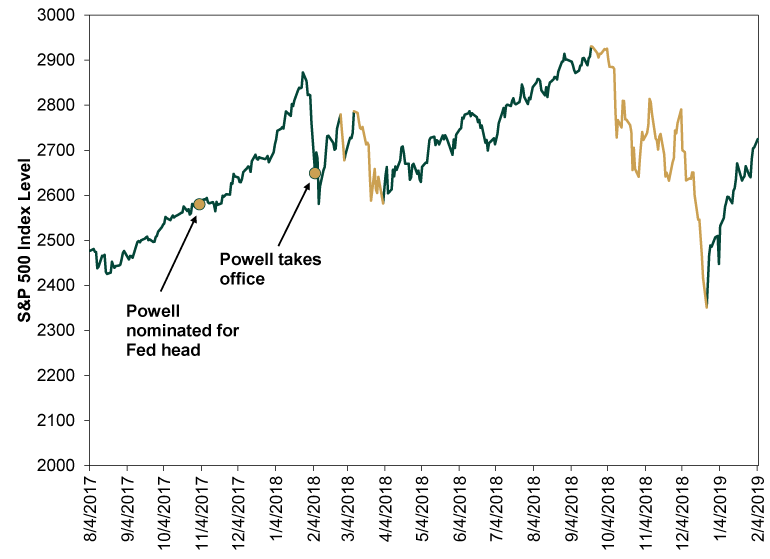
It is all mathematically fine, but it also doesn’t really tell you much. It is basically a fishing expedition. To illustrate this, here is a line graph of the S&P 500 during Powell’s first year. For full context, we start it six months before he sat in the big chair.[iv] The drawdowns identified in the research report are highlighted for your viewing pleasure.
Exhibit 1: The Problem With Fishing for Maximum Drawdowns
Source: FactSet, as of 2/5/2026. S&P 500 price index, 8/4/2017 – 2/4/2019.
See the problem? While stocks fell as Powell took office, that was late in a lightning-fast correction that began earlier. You can’t pin that on Powell, either, considering markets would have pre-priced that when he was nominated the prior November. Returns after his nomination were quite nice. Those downdrafts in the one, three and six-month windows were normal market volatility, the kind you see in any old year. Yes, the Fed was reducing its balance sheet at the time, but that started pre-Powell, lacking the surprise power to hit stocks in 2018 (and it wasn’t even inherently negative, given it allowed long rates more room to rise, which promotes a steeper yield curve—an economic positive).
Oh, and those short blips preceded a big rally that lasted through summer. The steep correction that started in late September was painful, but it wasn’t Fed-related. The culprit then was forced selling by hedge funds, which had to dump assets to meet redemption requests after years of poor performance. It was a whopper but ended as suddenly as it began, leaving the S&P 500 down just -1.3% in Powell’s first year.[v] And again, all this volatility was coincidental to who was Fed head at the time and how new they were at the job.
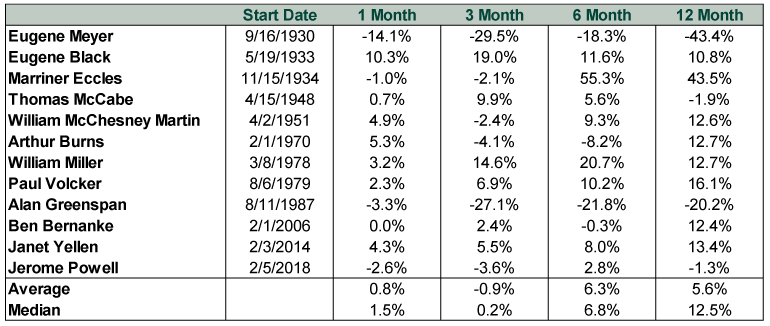
We could conduct a similar exercise for all the Fed heads in the research report, but to save you time and energy, here is a table of the S&P 500’s 1, 3, 6 and 12-month returns from the day each took office. As you will see, the average and median cumulative returns bear little resemblance to the maximum drawdowns in those windows.
Exhibit 2: S&P 500 Returns After New Fed Heads
Source: FactSet, as of 2/4/2026. S&P 500 price returns in the 1, 3, 6 and 12 months from market close before the new Fed head’s start date.
Now, we will concede that there are some big negative numbers in here, and we don’t think you can give a uniform “not guilty” verdict for all these Fed folks. Yes, Eugene Meyer had the misfortune of becoming Fed head after the Great Depression was underway, but he oversaw the continued deep contraction in money supply. Arthur Burns was an accomplice of the Nixon administration’s price and interest rate controls, which contributed directly to a bear market. But some of it is pure coincidence. Alan Greenspan might have the worst timing ever, taking the reins two weeks before late-1987’s bear market started. But he didn’t cause Black Monday.
Another problem: Looking only at the first year doesn’t tell you whether any of these guys or gal committed monetary policy errors. Many of them did, but outside this early sample size. Ben Bernanke had been in office for two and a half years when he failed to fulfill the Fed’s role as lender of last resort during the global financial crisis and panicked markets with a haphazard approach as financial institutions ran out of liquidity. Powell was two years in when the Fed spiked the money supply during COVID lockdowns, leading to 2022’s hot inflation. And as beneficial as Paul Volcker’s monetary medicine was as he sought to tame the late 1970s’ runaway inflation, a bear market did start a little over a year into his tenure, and one could argue fairly that rapid monetary tightening played a role.
Returns after new Fed heads are trivia, whether you calculate maximum drawdowns or consistent point-to-point moves. But the point remains: There is nothing inherently negative for stocks about a new Fed head taking over.
Now, the present situation, of course, bears monitoring, as we noted here in coverage last Friday. But presuming negativity is assured because a new Fed chair is incoming is a bias—and bias is dangerous in investing.
If you would like to contact the editors responsible for this article, please message MarketMinder directly.
*The content contained in this article represents only the opinions and viewpoints of the Fisher Investments editorial staff.
Get a weekly roundup of our market insights
Sign up for our weekly e-mail newsletter.

You Imagine Your Future. We Help You Get There.
Are you ready to start your journey to a better financial future?
Where Might the Market Go Next?
Confidently tackle the market’s ups and downs with independent research and analysis that tells you where we think stocks are headed—and why.
Related Resources
-
Politics Two Elections in the Americas—and Spain’s Coming Snap Vote2026-10-06
-
Weekly Wrap-Up Fisher Investments Reviews: Last Week in Markets — September 28 - October 22026-10-05
-
Market Analysis Budgeting for French Debt Fears2026-10-05
-
Expert Commentary This Week in Review | Q3 Recap, US Jobs, US-China Trade
 2026-10-02




Learn More
Learn why 210,000 clients trust us to manage their money and how Fisher Investments and its affiliates may be able to help you achieve your financial goals.
As of 9/30/2026
New to Fisher? Call Us.
Contact Us Today