


Personal Wealth Management / Market Analysis
Why Rising Japanese Bond Yields Aren’t Bearish
Global stocks have climbed alongside normalizing JGB yields.

Japanese government bond (JGB) yields have jumped lately, and with them, fears they will pull the rug out from under global markets are rising. To hear bears tell it, higher JGB yields risk reversing a supposed source of cheap borrowing that has pumped up world stocks. But we think a closer look reveals this to be a false fear.
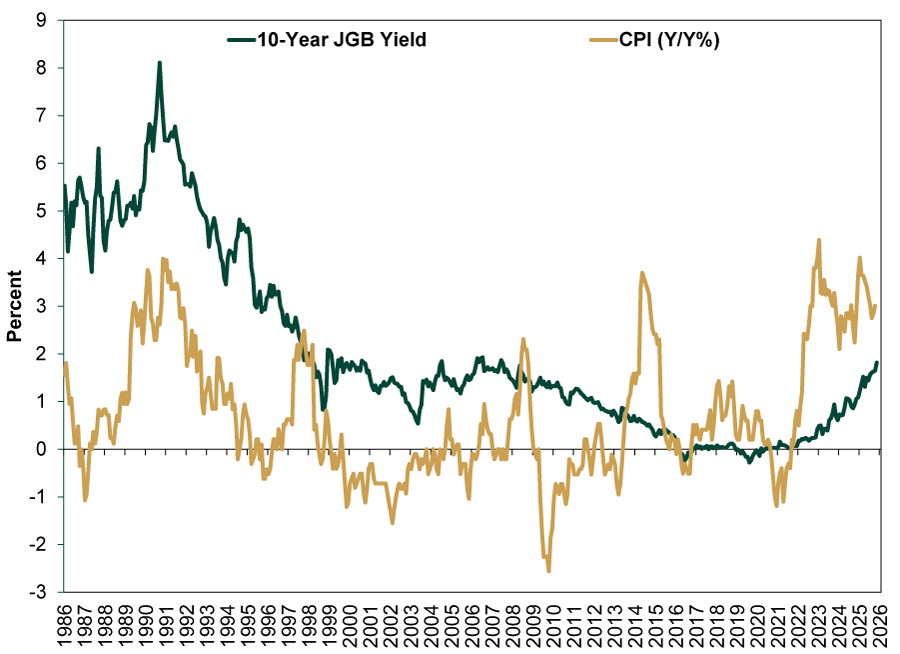
As Exhibit 1 shows, 10-year JGB yields are hitting 19-year highs, almost doubling from 1.1% at 2025’s start to just under 2.0% today. Now, higher yields in and of themselves make sense: Inflation—and expectations for it—are bond yields’ main driver, and those have climbed in Japan. Inflation erodes currencies’ purchasing power, so when it is expected to rise, yields on fixed-income instruments typically also climb to compensate. This explains the uptick, helped along by the Bank of Japan normalizing policy and gradually reducing its long-term JGB purchases as yield curve control ends. Inflation’s rise mostly looks like normalization, too—not anything to be overly concerned with.
Exhibit 1: 10-Year JGB Yields and Japan CPI
Source: FactSet, as of 12/11/2025. 10-year JGB yields, January 1986 – November 2025, and Japan CPI, January 1986 – October 2025.
But when yields rise swiftly, in Japan or elsewhere, headlines usually shift into overdrive, proclaiming their bearishness. In Japan, fearful headlines fixate on its gross debt-to-GDP ratio, which exceeds 200%—the highest in the developed world. Couple that with fears over fiscal profligacy from new Prime Minister Sanae Takaichi, and they fan rumors the infamous “bond vigilantes” will force a reckoning, the alleged reason why yields are rising. Rising yields, in turn, fan fears the long-touted yen carry trade will unwind. For the unfamiliar, a carry trade is when global investors borrow cheaply in one nation and plow funds into higher-yielding assets elsewhere. Today, many presume this is propping up global markets.
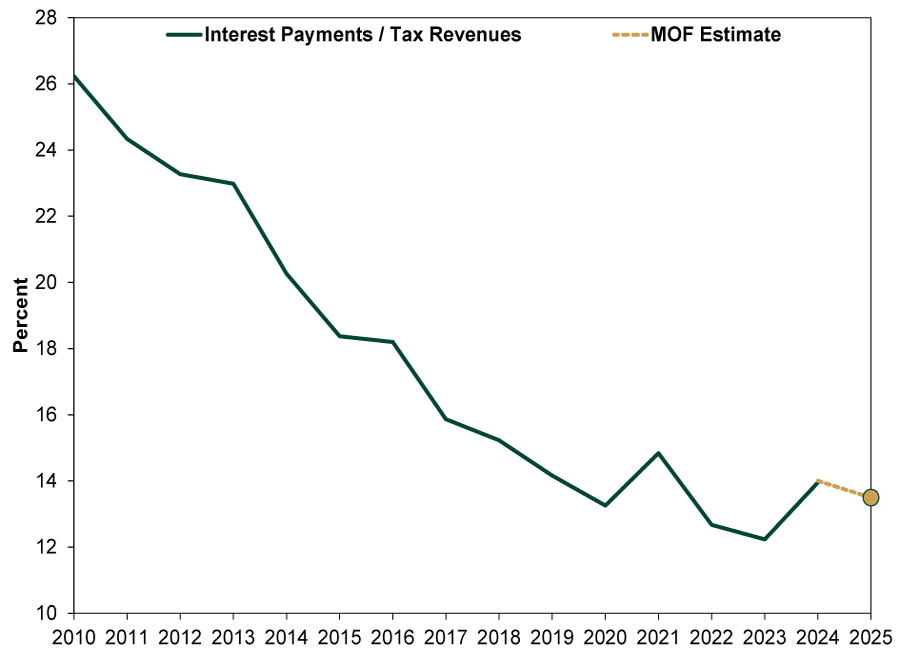
As always, though, when confronted with such claims, investors should ask themselves: Do they pass muster? A cursory inspection finds them easy to debunk. First, debt-to-GDP isn’t a very useful way to measure the presumed burden of Japan’s bond mountain. JGB investors aren’t paid with GDP, but out of government tax revenue. Japan’s debt service (or interest coverage) ratio provides a much better indication of its ability to meet its financial obligations by pairing them with incoming receipts. Exhibit 2 shows debt service remains historically low.
Exhibit 2: Japan’s Debt Service Isn’t Historically Onerous
Source: FactSet and Japan’s Ministry of Finance (MOF), as of 12/11/2025.
This is why JGB investors, the most sensitive to potential default risks, continue to view Japanese credit as rock solid, one reason Japan’s 10-year yields are the developed world’s second lowest, trailing only Switzerland’s. As for Japan’s seemingly newfound appetite for government spending, we don’t see Takaichi’s fiscal policy as some big bullish positive. We agree with the criticisms pointing out decades of fiscal stimulus in Japan didn’t create lasting growth. But it probably won’t break the bank, either.
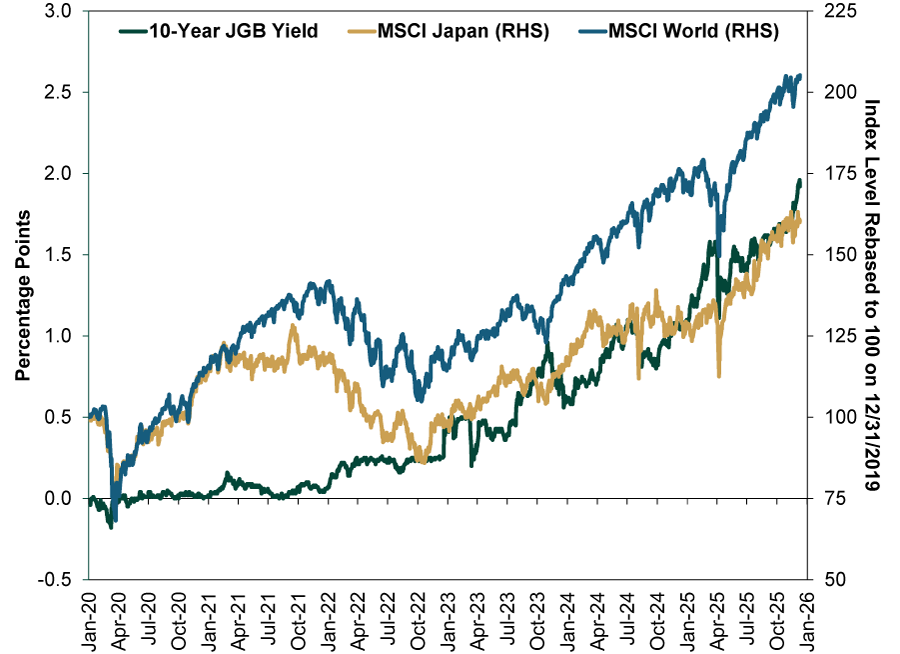
Meanwhile, Japanese and global stocks are rising in concert with long rates—once again debunking fears otherwise. Year to date, the MSCI Japan Index is up 24.1% in yen (24.6% in dollars), while the MSCI World Index, the developed world benchmark, has risen 20.9%.[i] Rising JGB yields are manifestly not tanking stocks in Japan or globally. Nor is this a new development, as Exhibit 3 illustrates. They have been rising together for basically the last three years.
Exhibit 3: Japanese Yields and Stocks Rising Together for Years
Source: FactSet, as of 12/11/2025. 10-year JGB yield, MSCI Japan returns with gross dividends and MSCI World returns with net dividends, 12/31/2019 – 12/10/2025.
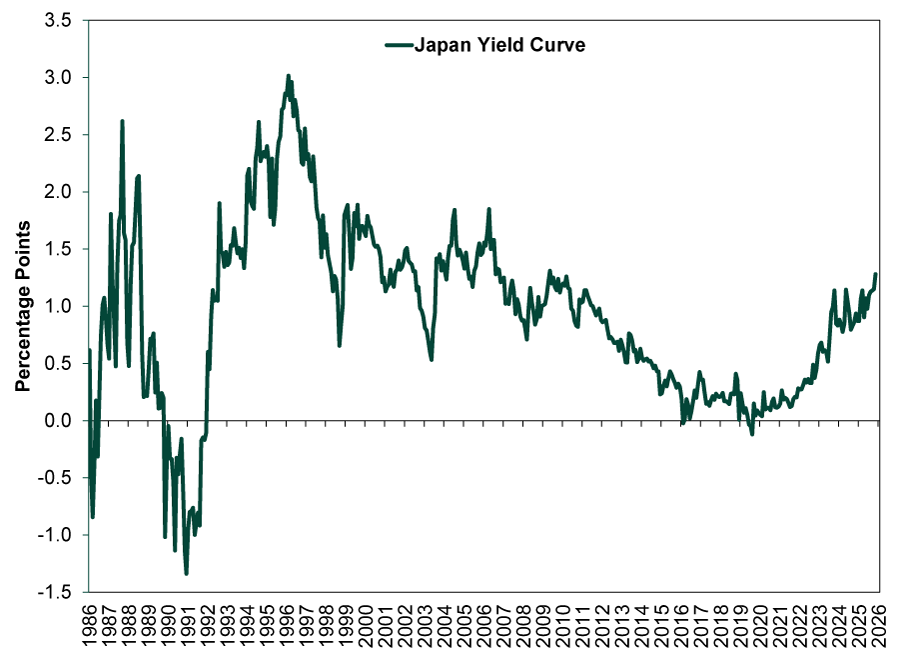
For investors, we see the fear over rising JGB yields as another case of the crowd viewing positives as negatives. Exhibit 4 shows how higher yields steepen Japan’s yield curve—the range of rates from shorter to longer maturities. This is helping boost Japanese lending, as banks’ business model is to borrow short and lend long, pocketing the difference. A higher spread between short- and long-term interest rates incentivizes them to extend credit. Total bank loans rose 4.5% y/y in November, their fastest growth rate in at least 25 years (outside emergency pandemic lending).[ii] And since more credit supports economic activity—helping fuel consumption and investment—it is brightening Japan’s growth prospects.
Exhibit 4: Japan’s Yield Curve Steepest Since 2006
Source: FactSet and Finaeon, Inc., as of 12/11/2025. 10-year minus 3-month JGB yields, January 1986 – November 2025.
So, all in all, we think worry over rising JGB yields is misplaced. We see it as a classic false fear, nothing to fret, but cheer.
If you would like to contact the editors responsible for this article, please message MarketMinder directly.
*The content contained in this article represents only the opinions and viewpoints of the Fisher Investments editorial staff.
Get a weekly roundup of our market insights
Sign up for our weekly e-mail newsletter.

You Imagine Your Future. We Help You Get There.
Are you ready to start your journey to a better financial future?

Where Might the Market Go Next?
Confidently tackle the market’s ups and downs with independent research and analysis that tells you where we think stocks are headed—and why.
Related Resources
-
Weekly Wrap-Up Fisher Investments Reviews: Last Week in Markets — September 28 - October 22026-10-05
-
Market Analysis Budgeting for French Debt Fears2026-10-05
-
Expert Commentary This Week in Review | Q3 Recap, US Jobs, US-China Trade
 2026-10-02
 -
Market Analysis Reader Mailbag: September 20262026-09-30




Learn More
Learn why 210,000 clients trust us to manage their money and how Fisher Investments and its affiliates may be able to help you achieve your financial goals.
As of 9/30/2026
New to Fisher? Call Us.
Contact Us Today