


Personal Wealth Management / Economics
Giving Credit to the Global Economy
Defying gloom, the world economy is in a credit upswing.

In all the talk lately from commentators we follow about an allegedly weak global economy, we see a common thread: It largely focusses on lagging indicators. What already happened. Oddly, in our view, few seem to be looking at inputs to future growth, and amongst the biggest and most essential: credit, the lifeblood of the economy. On that score, we find supply is flowing liberally to households and businesses eager to spend and invest, greasing the gears of commerce globally. We think this bodes well for stocks worldwide.
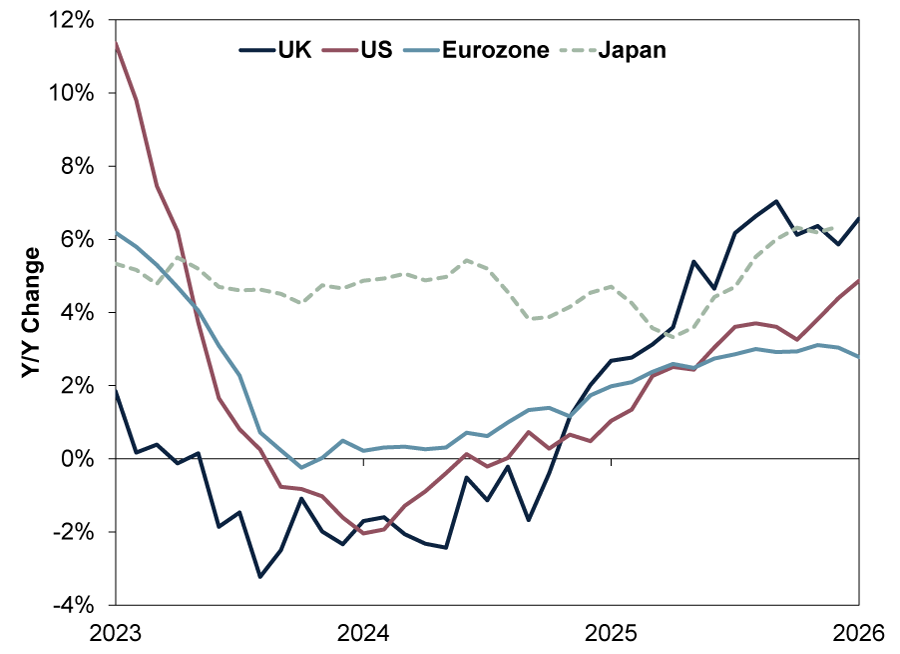
Largely overlooked amidst the current uproar in financial news we read (war/geopolitical risks, trade uncertainty, AI disruption, etc.): Loan growth is accelerating across the developed world.[i] As Exhibits 1 and 2 show, banks in the UK, US, eurozone and Japan are lending at their fastest rates in a few years. Whether to households or businesses, the pickup in loan issuance belies widespread warnings we have seen in publications we follow that they are retrenching. Sentiment may seem sour, but credit trends suggest to us a lot of room for positive surprise.
Exhibit 1: Total Lending Is Picking Up Worldwide
Source: Bank of England, Federal Reserve Bank of St. Louis, European Central Bank and FactSet, as of 3/3/2026. UK resident monetary financial institutions’ sterling net lending to private sector excluding intermediate other financial corporations, loans and leases in all US commercial bank credit, eurozone loans to the private sector adjusted for transfers and notional cash pooling and Japan outstanding loans and discounts of major, regional and Shinkin banks, January 2023 – January 2026.
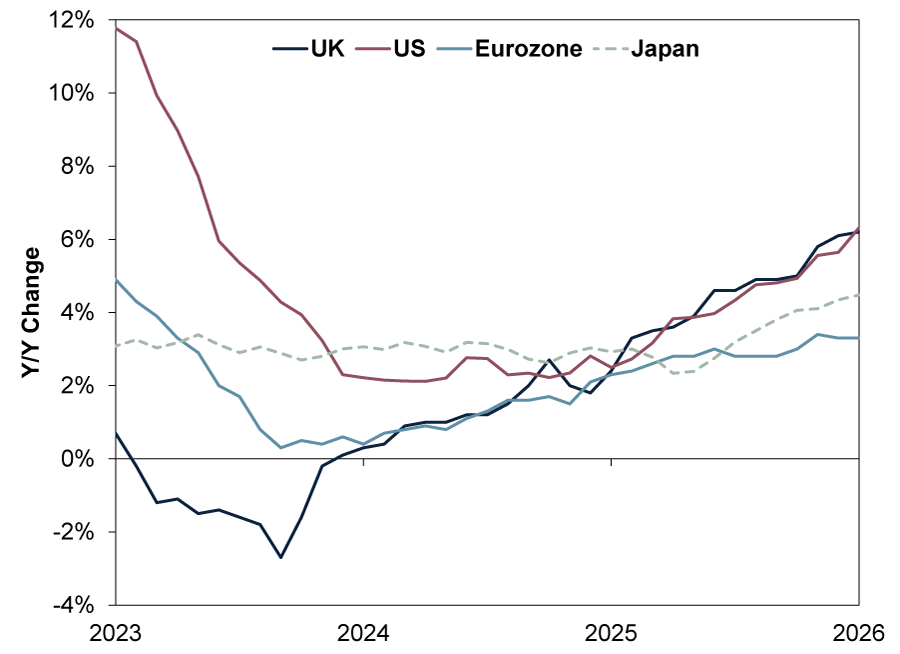
Exhibit 2: Business Lending Is Picking Up Worldwide
Source: Macrobond, as of 3/3/2026. Commercial & Industrial loan growth, January 2023 – January 2026. US C&I loan growth adjusted to remove one-time effects from US Federal Reserve loan category reclassifications.
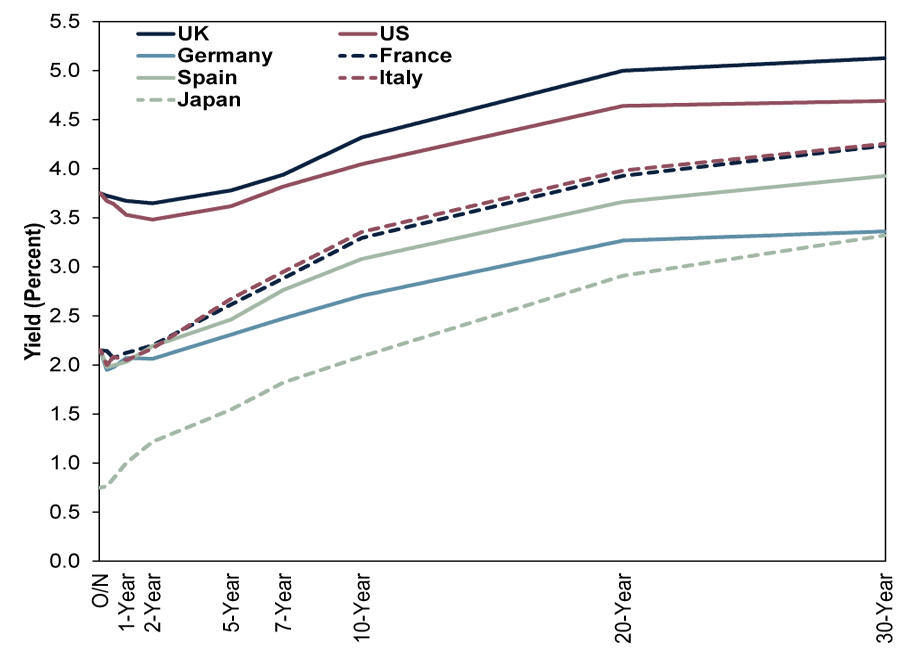
Banks appear to us more than willing to keep the spigots open to supply borrowers. As Exhibit 3 shows, developed world yield curves are upward sloping—long-term interest rates are comfortably above those for short-term maturities. Because banks fund loans at the short end and lend at the long, these steep yield curves mean new credit they extend likely earns them more profit, according to our analysis. We find that is a strong incentive for banks to lend, and as such, loan growth looks likely to continue for the foreseeable future. Based on American and European Q1 bank surveys, both demand for commercial loans and banks’ willingness to supply them are improving.[ii]
Exhibit 3: Selected Global Yield Curves
Source: FactSet, as of 3/3/2026.
Of course, we don’t think lending is the only way businesses get funding, especially in America. Happily, US corporate bond issuance is also strong, as investment-grade borrowing hit $208.4 billion in January, 12% higher than a year ago, and only the sixth time in history the monthly level exceeded $200 billion.[iii] That was with credit spreads—a measure of default risk—the tightest they have been this century.[iv] Investment-grade borrowers are having no trouble finding financing, and bond markets—amongst the most sensitive to potential trouble—show few signs of it based on our observations.
Nor do we find this just a US phenomenon. Global bond issuance surpassed $1 trillion this year at record pace, with euro-denominated offerings particularly active.[v] Such funding provides further fuel for their future endeavours—and earnings—in our experience, as companies don’t just borrow for no reason. We think it likely funds investment and growth, which they wouldn’t undertake if they didn’t view it as profitable.
Why does this support stocks? Our research shows markets are forward-looking, and faster lending suggests burgeoning economic activity. We think quicker loan growth is particularly noteworthy in Europe, where businesses rely more on bank financing than in America.[vi] European economic sentiment remains stuck in neutral.[vii] Yet faster lending has helped manufacturing purchasing managers’ indexes there recently flip back above 50—signalling expansion—alongside their dominant services sectors.[viii]
Around the world, we find credit markets are humming. That highlights to us how, looking ahead, growth likely extends, which undercuts so many warnings we see swirling endlessly through the press. And with reality set to continue overtaking expectations, in our view, we remain bullish.
[i] Source: Bank of England, Federal Reserve Bank of St. Louis, European Central Bank and FactSet, as of 3/3/2026. Statement based on UK resident monetary financial institutions’ sterling net lending to private sector excluding intermediate other financial corporations, loans and leases in all US commercial bank credit, eurozone loans to the private sector adjusted for transfers and notional cash pooling and Japan outstanding loans and discounts of major, regional and Shinkin banks, January 2023 – January 2026.
[ii] “The January 2026 Senior Loan Officer Opinion Survey on Bank Lending Practices,” Staff, US Federal Reserve, 2/2/2026. “January 2026 Euro Area Bank Lending Survey,” Staff, ECB, 3/2/2026.
[iii] “US High-Grade Bond Sales Top $200 Billion in Record Yearly Start,” Ying Luthra and Kevin Kingsbury, Bloomberg, 29/1/2026. Accessed via Financial Advisor Magazine.
[iv] Ibid.
[v] “Global Bond Sales Reach $1 Trillion at Their Fastest Pace Ever,” Kevin Kingsbury, Bloomberg, 2/2/2026. Accessed via The Business Times.
[vi] “International Bank Lending and Corporate Debt Structure,” Jose-Maria Serena and Serafeim Tsoukas, Bank for International Settlements, April 2020.
[vii] “Economic Sentiment and Employment Expectations Down in the EU and the Euro Area,” Staff, European Commission, 26/2/2026.
[viii] Source: S&P Global, as of 3/3/2026.
Get a weekly roundup of our market insights.
Sign up for our weekly e-mail newsletter.

You Imagine Your Future. We Help You Get There.
Are you ready to start your journey to a better financial future?

Markets Are Always Changing—What Can You Do About It?
Get tips for enhancing your strategy, advice for buying and selling and see where we think the market is headed next.
Related Resources
-
Macro Insights Brazil Review & Outlook2026-06-04
-
Market Analysis Global Bond Calamity Calls for Calm Perspective2026-05-27
-
Economics A May Global Economic Check-In2026-05-26
-
Macro Insights Macro Insights Q2 20262026-05-22




Contact Us
Learn why 200,000 clients trust Fisher Investments and its affiliates to manage their money and find out how we may be able to help you achieve your financial goals.
As of 31/03/2026. Includes Fisher Investments and its affiliates.
New to Fisher? Call Us.
Contact Us Today