


Personal Wealth Management / Market Analysis
What to Think of Another Aussie Rate Hike
Beware of monetary policymakers hiking for unwise reasons.

Whilst the US Federal Reserve, Bank of England (BoE) and European Central Bank (ECB) all held their benchmark interest rates last week, one monetary policy institution continues bucking the trend: The Reserve Bank of Australia (RBA) hiked for the third straight time Tuesday, bringing the Cash Rate to 4.35%.[i] Whilst we doubt this is a major economic headwind or bad news for stock markets, we see flaws in the RBA’s thinking that are worth exploring. Understand them, and we think you will be able to better assess the risks of errors elsewhere.
In its policy statement, the RBA noted higher fuel prices’ effects on inflation and warned the effects could trickle through inflation measures over the next several months as businesses passed their higher costs to customers.[ii] RBA Governor Michele Bullock elaborated in her post-meeting press conference, saying that, whilst policymakers are “looking through” pricey energy’s immediate effects, their analysis of downstream implications led them to act: “We’re already seeing that many firms are facing cost pressures, they’re looking to increase prices of their goods and services. If left unchecked, higher costs get embedded into price and wage setting decisions. These second round effects could lead to even higher, and persistent inflation. If so, that would require even more tightening and monetary policy to get inflation under control.”[iii]
So where do we see a problem? We think this logic ignores how inflation actually works, which is an error we see repeated globally. The RBA is acting now, but in reviewing past commentary from the Fed, BoE and ECB, we have noted all displaying this line of thinking. They seemingly disregard the old wisdom that inflation is always and everywhere a monetary phenomenon, as Nobel prizewinning economist Milton Friedman taught: too much money chasing too few goods and services. Our research finds that unless money supply grows at a rapid clip, businesses generally struggle to pass higher costs to consumers. They will probably find they lack pricing power, especially if households are trying to manage their own energy cost increases. When people cut discretionary budgets to cover pricier petrol and utilities, it logically saps demand for other goods and services, pressuring prices. We find rapid money supply growth is what gives businesses pricing power.
There is a potential risk here: If monetary policymakers tighten aggressively for what this monetary framework would hold are the wrong reasons, focussing on energy prices and wages—and ignoring money supply growth—they can end up needlessly inducing a recession.[iv]
Happily, we don’t think Australia is there today. Its broadest money supply measure, M3, grew 8.3% y/y in March.[v] Whilst that is fast relative to money supply growth rates in the US, UK and eurozone, it isn’t rapid by Australian standards.[vi] (Exhibit 1) Since 1960, Australia’s median M3 growth rate is 8.6% y/y, rendering today’s rate quite average.[vii] Historically, this pace has been fast enough to enable steady economic growth without igniting hot inflation.[viii]
Exhibit 1: A Long Look at Aussie Money Supply Growth
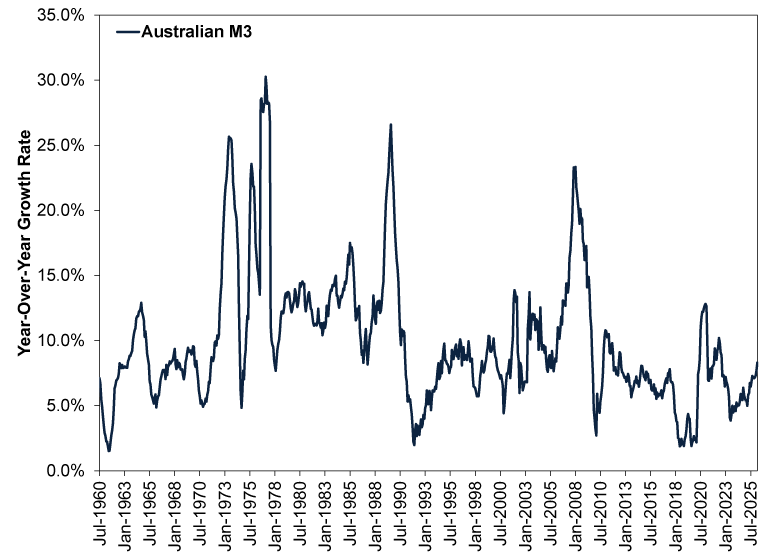
Source: RBA, as of 5/5/2026. Year-over-year M3 money supply growth rate, July 1960 – March 2026.
But our research finds monetary policy moves hit the economy at a lag, somewhere around 6 to 18 months. Bullock said today she wouldn’t expect rate hikes to start showing up in Australian economic data for at least half a year.[ix] So we think the real question is whether rate hikes thus far are going to choke off this money supply growth to a worrying extent. To assess this, we can check in with our old friend, the yield curve.
This curve, which plots government bond rates from short to long, is a good gauge of banks’ future lending, according to our research. Banks’ traditional business model is to borrow at short rates and lend at long rates, which we think makes the spread a proxy for their profit margin on new loans. This gets a little complicated in Australia, where most mortgages are floating-rate and based on the Cash Rate, but we find the logic generally holds for business loans, which influence business investment—a major economic swing factor, according to our research. So in general, when the yield curve is steep, with long rates well above short, we think you get more lending and economic growth. Flat curves raise the risk of slow growth, whilst we find inverted curves with short rates above long tend to signal a looming credit crunch and potentially recession.
The RBA’s hikes have flattened the yield curve, but not to a degree we find worrisome. (Exhibit 2) Mostly, they just undo a spate of late-2025 steepening, leaving the yield curve spread about where it was last summer and autumn … or in southern hemisphere terms, last winter and spring. That was a fine time for the Aussie economy and markets.[x]
Exhibit 2: A Year in the Life of Australia’s Yield Curve
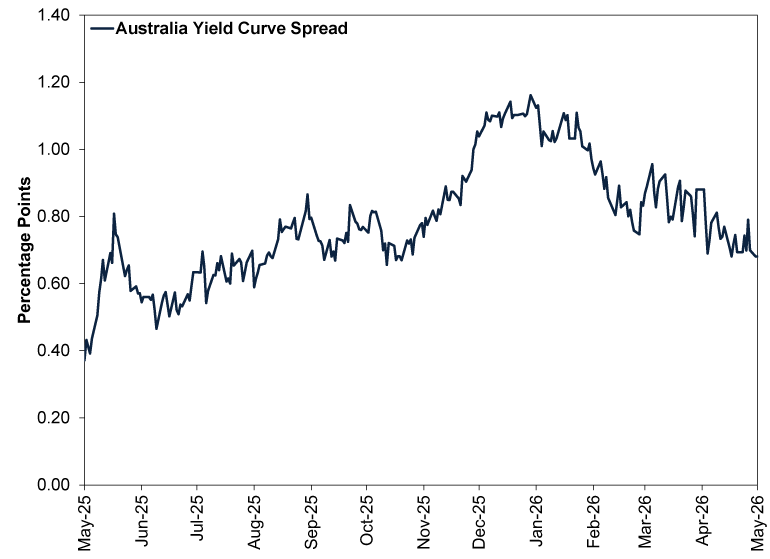
Source: FactSet, as of 5/5/2026. Spread between Australian benchmark 3-month and 10-year Treasury yields, 5/5/2025 – 5/5/2026.
We think the real danger would arrive if monetary policymakers globally overreacted and inverted their yield curves, taking the global yield curve with them. That doesn’t appear to be at hand now. Even with Australia’s curve flattening this year, the global curve has still steepened over the last six months.[xi] The RBA is an outlier.
Will it remain an outlier? We think no one can know now, because no monetary policymaker is predictable. We can look at market expectations using futures markets, but those aren’t airtight. We can look at policymakers’ commentary, but that would have led you vastly astray in 2022. Monetary policymakers’ decisions aren’t a market function. They are a human function, based on each voting member’s biases, opinions and forecasts. Those opinions and forecasts often change with incoming data. Whilst monetary policymakers (including Bullock) sometimes try to set expectations, they can change their mind. The Fed, ECB and BoE did in 2022, U-turning quickly from a view that inflation would be temporary to enacting steep, swift rate hikes.[xii]
So we suggest watching and waiting. Weigh what policymakers do, and if they start taking a proverbial mallet to the yield curve, watch sentiment carefully to see if people are dismissing the risks.
[i] Source: FactSet, as of 5/5/2026.
[ii] Source: RBA, as of 5/5/2026. Inflation refers to rising goods and services prices across the broad economy.
[iii] “A Sombre RBA Governor Michele Bullock Laments ‘Real Income Shock for Australia,’” Nick Whighman, Yahoo Finance Australia, 5/5/2026.
[iv] A recession is a broad decline in economic output, typically lasting several months or more.
[v] Source: RBA, as of 5/5/2026.
[vi] Source: FactSet, BoE and ECB, as of 5/5/2026.
[vii] Source: RBA, as of 5/5/2026.
[viii] Source: FactSet, as of 5/5/2026. Statement based on Australian gross domestic product and consumer price index inflation. Gross domestic product (GDP) is a government-produced output measure.
[ix] “RBA Interest Rates: Michele Bullock Says Australians Are Poorer With ‘No Way Out’ as She Warns of More Rate Hikes,” Patrick Commins and Luca Ittimani, The Guardian, 5/5/2026.
[x] Source: FactSet, as of 5/5/2026. Statement based on Australian GDP and the MSCI Australia Index return in GBP with net dividends.
[xi] Source: FactSet, as of 5/5/2026. Statement based on an aggregation of MSCI World Index constituent countries’ yield curves weighted according to their GDP.
[xii] Source: Fed, BoE and ECB, as of 5/5/2026.
Get a weekly roundup of our market insights.
Sign up for our weekly e-mail newsletter.

You Imagine Your Future. We Help You Get There.
Are you ready to start your journey to a better financial future?

Markets Are Always Changing—What Can You Do About It?
Get tips for enhancing your strategy, advice for buying and selling and see where we think the market is headed next.
Related Resources
-
Market Analysis Budgeting for French Debt Fears2026-10-06
-
Economics A World Trade Check-In Starring Southeast Asia2026-09-30
-
Politics A September European Political Update2026-09-24
-
Macro Insights Where the Manufacturing Cycle Goes From Here2026-09-23




Contact Us
Learn why 210,000 clients trust Fisher Investments and its affiliates to manage their money and find out how we may be able to help you achieve your financial goals.
As of 30/09/2026. Includes Fisher Investments and its affiliates.
New to Fisher? Call Us.
Contact Us Today