


Personal Wealth Management / Politics
A Market-Orientated Perspective on the UK’s Political Ructions and Q1 Economic Results
Inside the UK’s leadership dust-up, Q1 gross domestic product and bond market wiggles.

Editors’ Note: MarketMinder UK is politically agnostic. We prefer no politician nor any party and assess developments for their economic and political implications only.
UK Health Secretary Wes Streeting resigned Thursday morning, likely teeing up a Labour Party leadership contest that may oust Prime Minister Keir Starmer. And it happened in the shadow of a bustling Q1 gross domestic product (GDP, a government-produced output measure) report, with many commentators we follow scrutinising bond yields’ wiggles. As political analysts parse potential challengers and rank them according to their perceived bond market friendliness, we have a helpful reminder based on our research: Volatility is normal, and we think markets (stocks and bonds) price political change much faster than many investors presume. We suggest looking past headlines and wiggles and looking longer-term as we find markets do.
For now, nothing much has changed as we write (perhaps things will have evolved as you read this). Starmer remains in office, and no one has yet filed an official leadership challenge. The main development? Greater Manchester Mayor Andy Burnham is set to contest a by-election in Makerfield on 18 June, which could return him as an MP and render him eligible to stand for party leadership.[i] Whilst this is historically considered a safe Labour seat, Reform UK swept the constituency’s eight wards at last week’s local elections, perhaps complicating matters.[ii] In our experience assessing election campaigns, these things tend to come down to candidates’ individual strengths and the quality of campaign they run, which we find are unknowable in advance. In our opinion, this is a wild card with no clear outcome in advance. For markets we think it amounts to uncertainty, but clarity will arrive gradually.
So Starmer clings on, as does Chancellor of the Exchequer Rachel Reeves, which is where Thursday’s Q1 GDP report enters the fray. And we think it was … good! GDP grew 2.5% annualised, the fastest since Q2 2024.[iii] Household spending accelerated from 0.5% annualised in Q4 2025 to 2.6%, whilst business investment rebounded from Q4’s agonising -11.1% drop with 2.9% growth.[iv] Budget uncertainty perhaps delayed risk taking in Q4, but it seems that once they knew the lay of the land, businesses and consumers got on with things.
Some commentators and analysts we follow called faster growth a statistical anomaly, warning it is an artefact of seasonal adjustments and maybe not quite real.[v] Reeves, whose job may also be in jeopardy if Starmer leaves office, called the strong results evidence the economy is on the right track and declared that in her opinion a leadership change would put the economy at risk by “plunging the country into chaos when there is conflict in the world, but also at a time when our plan to grow the economy is starting to bear fruit.”[vi] Most coverage we reviewed called faster growth the last gasp before new leadership inevitably lurches policy to the left, inviting a debt crisis as bond yields soar.
We find all of these views overwrought. Yes, some seasonal adjustment is probably at work, given the UK’s recent history of quarterly GDP fizzling after strong Q1s.[vii] We observed COVID lockdowns and reopenings seemingly skewing this around the developed world. But we think there is also merit to the viewpoint that households and businesses sat tight in Q4, waiting to see how the Budget (released in late November) would alter taxes and investment incentives, then deployed pent-up demand in Q1. We think monthly GDP numbers back that up, with March particularly strong in manufacturing especially.[viii] That echoes what purchasing managers’ indexes showed worldwide as well as in Britain.[ix] It also meshes with US GDP, which showed surging imports as businesses’ pre-tariff stockpiles ran out and the possibility of disruptions from the Iran war seemingly inspired the world to stock up ahead of feared supply chain chaos.[x]
Which shows a phenomenon we have long observed: Global factors often swamp local. The developed world frequently has pockets of weakness and strength, but we find the strong generally carry the weak along during an overall expansion. Whether the UK is carrying or being carried may be up for debate, but growth looks real to us, and given the UK’s interconnectedness with its trading partners, we doubt it is so fragile that a new leader some analysts deem anti-growth can disrupt it. Consider that as Labour’s factions split further apart over economic and social policy, it likely promotes political gridlock. Some measures may stall amidst intraparty opposition, whilst others may get sanded down in order to win broad support.
We think global matters for bond markets, too. Whilst UK yields spiked this month, this looks like sentiment to us—not a sea change in market fundamentals.[xi] Reading into the wiggles seems to us like an exercise in futility. Yields jumped Wednesday as Streeting’s resignation plans hit headlines and fell Thursday as the rumours turned to facts.[xii] But nothing has changed, and not just because Starmer clings on for now. Rather: In our opinion, based on our analysis of official fiscal data, the UK doesn’t have a debt problem. Debt service costs remain manageable at just 8.7% of tax revenue in the 12 months through April, cheaper than America’s load.[xiii] Some commentators we follow say this is a mirage since the UK has more inflation-linked debt, but inflation-linked bonds actually subtracted from the interest burden in March despite faster inflation then.[xiv]
Exhibit 1: The UK’s Cheap Debt Load
Source: Office for National Statistics, as of 14/5/2026. Rolling 12-month interest and tax revenues, March 1998 – March 2026.
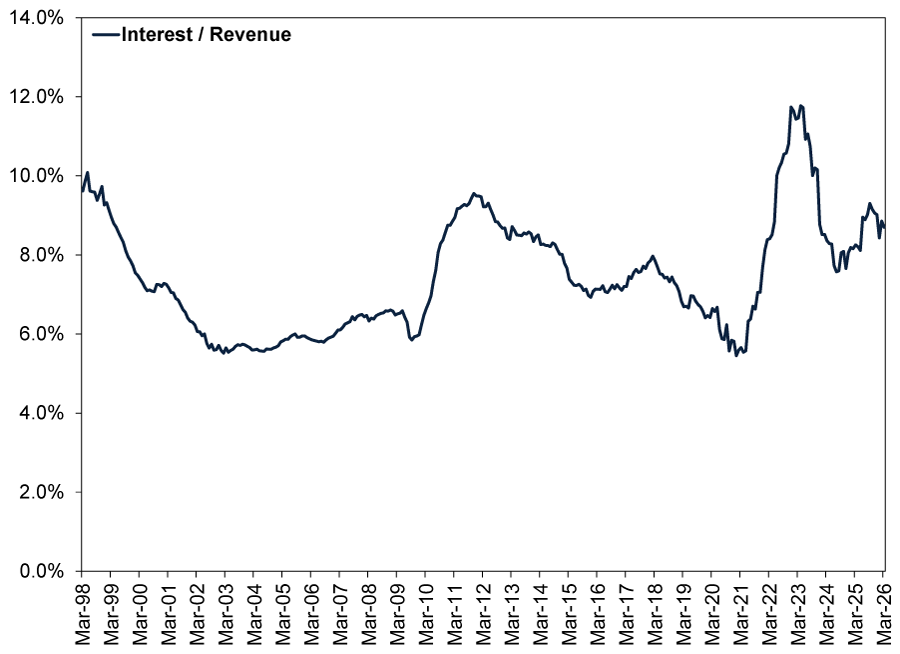
We don’t think UK debt affordability hinges on the residents of Nos. 10 and 11 Downing Street. Regardless of who is prime minister and chancellor, UK debt issuance is bound by statutory fiscal rules, which Parliament appears to us to be too fractured to change. We think that makes refinancing maturing debt the swing factor, and the UK’s average debt maturity is 13.64 years.[xv] Hence, short-term yield swings are largely irrelevant to financing costs in the timeframe our research finds markets care most about, the next 3 – 30 months. And we strongly doubt the updrift in very long rates over the past few weeks lasts long.
Our research finds stock and bond markets move on the gap between reality and expectations. Both can be volatile in the short term as sentiment swings. But longer term they weigh fundamentals. The more fear is baked into prices today, the more positive surprise power we think there is for that 3 – 30-month window. If headlines and their tone are any indication, UK stocks and bonds have likely priced a lot of fear. All the worst-case scenarios politically and economically have swirled for months, likely sapping negative surprise power from here. There appears to be a big wall of worry. We suggest focussing there, not on daily moves.
[i] “Labour’s NEC Approves Burnham’s Byelection Pathway Back to Parliament,” Ben Quinn and Peter Walker, The Guardian, 15/5/2026. “Andy Burnham Will Push to Become PM Before Labour Conference, Allies Say,” Rowena Mason, Jessica Elgot and Pippa Crerar, The Guardian, 15/5/2026.
[ii] “Andy Burnham Has Path to Challenge PM but Must Win Byelection First,” Pippa Crerar, Kiran Stacey and Jessia Elgot, The Guardian, 14/5/2026.
[iii] Source: FactSet, as of 14/5/2026. The annualised growth rate is the rate at which GDP would grow in a full year if the quarter-on-quarter rate persisted in all four quarters.
[iv] Ibid.
[v] Seasonal adjustments refers to the calculations the Office for National Statistics use to smooth out the effects of regularly occurring events like holidays.
[vi] “Reeves Seizes on Surprise UK Growth as Evidence Labour Leadership Must Stay,” Tom Knowles, The Guardian, 14/5/2026.
[vii] Source: FactSet, as of 14/5/2026.
[viii] Ibid.
[ix] Ibid.
[x] Ibid.
[xi] Ibid.
[xii] Ibid.
[xiii] Source: Office for National Statistics and Federal Reserve Bank of St. Louis, as of 14/5/2026.
[xiv] Source: Office for National Statistics, as of 14/5/2026.
[xv] Source: Debt Management Office, as of 14/5/2026.
Get a weekly roundup of our market insights.
Sign up for our weekly e-mail newsletter.

You Imagine Your Future. We Help You Get There.
Are you ready to start your journey to a better financial future?

Markets Are Always Changing—What Can You Do About It?
Get tips for enhancing your strategy, advice for buying and selling and see where we think the market is headed next.
Related Resources
-
Market Analysis Budgeting for French Debt Fears2026-10-06
-
Economics A World Trade Check-In Starring Southeast Asia2026-09-30
-
Politics A September European Political Update2026-09-24
-
Macro Insights Where the Manufacturing Cycle Goes From Here2026-09-23




Contact Us
Learn why 210,000 clients trust Fisher Investments and its affiliates to manage their money and find out how we may be able to help you achieve your financial goals.
As of 30/09/2026. Includes Fisher Investments and its affiliates.
New to Fisher? Call Us.
Contact Us Today