


Personal Wealth Management / Economics
Pain at the Petrol Station Won’t Hurt the Global Economy
What to make of the recent jump in gasoline prices.

More than a week after conflict in the Middle East erupted, downstream effects are garnering attention in financial publications we follow, including a perennial eyeball-grabbing issue worldwide: petrol prices. They are surging, and from London to Los Angeles and Birmingham to Berlin, we have seen government officials and consumer groups alike airing concerns about price gouging, profiteering and economic effects. We agree it is annoying to pay more to fill your car. But despite their visibility, keep petrol prices in perspective—our research has found their macroeconomic octane is limited, and they don’t drive stocks.
In the US, the national average for a gallon of regular petrol hit $3.54 (£2.64) as of 10 March, up more than 43 cents from a week ago ($3.12 or £2.33) and 62 cents ($2.92 or £2.18) a month earlier.[i] Germany’s ADAC motoring club reported average diesel prices crossed over €2 (£1.73) per litre.[ii] In the UK, motor groups reported petrol prices are up nearly 5 pence a liter to 137.5p since the conflict’s start, fuelling fears the cost of filling the family car will soon top £100.[iii] Down Under, Australian motoring groups have said Sydneysiders are paying 25 cents more for a litre of petrol than before the Middle East conflict.[iv]
We don’t know anybody who likes paying more for fuel, and petrol prices are a very visible cost many folks must pay. However, keep their relative importance in mind. For instance, they don’t factor hugely into consumer price measures (government-produced indexes that track prices of commonly consumed goods and services by a nation’s households). Petrol is just 2.9% of America’s Bureau of Labor Statistics’ Consumer Price Index (CPI) basket.[v] That is similar to, if unsurprisingly a bit above, its share of the European Union’s harmonised index of consumer prices basket (2.4%) and the UK’s CPIH basket (2.2%).[vi]
Now, CPI, HICP and CPIH aren’t cost-of-living measures. Depending on your personal circumstances, petrol may take up more of your monthly budget if you have a long commute—or less, if you drive an electric vehicle. But broadly speaking, petrol is a small segment of consumer spending (housing, water, electricity, gas and other fuels, in comparison, is the biggest portion of UK CPIH at around 30%).[vii] Buying petrol also contributes to broader consumer spending. We have seen commentators in financial publications we read habitually equate rising petrol or oil prices to a tax hike. No. Households may have to change discretionary spending to account for higher prices at the pump, but the overall amount spent isn’t changing.
Whilst higher prices will drive headlines, petrol doesn’t make up as much of consumer spending as it used to. For historical reference using the US’s long-running detailed economic dataset, go back to the 1973 – 1974 oil shock, when Arab members of the Organization of Petroleum Exporting Countries (OPEC) implemented an oil embargo on the US and other Western countries.[viii] That caused global crude oil prices to surge from $4.60 a barrel in October 1973 to $15.50 a barrel in January 1974—and prices would remain elevated for the rest of the decade before levelling off in the early 1980s.[ix] Correspondingly, American petrol prices rose throughout the mid-1970s and hit a high in 1981—a level they wouldn’t hit again until 2000.[x] Following crude’s climb, petrol’s share of US consumer spending also rose, from 3.2% in 1972 to 5.1% in 1981. (Exhibit 1) Since then, petrol as a percentage of total personal consumer spending has trended downward. A jump in prices in the 2000s did temporarily raise petrol purchases’ share of total spending, though it was no 1970s redux. Similarly, Transport’s share of UK final household consumption, which includes petrol, has nearly halved since detailed data begin in 1985.[xi]
Exhibit 1: Rising US Gasoline Prices, Falling Share of American Consumer Spending
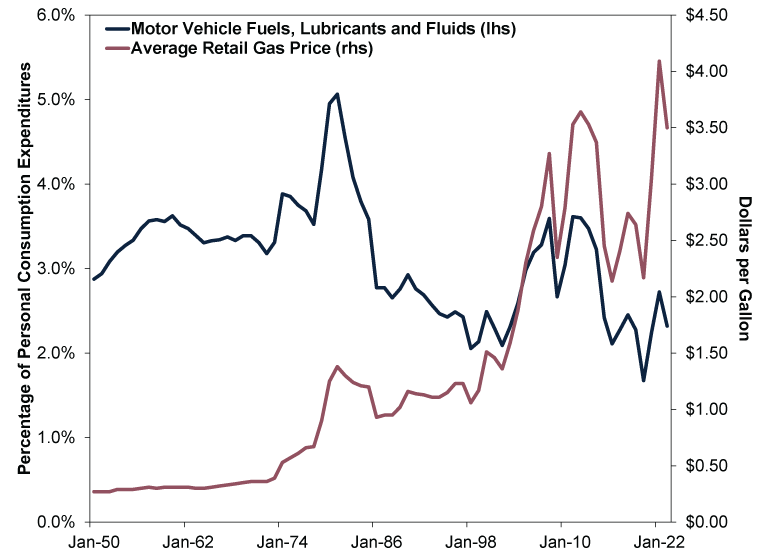
Source: St. Louis Federal Reserve and US Department of Energy, as of 9/3/2026. Motor vehicle fuels, lubricants and fluids expenditures as a percentage of personal consumption expenditures and US average annual retail price of gasoline, annual, 1950 – 2023 (the latest data available for average annual retail gasoline prices).
Whilst crude oil prices are a big individual contributor to what you pay at the petrol station, they make up around 32% of the retail price of a litre of petrol per automobile club RAC.[xii] Other contributors include the fuel duty (38%), VAT (17%), retailer margin (7%), bio content (5%) and delivery (1%), implying UK taxes have the largest effect over retail petrol prices.[xiii] We understand the handwringing over higher petrol prices. It would be more fun to spend our funds on a new spring wardrobe or vacation than at the roadside garage. But global crude oil developments aren’t the macroeconomic negative many people perceive, in our view. That many think otherwise is further evidence of the sentiment reset this year and reason to remain bullish on global stock markets.
[i] Source: AAA, as of 10/3/2026.
[ii] “Germany: Fuel Prices Spike Amid Iran Conflict,” Mark Hallam, Deutsche Welle, 4/3/2026.
[iii] “Drive Less to Cope With Petrol Price Surge, Says AA,” Chris Price, Tim Wallace and Szu Ping Chan, The Telegraph, 9/3/2026. Accessed via Yahoo! News.
[iv] “Australian Petrol Retailers Accused of Price Gouging Over Rising Fuel Costs Amid Iran War,” Patrick Commins, The Guardian, 5/3/2026.
[v] Source: Bureau of Labor Statistics, as of 6/3/2026.
[vi] Source: Eurostat and Office for National Statistics, as of 6/3/2026. Statement based on petrol as item weight of EU HICP for 2025 and petrol and diesel’s weight of the 2025 UK CPIH.
[vii] Source: Office for National Statistics, as of 11/3/2026. Of this category, approximately 17% reflects occupiers’ housing costs.
[viii] “Oil Embargo, 1973 – 1974,” Office of the Historian, accessed on 11/3/2026.
[ix] Source: FactSet, as of 3/10/2026. Statement based on Brent crude oil spot price, monthly, October 1973 – December 1983.
[x] Source: US Department of Energy, as of 9/3/2026. US average annual retail price of gasoline, annual, 1970 – 1982.
[xi] Source: Office for National Statistics, as of 11/3/2026.
[xii] “What Makes Up the Cost of a Litre of Petrol?” Simon Williams, RAC, accessed on 11/3/2026.
[xiii] Ibid.
Get a weekly roundup of our market insights.
Sign up for our weekly e-mail newsletter.

You Imagine Your Future. We Help You Get There.
Are you ready to start your journey to a better financial future?

Markets Are Always Changing—What Can You Do About It?
Get tips for enhancing your strategy, advice for buying and selling and see where we think the market is headed next.
Related Resources
-
Market Analysis Budgeting for French Debt Fears2026-10-06
-
Economics A World Trade Check-In Starring Southeast Asia2026-09-30
-
Politics A September European Political Update2026-09-24
-
Macro Insights Where the Manufacturing Cycle Goes From Here2026-09-23




Contact Us
Learn why 210,000 clients trust Fisher Investments and its affiliates to manage their money and find out how we may be able to help you achieve your financial goals.
As of 30/09/2026. Includes Fisher Investments and its affiliates.
New to Fisher? Call Us.
Contact Us Today