


Personal Wealth Management / Market Analysis
Stay Calm Amidst the Middle East Storm
Our take on the volatility stock markets and energy prices.

Three trading days into the war in Iran, market volatility continues globally. European stocks rebounded a bit Wednesday after two tough days, whilst Asian markets’ slide continued and US stocks bounced from Tuesday’s drop.[i] Brent crude oil prices stabilised Wednesday after jumping Monday and Tuesday, and European natural gas prices eased a bit after soaring the two days prior. When markets swing quickly amidst rapidly evolving events, we have observed it can be unsettling, but we think it is beneficial for long-term investors to resist the urge to react. We still think volatility is a sentiment reaction, not a case of stocks’ pricing a long energy shortage and economic catastrophe. Staying calm through the swings is key, in our view.
Usually, we find markets follow a standard path when dealing with regional conflict. In the runup, amidst sabre-rattling and rumours of war, our research finds volatility tends to escalate. When armed conflict actually breaks out, the initial bombs and bullets can add to this. But in reviewing market history, we find it generally doesn’t take long for markets to assess the conflict’s scope, weigh how much of global economic activity it will affect, see life going on elsewhere, and resume pricing in continued global economic growth. We have seen this throughout both Iraq wars, Israel’s war with Hamas in Gaza, the Bosnian War, the civil war in Syria and many, many others.[ii] In modern market history, we find only World War II directly and solely caused a bear market (meaning a prolonged stock market drop of -20% or worse with a fundamental cause).[iii] That was the only one big enough to disrupt a significant chunk of global economic activity.
Even in the one apparent exception, when Russia’s war in Ukraine contributed to 2022’s global bear market, we think that was less about the war than fears of related economic issues (sanctions and energy markets) colliding with other fears (monetary policymakers’ reversing course and hiking rates, inflation, post-COVID supply chain chaos) to hit sentiment. That bear market was also short, shallow and ended in October 2022, whilst the war sadly rages to this day.[iv] By then, oil had erased its post-invasion spike, falling from 8 March 2022’s high of $133.18 per barrel to well under $100.[v]
Whilst regional conflict’s market impact is usually fleeting, we find the wobbles have no preset time or magnitude. In 2022, after Russia invaded Ukraine, volatility lingered a while as investors seemingly grappled with the potential for a wider-ranging war on European soil (remember all the who’s next talk involving Moldova, Finland and the Baltic states?) and the risk of a nuclear attack. European stocks sank, falling -8.9% between their pre-invasion close and 8 March.[vi] That was a rough two-plus weeks of dread as markets priced the conflict, escalation fears and the economic blowback from sanctions, including a potential oil shock. In that same window, Brent crude oil skyrocketed from $99.29 per barrel to $133.18.[vii]
But then both reversed. Oil was back below pre-invasion levels by mid-April.[viii] European stocks regained pre-invasion levels by mid-March.[ix] That wasn’t the end of fear and volatility, but it shows the initial shock didn’t last—in our view, it took further, separate fears to drive markets down into bear market territory from there.
When conflict escalates quickly, we find it is a scramble. Markets continually get new information, fast and furious, and the fog of war is thick. We think they digest all of this real-time, initially with a lot of emotion, and often leap to worst-case scenarios. Think of all markets have had to digest this week beyond the initial attack: rocket and drone strikes across the Middle East, hitting civilian and military targets as well as oil infrastructure; British and French ships reportedly mobilising to defend military assets in the region; air strikes on a RAF base in Cyprus, taking the fighting from the Middle East to the Eastern edge of the European Mediterranean; attacks on the US embassy in Saudi Arabia; reports of horrific destruction in Tehran; warnings that Gulf nations’ air defences will be exhausted in a week; natural gas production idled in Qatar; and reports of tanker traffic in the Strait of Hormuz, a major chokepoint for seaborne oil and gas exports, slowing to a trickle. It is a lot for markets to deal with at once.
That kind of snowballing can easily lead to panic selling as investors envisage wider war erupting. But for now, much as the conflict has spread, the nations taking fire presently combine to about 3.4% of global gross domestic product (GDP, a government-produced measure of output).[x] And artillery fire and drones don’t appear to be wiping out all of it. As the shock wears off, we think this is what markets are likely see.
Plus, the fog is starting to clear. Shipping trackers reported a few cargo ships and tankers made it through the Strait of Hormuz Monday and Tuesday.[xi] Some were attacked but carried on. The implication: For all Iran’s talk of the Strait being closed, it looks more to us like a voluntary decision by the ships themselves to wait. We see a simple purpose and logic to this: Several leading maritime insurance providers cancelled their war risk coverage Monday, stranding ships financially.[xii] Now the calculus is changing: On Tuesday, US President Donald Trump announced the US Development Finance Corporation will provide insurance and guarantees to all shipping lines operating in the region, filling the void left by private insurers.[xiii] He also stated the US Navy will begin escorting tankers and cargo ships through the Strait, echoing the naval response to Yemen’s Houthi rebels attacking ships in the Red Sea in 2023. This isn’t the world’s first time dealing with strife in this corridor. There is a blueprint.
Meanwhile, on the natural gas front, European and Asian prices initially jumped, whilst US prices merely inched higher.[xiv] This looks to us like continued fallout from 2022. At that time, when Europe raced to replace Russian gas, benchmark European gas prices temporarily went through the roof on fears of wintertime shortages.[xv] The Continent got through it, opening more liquefied natural gas (LNG) import terminals to receive shipments from the US and, to a lesser degree, Qatar, which has suspended natural gas production after Iranian attacks on its infrastructure. That seems to have resurrected supply shortage fears in Europe, which has now temporarily lost a supplier and may face more competition from Asian nations for US LNG in a prolonged Qatari shutdown. We think this also explains soaring natural gas prices in Asia, where Qatar is a major supplier.
Yet even with the recent spike, gas prices in Europe and Asia remain far below their 2022 highs. In 2022, European gas hit a high of €339.20 per megawatt hour on 26 August as fear spiked amidst concerns about low gas storage levels heading into the winter.[xvi] Today, we are heading out of winter, and European gas’s sits presently at $48.77 per mwh.[xvii] Instead of losing a major supplier full stop, as it did in 2022, and lacking infrastructure to replace it, Europe is facing the potential need to adjust supply temporarily. Whilst Qatar doesn’t yet have an official timeline for bringing supply back online, industry analysts suspect it will be later this month. And given natural gas’s importance to Qatar’s economy, we think they have every incentive to move quickly and the expertise to accomplish that.
We think US gas prices add more context. We have seen abundant talk of US exports being the solution to any lasting shortages from Qatar or other Middle Eastern producers. Now, that talk is probably true. Ten years after the US began exporting LNG, it is a major international player in gas exports.
But in our view, if there were going to be a sudden, huge competition for US supply, prices would probably jump to reflect that. Instead, Henry Hub, which is the US natural gas benchmark, remains below $3 per million British thermal units, which is where it sat before January blizzards temporarily raised prices. This indicates to us that US prices aren’t presently registering a demand surge, which in turn suggests the immediate jump in European and Asian prices was influenced heavily by sentiment. (Exhibit 1)
Ultimately, we think patience and time are beneficial tools for long-term investors to employ now. Again, throughout stock market history, short-term volatility after conflict breaks out is common. But with a little time, we think global stock markets are likely look past excess fears of wider war and worst-case scenarios and start seeing that, economically, the world didn’t change overnight.
Exhibit 1: Global Natural Gas at a Glance
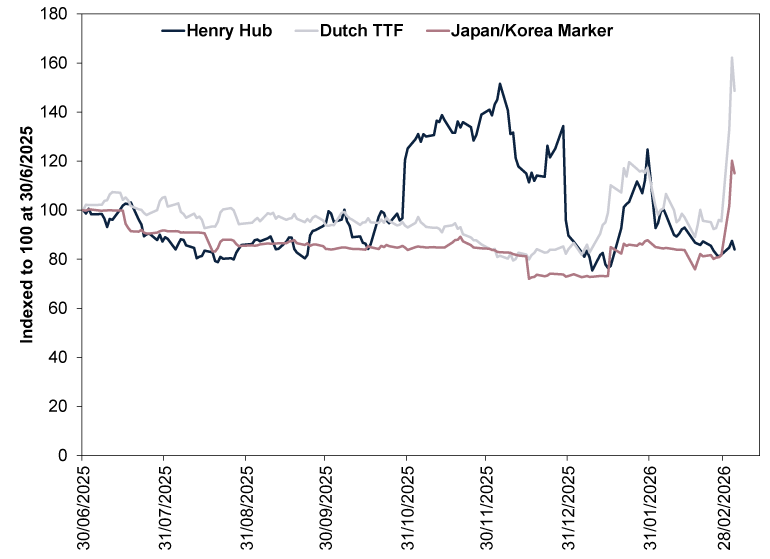
Source: FactSet, as of 4/3/2026. Henry Hub, Dutch TTF and Japan/Korea Marker natural gas prices, 30/6/2025 – 4/3/2026. Indexed to 100 at 30/6/2025 to account for currency and measurement unit differences.
[i] Source: FactSet, as of 4/3/2026. Statement based on Stoxx Europe 600, S&P 500, Nikkei 225, KOSPI and Hang Seng index price returns in local currencies, 27/7/2026 – 4/3/2026. Currency fluctuations between these currencies and the pound may result in higher or lower investment returns.
[ii] Ibid. Statement based on S&P 500 price returns in USD during the conflicts referenced. Currency fluctuations between the dollar and pound may result in higher or lower investment returns.
[iii] Ibid.
[iv] Ibid. Statement based on MSCI World Index returns with net dividends in US dollars, 3/1/2022 – 12/10/2022. Currency fluctuations between the dollar and pound may result in higher or lower investment returns.
[v] Source: FactSet, as of 3/2/2026.
[vi] Ibid. MSCI Europe return in GBP with net dividends, 23/2/2022 – 8/3/2022.
[vii] Ibid. Brent crude oil price, 23/2/2022 – 8/3/2022.
[viii] Ibid. Statement based on Brent crude oil price, 23/2/2022 – 11/4/2022.
[ix] Ibid. Statement based on MSCI Europe returns in GBP with net dividends, 23/2/2022 – 17/3/2022.
[x] Source: World Bank, as of 3/3/2026. Based on 2023 nominal GDP in USD, the most recent year with complete data for all affected countries (Bahrain, UAE, Cyprus, Iran, Iraq, Israel, Jordan, Kuwait, Lebanon, Oman, Qatar and Saudi Arabia).
[xi] “China Calls for Vessels in Strait of Hormuz to Be Protected Amid Soaring Shipping Costs,” Joanna Partridge, The Guardian, 3/3/2026.
[xii] Ibid.
[xiii] “Trump: US Navy May Escort Tankers Through Strait of Hormuz, More European Warships en Route to Med,” US Naval Institute, 3/3/2026.
[xiv] Source: FactSet, as of 4/3/2026. Statement based on Dutch TTF, Japan/Korea Marker and Henry Hub benchmark national prices, 12/2/2026 – 4/3/2026.
[xv] Ibid. Statement based on Dutch TTF natural gas prices in 2022.
[xvi] Ibid.
[xvii] Ibid. Dutch TTF gas price on 4/3/2026.
Get a weekly roundup of our market insights.
Sign up for our weekly e-mail newsletter.

You Imagine Your Future. We Help You Get There.
Are you ready to start your journey to a better financial future?

Markets Are Always Changing—What Can You Do About It?
Get tips for enhancing your strategy, advice for buying and selling and see where we think the market is headed next.
Related Resources
-
Market Analysis Budgeting for French Debt Fears2026-10-06
-
Economics A World Trade Check-In Starring Southeast Asia2026-09-30
-
Politics A September European Political Update2026-09-24
-
Macro Insights Where the Manufacturing Cycle Goes From Here2026-09-23



Contact Us
Learn why 210,000 clients trust Fisher Investments and its affiliates to manage their money and find out how we may be able to help you achieve your financial goals.
As of 30/09/2026. Includes Fisher Investments and its affiliates.
New to Fisher? Call Us.
Contact Us Today