


Personal Wealth Management / Market Analysis
Why Rising Japanese Bond Yields Aren’t Bearish
Global stocks have climbed alongside normalising JGB yields.

Japanese government bond (JGB) yields have jumped lately, and with them, warnings they will pull the rug out from under global markets are rising across financial coverage we monitor.[i] To hear bearish commentators we follow tell it, higher JGB yields risk reversing a supposed source of cheap borrowing that has pumped up world stocks. But we think a closer look reveals this to be a false alarm.
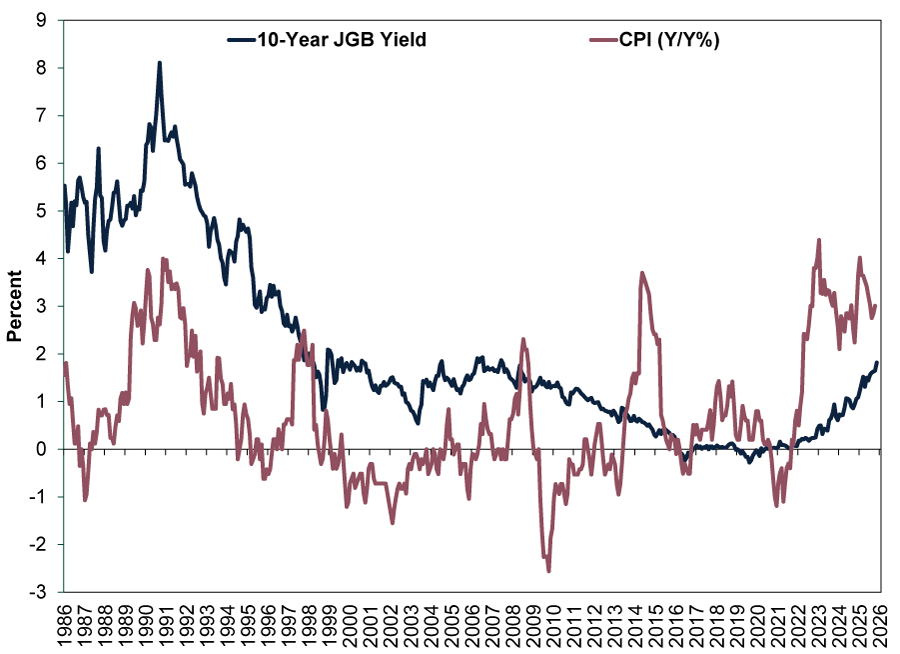
As Exhibit 1 shows, 10-year JGB yields are hitting 19-year highs, almost doubling from 1.1% at 2025’s start to just under 2.0% today. Now, we find higher yields in and of themselves make sense: Inflation (the rate of change in prices economywide)—and expectations for it—are bond yields’ main driver, and those have climbed in Japan. Inflation erodes currencies’ purchasing power, so when it is expected to rise, yields on fixed-income instruments typically also climb to compensate. This explains the uptick, in our view, helped along by the Bank of Japan normalising policy and gradually reducing its long-term JGB purchases as yield curve control ends. Inflation’s rise mostly looks like normalisation to us, too—not anything to be overly concerned with.
Exhibit 1: 10-Year JGB Yields and Japan CPI
Source: FactSet, as of 12/12/2025. 10-year JGB yields, January 1986 – November 2025, and Japan CPI, January 1986 – October 2025.
But when yields rise swiftly, in Japan or elsewhere, headlines often shift into overdrive, proclaiming their bearishness. In Japan, financial publications we read fixate on its gross debt-to-GDP (gross domestic product) ratio, which exceeds 200%—the developed world’s highest.[ii] Couple that with alarm over potential fiscal profligacy from new Prime Minister Sanae Takaichi, and they fan rumours the bond market will react negatively and force a reckoning, the alleged reason why yields are rising.[iii] Rising yields, in turn, sound warnings the long-touted yen carry trade will unwind.[iv] For the unfamiliar, a carry trade is when global investors borrow cheaply in one nation and plough funds into higher-yielding assets elsewhere. Today, many commentators we follow argue this is propping up global markets.
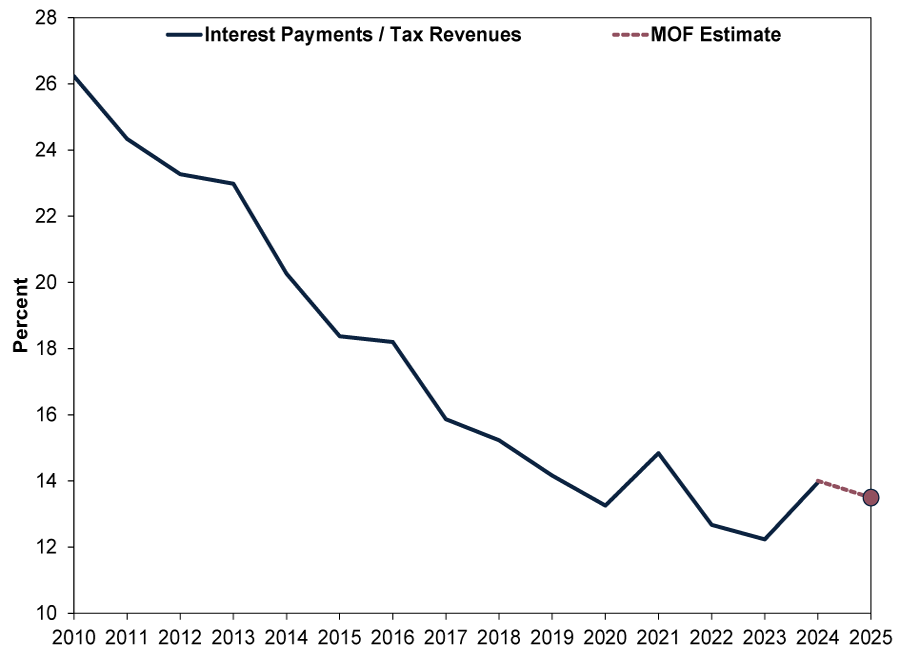
As always, though, when confronted with such claims, investors should ask themselves: Do they pass muster? A cursory inspection finds them easy to debunk. First, we find debt-to-GDP isn’t a very useful way to measure the presumed burden of Japan’s bond mountain. JGB investors aren’t paid with GDP, but out of government tax revenue.[v] We think Japan’s interest payments’ share of tax revenue provides a much better indication of its ability to meet its financial obligations by pairing them with incoming receipts. Exhibit 2 shows this remains historically low and has fallen over the past 15 years. There was no Japanese debt reckoning then, so why would there be now?
Exhibit 2: Japan’s Debt Service Isn’t Historically Onerous
Source: FactSet and Japan’s Ministry of Finance, as of 12/12/2025.
This is why we think JGB investors, the most sensitive to potential default risks, continue to view Japanese credit as rock solid, one reason Japan’s 10-year yields are the developed world’s second lowest, trailing only Switzerland’s.[vi] As for Japan’s seemingly newfound appetite for government spending, we don’t see Takaichi’s fiscal policy as some big bullish positive. We agree with the criticisms pointing out decades of fiscal stimulus in Japan didn’t create lasting growth. But it probably won’t break the bank, either, in our view.
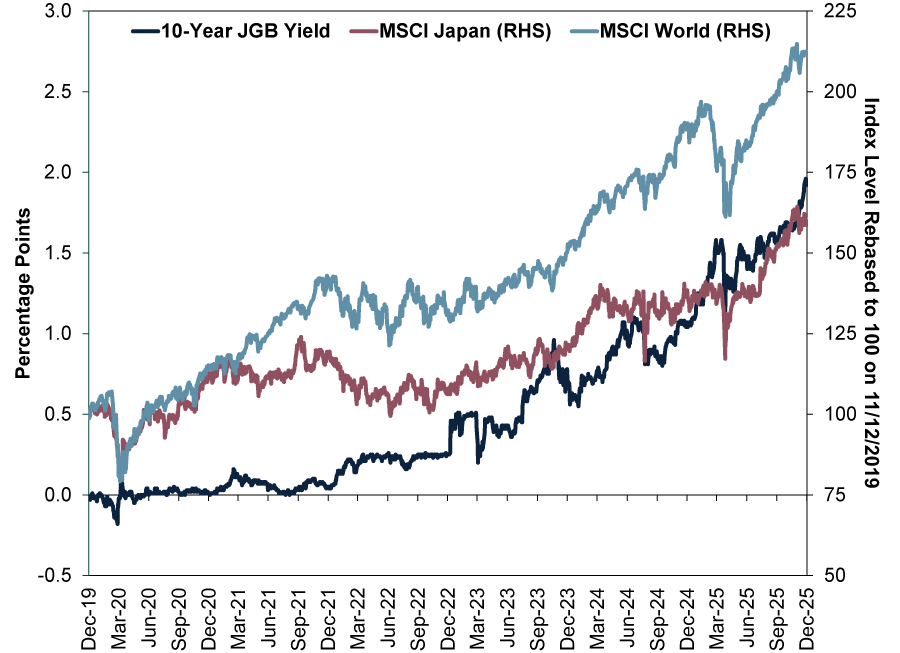
Meanwhile, as Exhibit 3 illustrates, Japanese and global stocks are rising in concert with long rates—once again debunking fears otherwise. Year to date, the MSCI Japan Index is up 23.0% in yen (16.1% in pounds), whilst the MSCI World Index, the developed world benchmark, has risen 13.2%.[vii] Rising JGB yields are manifestly not tanking stocks in Japan or globally. Nor is this a new development. They have been rising together for basically the last three years.
Exhibit 3: Japanese Yields and Stocks Rising Together for Years
Source: FactSet, as of 12/12/2025. 10-year JGB yield, MSCI Japan returns with gross dividends and MSCI World returns with net dividends, both in GBP, 11/12/2019 – 11/12/2025.
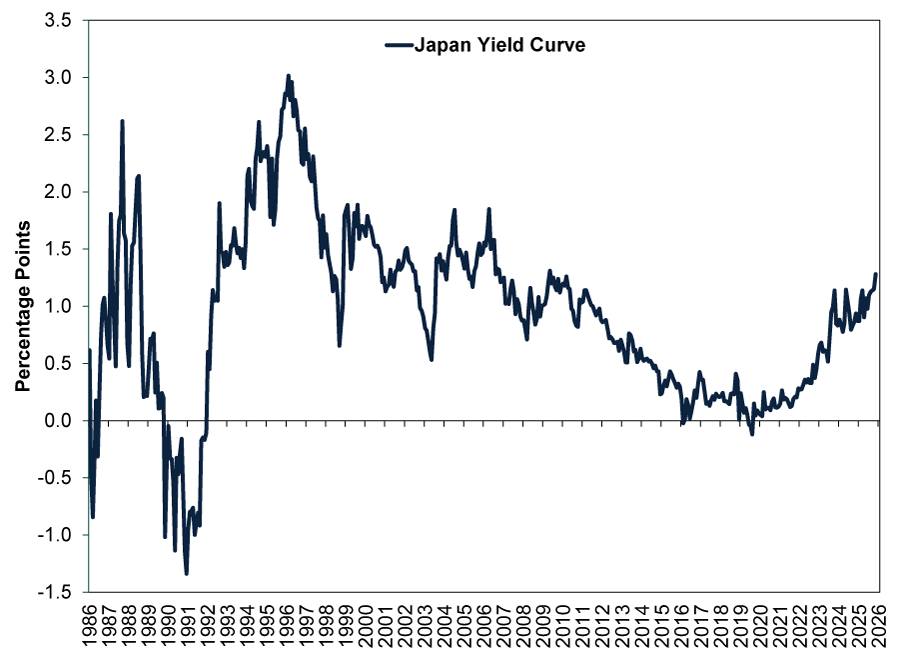
For investors, we see the alarm over rising JGB yields as another case of the crowd viewing positives as negatives. Exhibit 4 shows how higher yields steepen Japan’s yield curve—the range of rates from shorter to longer maturities. We find this is helping boost Japanese lending, because banks’ business model is to borrow short and lend long, pocketing the difference, and as higher spreads between short- and long-term interest rates incentivises them to extend credit. Total bank loans rose 4.5% y/y in November, their fastest growth rate in at least 25 years (outside emergency pandemic lending).[viii] And to the degree more credit supports economic activity—helping fuel consumption and investment—it contributes to Japan’s growth prospects.
Exhibit 4: Japan’s Yield Curve Steepest Since 2006
Source: FactSet and Finaeon, Inc., as of 12/12/2025. 10-year minus 3-month JGB yields, January 1986 – November 2025.
So, all in all, we think worry over rising JGB yields is misplaced. We see it as a classic false fear, nothing to fret, but cheer.
[i] “Bank of Japan Faces a Policy Dilemma as Government Bond Yields Keep Hitting New Highs,” Lim Hui Jie, CNBC, 3/12/2025.
[ii] “Japan Is Out Spending. Bond Markets Seem Nervous About Picking Up the Tab.” Megumi Fujikawa, The Wall Street Journal, 8/12/2025. Accessed via MSN. GDP is a government measure of economic output.
[iii] “Japan Reaches for Stimulus. The Bond Vigilantes Will Pounce.” Desmond Lachman, Barron’s, 17/11/2025. Accessed via MSN.
[iv] Ibid.
[v] “Japanese Public Finance Fact Sheet,” Staff, Japan’s Ministry of Finance, April 2025.
[vi] Source: FactSet, as of 12/12/2025.
[vii] Source: FactSet, as of 12/12/2025. MSCI Japan returns with gross dividends and MSCI World returns with net dividends, both in GBP, 12/31/2024 – 11/12/2025. Former also presented in Japanese yen. Currency fluctuations between the yen and pound may result in higher or lower investment returns.
[viii] Source: FactSet, as of 12/12/2025.
Get a weekly roundup of our market insights.
Sign up for our weekly e-mail newsletter.

You Imagine Your Future. We Help You Get There.
Are you ready to start your journey to a better financial future?

Markets Are Always Changing—What Can You Do About It?
Get tips for enhancing your strategy, advice for buying and selling and see where we think the market is headed next.
Related Resources
-
Market Analysis The Ineffectual Fed Hike2026-09-21
-
To raise interest rates today is to misunderstand inflation2026-09-17
-
In The News Putting the BoE’s Bond Sale ‘Pause’ In Perspective2026-09-17
-
Market Analysis By the Numbers: A Japanese Growth Check In2026-09-16





Contact Us
Learn why 210,000 clients trust Fisher Investments and its affiliates to manage their money and find out how we may be able to help you achieve your financial goals.
As of 30/06/2026. Includes Fisher Investments and its affiliates.
New to Fisher? Call Us.
Contact Us Today