


Personal Wealth Management / Market Analysis
Will Lower Capital Requirements Send Banks Higher?
Don’t overrate recent financial regulatory tailwinds.

Editors’ Note: MarketMinderEurope doesn’t make individual security recommendations. Those mentioned here merely represent the broader theme we wish to highlight.
Are US banks about to embark on a big lending and dividend spree? Some observers in financial publications Fisher Investments <Branch> follow claim this is likely after American regulators introduced new proposals to ease capital requirements (the minimum regulatory amount of capital banks must hold against risk-weighted assets, including loans and investments). Whilst these proposed new rules have sparked a mix of reactions, ranging from expectations for more risk-taking to speculation over a potential financial crisis, we think reality is likely to prove rather underwhelming. These rules are a relatively minor factor amongst the reasons to be bullish on banks today, in our view.
The latest proposals originate from Basel III, a regulatory framework aimed at strengthening the global financial system’s guardrails following the 2007 – 2009 crisis. The regulatory regime raised capital requirements and mandated higher capital and liquidity buffers as well as living wills for the biggest banks—ostensibly to end the problem of too big to fail banks that would require a government bailout if they encountered trouble, as the economic consequences of bankruptcy were thought too dire.
The Basel Committee approved the rules in 2010, but actual implementation rolled out from 2013 – 2019.[i] In 2017 the Basel Committee published additional reforms, and these changes, known as Basel III Endgame or Basel IV, started taking effect in January 2023 (delayed by 12 months due to the pandemic).[ii] Regional US bank failures that year spurred American regulators to push for aggressive implementation and tougher regulations, including higher capital requirements based on risk weights (assigned percentages to account for the risk of various types of assets) and a standardised approach (rather banks’ internal models) for estimating credit, operational and trading risks for large financial institutions.[iii] However, the effort languished amidst bipartisan blowback, and after President Donald Trump won 2024’s election, we observed many banking industry observers discuss a climbdown. But uncertainty lingered, and banks didn’t wait for clarity but began pre-emptively building buffers, lest they have to race to do it by deleveraging later.[iv]
That clarity has arrived, and whilst the latest proposals are subject to a 90-day comment period and subject to change, we do see a few positives. Lowered capital requirements could free up around $200 billion in capital that can be deployed elsewhere—funding dividends or share buybacks or backing new lending.[v] Banks’ capital calculations are now more risk sensitive, meaning risk weights move from a flat to a sliding scale based on borrower quality for most types of corporate and mortgage lending. Allocating less capital to buffer against potential losses may let some big banks grow their loan books, particularly on the commercial front—which we think may be the government’s way to reverse the general move toward private credit (loans made by non-bank institutions to companies). The updates also reduce banks’ compliance costs and bring US regulations in line with other jurisdictions (e.g., Europe and UK).
We have seen some observers argue the latest proposals will lead to a surge in banking activity as the biggest financial institutions unleash this unlocked capital. That is possible but consider: The largest banks’ common equity Tier 1 capital (the highest-quality regulatory capital) is set to decrease by just 2.4% in aggregate—smaller relative to midsize banks’ 5.2% and small banks’ 7.8%.[vi] Major bank executives also have tempered expectations. Whilst some will consider using excess cash for deals and/or stock buybacks, they won’t necessarily spend willy nilly—Goldman Sachs’ CEO said “the bar is going to be very high” to move forward with an acquisition opportunity.[vii]
Ultimately, banks may not deploy all that excess capital. Financial firms have been dealing with the Basel IV framework for nearly a decade and subject to Basel’s general capital requirements for even longer. Given all the regulatory changes—which can shift depending on the political party in power—it doesn’t seem wise to us for banks to immediately draw down capital buffers. What if the next presidential administration pushes for stricter capital requirements? That long-term uncertainty likely discourages risk taking to an extent, so we don’t think investors should hold their breath waiting for a surge in banking activity.
Whatever the finalised rules may be, falling uncertainty is a positive and minor tailwind. However, regulatory clarity alone isn’t reason to be bullish about the Financials sector. Consider a fundamental driver: a positively sloped US yield curve. The yield curve signals credit markets’ health. Banks borrow at short rates and lend at long rates, with the spread a proxy for loan profitability: The wider the spread, the more incentive banks have to lend. Whilst the yield curve isn’t perfect, it has a long history of being a useful forward-looking economic indicator.
A year ago, the spread between America’s 10-year yield and 3-month yield was negative (-0.04%).[viii] Today, the spread is 0.69%.[ix] Whilst that reflects some volatility in long rates since the war began, the spread was already steepening before the conflict—indicating US banks’ core business looks healthy and profitable right now, a compelling (and overlooked) reason to be bullish about the industry. (Exhibit 1)
Exhibit 1: Treasury Yield Spread Points Positively
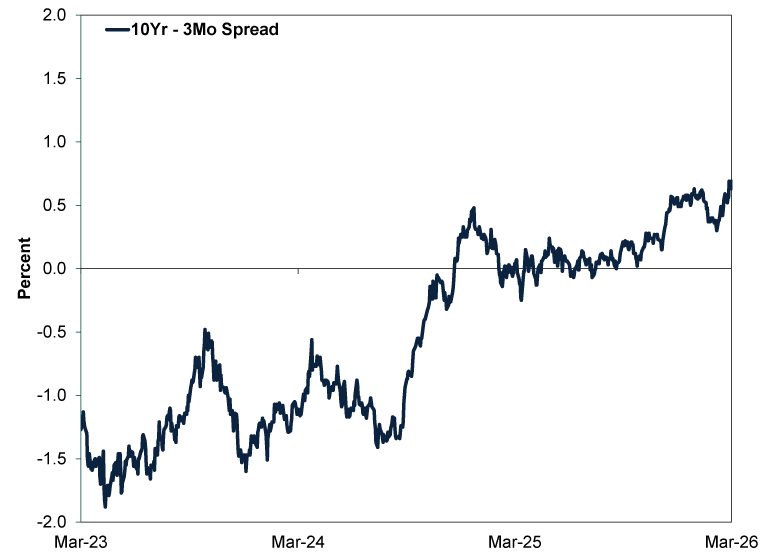
Source: St. Louis Federal Reserve, as of 23/33/2026. 10-year US Treasury Yield minus 3-month Treasury Yield, daily, 22/3/2023 – 22/3/2026.
We don’t dismiss the possibility banks, emboldened by the rule changes, eventually lend aggressively and cause the economy to overheat. However, we think it is unlikely that scenario would break out overnight, and we have time to monitor how activity evolves from here. For now, the new regulations look like an underappreciated, albeit minor, tailwind.
[i] “History of the Basel Committee,” Bank for International Settlements, accessed on 31/3/2026.
[ii] Ibid.
[iii] “How US Regulators Are Overhauling Bank Capital Rules,” Pete Schroeder, Reuters, 19/3/2026. Accessed via AOL.com.
[iv] Bank Earnings Show a Monster 2025 and Shareholders Reap Rewards,” Catherine Baab, Quartz, 14/1/2026.
[v] “The Fed’s $200 Billion Bank Stimulus Poses a Big Risk,” Paul J. Davies, Bloomberg, 19/3/2026. Accessed via Financial Advisor Magazine.
[vi] “Big Banks Score Win Under New Plan to Loosen Capital Rules,” Dylan Tokar, The Wall Street Journal, 19/3/2026. Accessed via MSN.
[vii] “Banks Ready to Put Billions to Work After Regulatory Win,” Gina Heeb and Ben Glickman, The Wall Street Journal, 20/3/2026. Accessed via MSN.
[viii] Source: FactSet, as of 25/3/2026.
[ix] Ibid.
Get a weekly roundup of our market insights.
Sign up for our weekly e-mail newsletter.

You Imagine Your Future. We Help You Get There.
Are you ready to start your journey to a better financial future?

Markets Are Always Changing—What Can You Do About It?
Get tips for enhancing your strategy, advice for buying and selling and see where we think the market is headed next.
Related Resources
-
Market Analysis A Market Perspective on Iran Truce Talks2026-06-17
-
Market Analysis Gold Fails the Safe Haven Test Again2026-06-17
-
Macro Insights Japanese Equity Outperformance & Why It's Poised to Continue2026-06-15
-
Macro Insights Assessing Private Credit Risks and Exposures2026-06-09



Contact Us
Learn why 200,000 clients trust Fisher Investments and its affiliates to manage their money and find out how we may be able to help you achieve your financial goals.
As of 31/03/2026. Includes Fisher Investments and its affiliates.
New to Fisher? Call Us.
Contact Us Today