


Personal Wealth Management / Market Analysis
A Gloomy Greeting for Better-Than-Feared UK Data
When good news is bad news, stocks’ wall of worry is high.

Sentiment is often tricky to pin down, but now and then we get an easy gut check: How do headlines react to good news? Friday gave us a good opportunity to check the mood in the UK, where the Office for National Statistics announced a record-high monthly budget surplus for January. And it seems that, despite resilient GDP growth and continued stock market outperformance, UK sentiment remains pretty gloomy. The wall of worry still looks high.
So far, the UK is having a pretty good year on the economic and market front. We now know GDP grew a bit in Q4, rebuking worries over contraction. Retail sales and purchasing managers’ indexes hint at the economy gaining steam early this year.[i] And through Friday’s close, UK stocks are outperforming Europe and the world.[ii] Reality, quietly, is beating expectations.
And all this is happening against a backdrop of austerity gloom. When Chancellor of the Exchequer Rachel Reeves announced some modest tax hikes in last autumn’s Budget, observers across the political spectrum warned that might not be the end of it. Every uptick in long-term interest rates sparked fear that higher debt financing costs would eat up all of Reeves’s budget buffer, necessitating more tax hikes to satisfy balanced budget rules. Accordingly, people have watched monthly fiscal results closely.
So you would think January’s bumper surplus would cause a universal sigh of relief. The £30.4 billion haul was over twice January 2025’s and a big reversal from December’s -£11.6 billion deficit.[iii] Even accounting for seasonal skew (January is always a big month for self-assessed income tax payments), it was a big result, much bigger than forecast, theoretically giving Reeves a lot more budget headroom than anticipated. That would seemingly reduce austerity and deficit jitters, clearing some of the uncertainty hanging over markets.
But that isn’t the reaction we saw. Instead, on both sides of the political divide, we saw abundant skepticism. In outlets whose editorial boards tend to lean more to the free-market end of the spectrum, headlines warned Reeves would soon come under political pressure from Labour Party backbenchers to dial up spending, storing up future deficit troubles and even worse austerity. And outlets whose editors’ views tend to favor more government activity warned the big surplus is a false dawn, inflated solely by people racing to lock in capital gains ahead of a potential hike. Nothing to get excited about, and nothing to prevent more fiscal pain this autumn.
As is typical, there are probably kernels of truth in both views. We have seen plenty of lobbying for higher spending, especially with Prime Minister Keir Starmer eyeing higher defense outlays. Other departments are angling to get in on the fun. Yet the Treasury has been working overtime trying to put this to bed. The ever-verbose unnamed sources told The Telegraph just last week that Reeves “is opposing virtually all demands for changes to tax and spending in her upcoming Spring Statement” and sticking to her pledges to have just one budget-type “fiscal event” per year.[iv] While there are doubts about her and Starmer’s longevity in their current roles, the rumored challengers have been singing heartily from the fiscal probity hymn sheet lately. So while we don’t doubt there is pressure to loosen the purse strings, pressure isn’t policy.
And it is also true that capital gains tax revenues contributed to the surplus, which probably was indeed the fruit of panic selling a while back. The UK tax year runs from April 6 – April 5 of the next year, with capital gains tax payments due by the following January 31. So taxes paid this January would have been on gains incurred between April 6, 2024 and April 5, 2025. That coincides with the rumors and fears that October 2024’s Budget would include a stiff capital gains tax hike, and we saw numerous reports of people selling in advance, just in case, to lock in lower rates. That proved prescient as Reeves hiked capital gains tax rates effective October 30, 2024, and now His Majesty’s Treasury is reaping the fruit of that strategic selling.
So in that sense, it is probably a one-off. Typically, with capital gains tax hikes, you tend to get extra selling in the run-up to the hike and less in the aftermath. The hike pulls forward activity. But it generally isn’t a permanent pothole. Heck, the UK had another round of capital gains tax hike rumors last summer, with another wave of selling if fund flows and anecdotal reports are any indication. This time, fears didn’t come true, but it might still boost Treasury coffers in January 2027 all the same.
But tax revenues are always lumpy, and there are other forces helping the UK’s finances. 10-year Gilt yields are down over the past year. 30-year yields are down significantly from last summer’s freakout. Bank of England Rate cuts have helped pull down shorter-term rates. And with inflation easing, the interest burden on inflation-linked UK Gilts is easing. Monthly UK interest costs fell by -£5 billion in January. On a rolling 12-month basis, interest costs are now down for four straight months both in absolute terms and relative to tax revenue, which is what matters most for debt affordability. The sharp summer uptick that freaked everyone out has largely reversed.
Exhibit 1: UK Debt Interest Is Easing Again
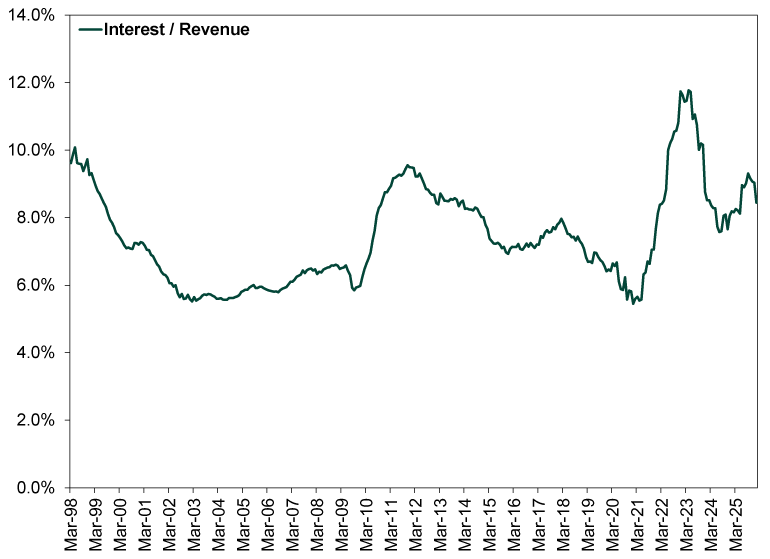
Source: Office for National Statistics, as of 2/23/2026. Public sector interest and current receipts, rolling 12-month, April 1997 – January 2026.
So it looks to us like the gloom is unwarranted. The UK’s public finances aren’t in perfect shape, but perfect doesn’t exist. Markets care most about reality relative to expectations, and things look overall better than feared. That is all stocks need to keep climbing the wall of worry.
[i] “UK Businesses Report Another Strong Month, PMI Survey Shows,” William Schomberg, Reuters, 2/20/2026.
[ii] Source: FactSet, as of 2/23/2026. Statement based on MSCI UK IMI, MSCI World and MSCI Europe returns in USD with net dividends, 12/31/2025 – 2/20/2026.
[iii] Source: Office for National Statistics, as of 2/23/2026.
[iv] “Reeves to Do ‘as Little as Possible’ in Spring Statement Despite Pressure to Spend,” Tim Wallace, The Telegraph, 2/19/2026.
If you would like to contact the editors responsible for this article, please message MarketMinder directly.
*The content contained in this article represents only the opinions and viewpoints of the Fisher Investments editorial staff.
Get a weekly roundup of our market insights
Sign up for our weekly e-mail newsletter.

You Imagine Your Future. We Help You Get There.
Are you ready to start your journey to a better financial future?

Where Might the Market Go Next?
Confidently tackle the market’s ups and downs with independent research and analysis that tells you where we think stocks are headed—and why.
Related Resources
-
Market Analysis The New Tariffs in Town Are Still Old News2026-07-24
-
Expert Commentary This Week in Review | Market Volatility, Tariffs, SpaceX
 2026-07-24
 -
Expert Commentary Why Ken Fisher Is Optimistic About European Stocks
 2026-07-23
 -
Economics A Summertime Check-in on US Consumers2026-07-23



Learn More
Learn why 210,000 clients trust us to manage their money and how Fisher Investments and its affiliates may be able to help you achieve your financial goals.
As of 6/30/2026
New to Fisher? Call Us.
Contact Us Today