


Personal Wealth Management / Market Volatility
Anatomy of a (Near-)Correction
Underlying trends—and countertrends—show March’s sentiment-driven downturn reversing.

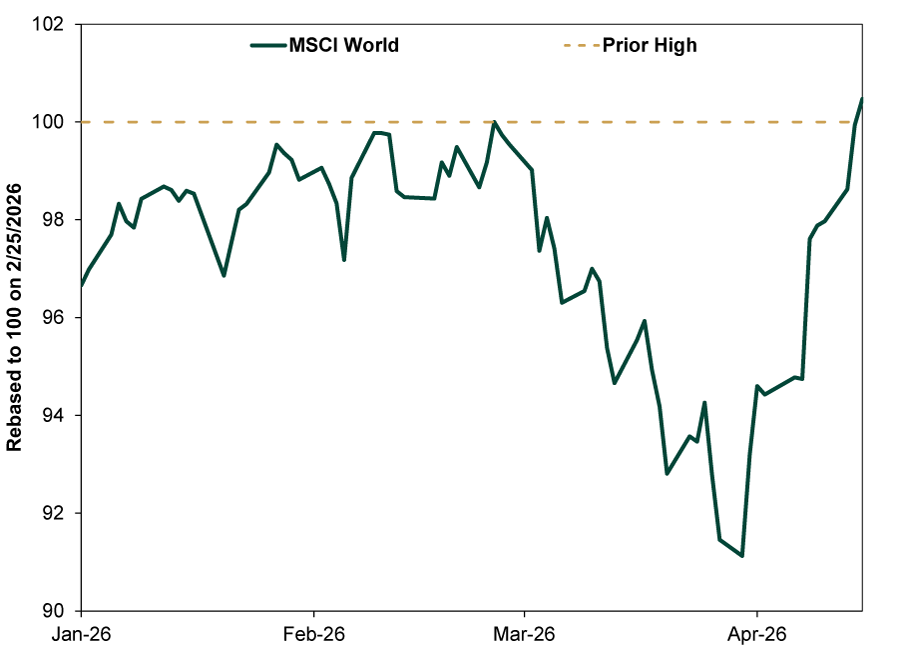
After rallying further to start the week, the MSCI World Index is slightly positive on the year ... and recouped pre-war levels Wednesday. But those who have followed all the daily wiggles along the way could be forgiven for not knowing that, given rampant war worries. Of course, we can’t rule out more volatility or another leg lower, if sentiment sours anew. Such swings and volatility strike without warning for any or no reason. They also can feature temporary blips at the sector and regional level, and this latest move seems like no exception. Let us recap how this year has unfolded thus far to illustrate why sentiment-driven swings call for patience.
After starting the year drifting higher, markets peaked on February 25—as tensions with Iran mounted three days before actual fighting began. At global stocks’ deepest point March 30, they were down -8.9%—nearly a correction (short, sharp, sentiment-driven drop of -10% to -20%), as the month-long Iran war fanned fears of escalating conflagration and disruptions to global energy supplies.[i] (Exhibit 1) But then stocks turned north. Ahead of the ceasefire. Ahead of actual peace, which isn’t in place even now. Ahead of the Strait of Hormuz reopening. It is arguably more effectively closed now!
Exhibit 1: Stocks’ Near-Correction This Year
Source: FactSet, as of 4/16/2026. MSCI World Index return with net dividends, 12/31/2025 – 4/15/2026.
We don’t know if war participants will definitively step back from the brink—or if hostilities will resume. But if last year’s -16.6% tariff-induced correction is any indication, markets may not look back.[ii] A year ago, stocks priced in worst-case scenarios leading to global recession (if not another Depression), but with reality uncooperative, they rallied to new highs by June 2025.
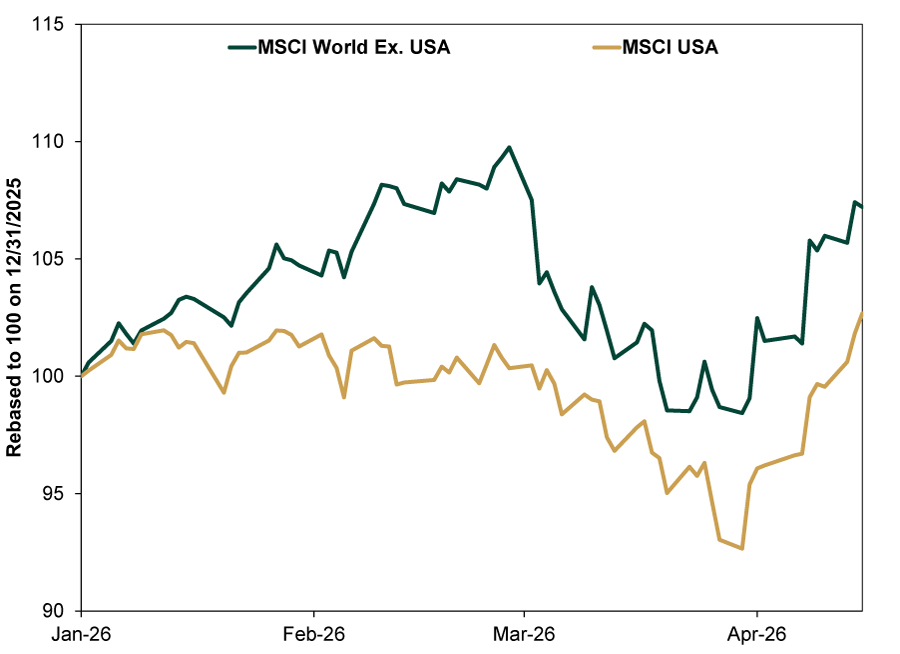
Corrections (or near ones) also typically bring countertrends—temporary shifts in sector, style and geographic leadership that go against the prevailing direction—under the hood. As Exhibit 2 shows, non-US stocks boomed to start the year, rising 9.8% through February 27.[iii] Meanwhile, hamstrung by high expectations, US stocks rose 0.3%.[iv] When March’s volatility struck, that reversed. This looks to us like a countertrend. Perhaps from the perception that America’s oil and gas abundance insulate it from Middle East turmoil and perhaps because growth stocks are less reliant on petrochemical feedstocks, US stocks fell -7.7% in the downturn while non-US stocks fell -10.3%.[v]
Exhibit 2: Value-Tilted Non-US Stocks Leading Growth-Heavy US
Source: FactSet, as of 4/16/2026. MSCI World Ex. USA return with net dividends and MSCI USA return with gross dividends, 12/31/2024 – 4/15/2026.
Digging further, we also see countertrends in sectors and styles. Non-US markets tend to be more value-oriented than in America. Value led early in the year but lagged during the downturn. Value-oriented sectors like Industrials fell more during the near-correction than growth sectors like Tech. (Exhibit 3) Non-US Financials, leading handily through February’s end, also dropped more than US Tech in March. What worked before got disproportionately punished when sentiment shifted.
Exhibit 3: It Has Been Energy Versus Everything Else Since the War
Source: FactSet, as of 4/16/2026. MSCI World Industrials, Information Technology and Energy returns with net dividends, 12/31/2025 – 4/15/2026.
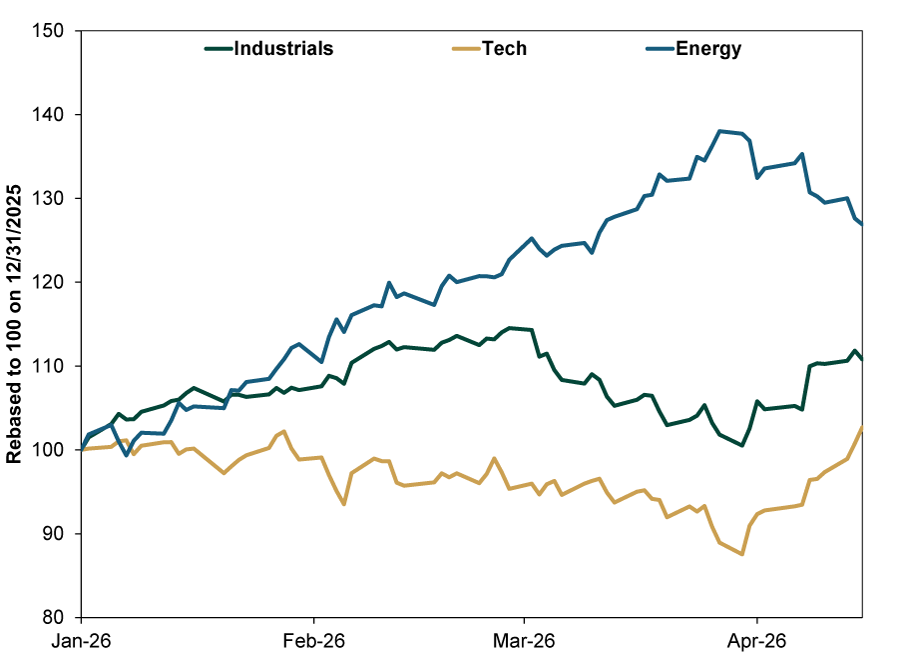
Meanwhile, Energy climbed before the war with oil prices—and profits—already rising. Energy profits are highly price-sensitive, so when tensions contributed to driving prices up pre-war, Energy outperformed. When prices spiked in the conflict, Energy stocks boomed. That has reversed some since March 30. Those convinced they needed to chase Energy as a “war winner” could easily have been whipsawed by the reversal.
Again, even with stocks back to all-time highs, we can’t rule out more volatility or a renewed downturn ahead. There is never an all-clear that will signal such sentiment swings are over and done with. But what you can take from this downturn that has lasting influence is this: When markets move so quickly, patience is your best asset. We don’t think trying to time mini-corrections or chase countertrends that reverse with no warning is a path to ongoing investment success.
[i] Source: FactSet, as of 4/15/2026. MSCI World Index return with net dividends, 2/25/2026 – 3/30/2026.
[ii] Source: FactSet, as of 4/15/2026. MSCI World Index return with net dividends, 2/18/2025 – 4/8/2025.
[iii] Source: FactSet, as of 4/15/2026. MSCI World ex. USA return with net dividends, 12/31/2025 – 2/27/2026.
[iv] Source: FactSet, as of 4/15/2026. MSCI USA return with gross dividends, 12/31/2025 – 2/27/2026.
[v] Source: FactSet, as of 4/15/2026. MSCI USA return with gross dividends and MSCI World ex. USA return with net dividends, 2/27/2026 – 3/30/2026.
If you would like to contact the editors responsible for this article, please message MarketMinder directly.
*The content contained in this article represents only the opinions and viewpoints of the Fisher Investments editorial staff.
Get a weekly roundup of our market insights
Sign up for our weekly e-mail newsletter.

You Imagine Your Future. We Help You Get There.
Are you ready to start your journey to a better financial future?
Where Might the Market Go Next?
Confidently tackle the market’s ups and downs with independent research and analysis that tells you where we think stocks are headed—and why.
Related Resources
-
In The News Will France’s Protests Disrupt Growth?2026-10-26
-
Market Analysis The Sentiment Cooldown Unfolding2026-10-26
-
Market Analysis Earnings Ghost Stories2026-10-26
-
Weekly Wrap-Up Fisher Investments Reviews: Last Week in Markets — October 19 - October 232026-10-26





Learn More
Learn why 210,000 clients trust us to manage their money and how Fisher Investments and its affiliates may be able to help you achieve your financial goals.
As of 9/30/2026
New to Fisher? Call Us.
Contact Us Today