


Personal Wealth Management / Economics
False Fears Over Fine Employment
Why all the fretting over job growth is bullish.

The first stretch of two-month employment growth since last May might sound welcome, but April’s 115,000 job gain, which followed March’s upwardly revised 185,000, left some folks in a huff.[i] Pouting pundits say it, plus other price pressures, rules out more rate cuts ... rate cuts the economy and stocks supposedly need. Don’t buy this hype, though. While backward looking, the job report’s better-than-expected result shows this bull market is on firmer footing than most fathom—and doesn’t need lower policy rates to keep hitting new record highs.
As Friday’s nonfarm payroll release showed, though federal government employment kept shrinking (-9,000) as April’s partial shutdown persisted, private-sector job growth of 123,000 was broad-based.[ii] This more than doubled economists’ expectations for 59,000. Underlying the workforce gain, healthcare continued to lead, adding 37,000 new positions. But, contrary to a common narrative, medical fields weren’t the only categories growing. Transportation and warehousing (30,000), retail (22,000) and social assistance (17,000) also saw significant gains last month, while goods-producing industries added 10,000 jobs, led by construction.
Of course, longer-term trends matter more than any one month. On a year-over-year basis, most major private service-providing categories rose. Now, goods-producing jobs remain slightly lower than a year ago with ongoing contractions in manufacturing and mining & logging likely due to lingering tariff uncertainty, but construction has accelerated. And bigger picture, the service sector far outweighs this in the US economy and labor market.
Meanwhile, the unemployment rate remained historically low, 4.3%.[iii] The economy is proving resilient. Growth continues leading to higher employment. Remember: Companies hire when they must in order to sustain expansion—and downsize when and if demand fails to materialize. Jobs are a late-lagging aftereffect of business cycle changes—not a leading or even coincident indicator. So despite war—and warnings about its potential economic hit—there are few signs of any negative consequences, even in hindsight. Jobs’ rise not only confirms recent expansion, but also what markets have long since pre-priced. Stocks, the ultimate leading indicator—relentlessly surveying economic conditions affecting earnings approximately 3 to 30 months ahead—spied growth. That has followed through, and now we are seeing the employment trails to back it up.
Rather than raise confidence, though, many choose to view the glass half-empty. With stocks seemingly looking beyond the war, pundits immediately switched to supposedly forthcoming Fed cuts that are now off the table, jeopardizing the bull market. Previously, some suggested the past year’s flip-flopping job market (Exhibit 1)—plus a new Fed head—meant rate cuts were a distinct possibility. That promise, purportedly, was lifting stocks—a chief driver of the bull market and its swift rebound after the war’s mini-correction.
Exhibit 1: Payrolls Rose a Second Month
Source: FactSet, as of 5/8/2026.
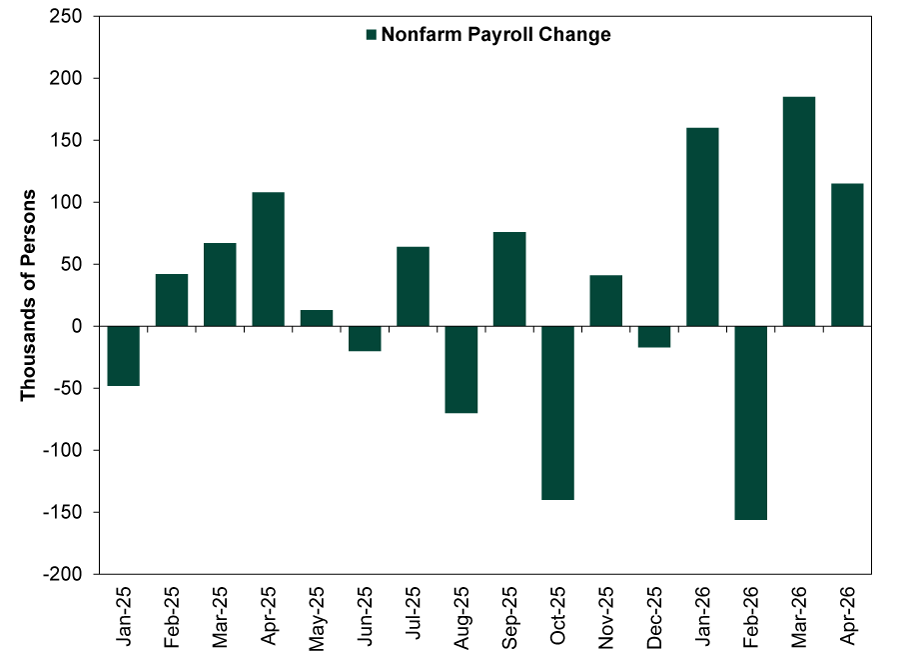
But with April’s second-in-a-row monthly job growth inconveniently disrupting that pattern, the Fed is now ostensibly on hold, removing the reason to be bullish. Rising employment, with oil driving up inflation rates, apparently means neither end of the Fed’s dual mandate (to balance full employment and price stability) supports cuts. Is that an airtight assumption though? While a widely held outlook, we find the alleged links—from rearview labor data to forthcoming interest rate changes (or lack thereof) to stocks’ direction—rather unclear.
We see several problems with the conventional wisdom. First, you can never know what employment means for rate decisions. There is no set definition about what “full” employment or “stable” prices entail exactly or how policymakers think they interact. They are left to Fed members’ interpretation—which has shifted over the years in no predictable way, and judging by incoming Fed head Kevin Warsh’s remarks, could yet again if his opinions hold sway. Also, whether the Fed responds to past data or forecasts where things head (and how they evolve) is an open, unanswerable question.
While we can’t say for sure—we can’t get into their heads (nor would we want to!)—we suspect the concepts are so fuzzy because there is, indeed, no set relationship between employment and prices (however they are defined). But that is just the start of the difficulty. Moving overnight rates around can’t magic supply (housing, healthcare, food, gas, etc.) into existence, never mind jobs. It can affect demand, bluntly, by affecting the yield curve’s shape and, therefore, credit access. But imperfectly and only at a long and variable lag.
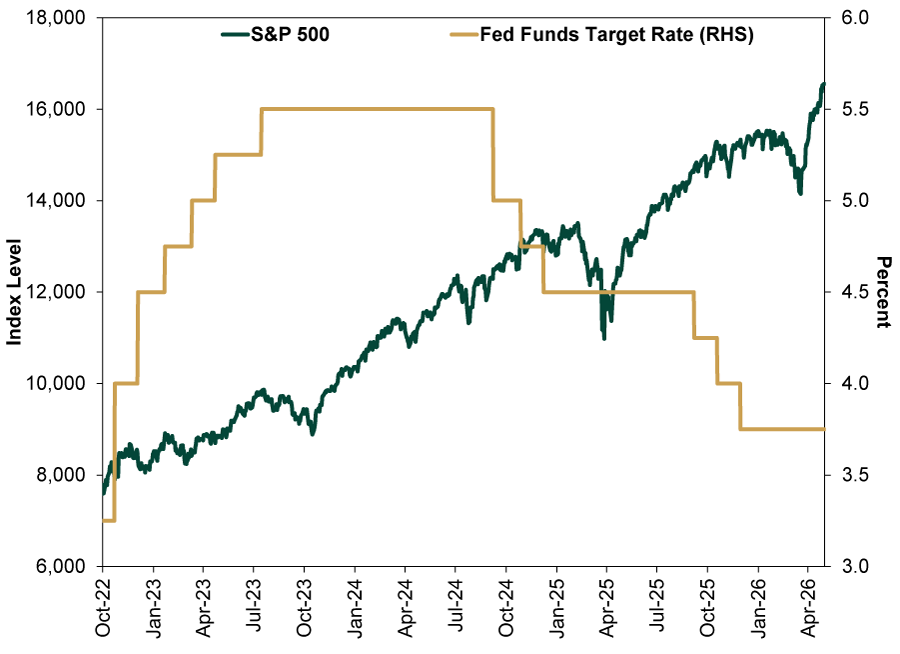
Most importantly for investors, rates don’t drive stocks. Just look at the current market cycle. As Exhibit 2 shows, the bull market started during fast rate hikes, continued over a hold, then cuts, another hold (around Liberation Day), more cuts late last year and this year’s ongoing hold. With rates unchanged since December, stocks are hitting record highs. Where is the evidence stocks need cuts?
Exhibit 2: Stocks Rise Regardless of Rates
Source: FactSet, as of 5/12/2026. S&P 500 total return and fed funds target rate, 10/12/2022 – 5/11/2026.
All markets need is reality to go better than expected. The sound and fury over a non-existent relationship between rates and employment serves only to lower expectations. That makes positive surprise—the secret sauce that feeds bull markets—easier to attain.
If you would like to contact the editors responsible for this article, please message MarketMinder directly.
*The content contained in this article represents only the opinions and viewpoints of the Fisher Investments editorial staff.
Get a weekly roundup of our market insights
Sign up for our weekly e-mail newsletter.

You Imagine Your Future. We Help You Get There.
Are you ready to start your journey to a better financial future?
Where Might the Market Go Next?
Confidently tackle the market’s ups and downs with independent research and analysis that tells you where we think stocks are headed—and why.
Related Resources
-
Economics Checking in on US Consumers2026-10-08
-
Politics Two Elections in the Americas—and Spain’s Coming Snap Vote2026-10-06
-
Weekly Wrap-Up Fisher Investments Reviews: Last Week in Markets — September 28 - October 22026-10-05
-
Market Analysis Budgeting for French Debt Fears2026-10-05





Learn More
Learn why 210,000 clients trust us to manage their money and how Fisher Investments and its affiliates may be able to help you achieve your financial goals.
As of 9/30/2026
New to Fisher? Call Us.
Contact Us Today