


Personal Wealth Management / Economics
Fretting Over Part-Time Work Misses the Full Picture
Handwringing over part-time work says more about sentiment than the state of the economy.

Hey look, a jobs report![i] After months of handwringing over the lack of data due to the government shutdown, the Bureau of Labor Statistics released its first “clean” look at the labor market last week. Naturally, the fretting morphed from concerns about “flying blind” to worries about meager job growth. While December’s jobs report was nothing to write home about, the focus on alternative work arrangements reveals lingering skepticism persists.
December nonfarm payrolls rose by 50,000 after November’s downwardly revised 56,000 addition while the unemployment rate ticked down from 4.5% to 4.4%.[ii] At an industry level, healthcare and social-assistance employment continued its upward trend, climbing by 38,500 in December and bringing the industry to 820,000 jobs added for the year.[iii] While the federal workforce was little changed in December (+2,000), the public sector was one of 2025’s biggest detractors.[iv] Federal payrolls have tumbled -277,000 since January 2025’s peak, the sector’s largest annual drop since 1953.[v]
For 2025, total nonfarm payrolls rose 584,000, an average monthly gain of 49,000, slowing from 2024’s 2.0 million jobs (an average monthly gain of 168,000). Some pointed out 2025’s average monthly job growth was the lowest since 2003 (outside recession years 2020, 2009 and 2008, naturally). However, this was partially tied to the aforementioned decrease in federal government positions. Private sector payrolls—which comprise the bulk of the US economy—rose 733,000 on the year.[vi] This is still a slow pace relative to history and lowest average since 2003 outside recession. Just perhaps not as extreme.
From a high level, jobs growth is still growth. But analysts zeroed in on a “low hire, low fire” labor market, highlighting the plight of some workers who are having a tougher time getting by. The Washington Post warned US workers were “stuck in part-time jobs,” a consequence of the cost-of-living crisis.[vii] That is a supposed economic warning Americans can’t find full-time work and that this “underemployment” trend means the labor market is worsening. While we don’t dismiss anyone’s plight, and it is clear lower-income households continue to struggle under the weight of accumulated price rises, beware extrapolating anything forward-looking from this.
First, folks’ working multiple jobs isn’t unique to this environment. As Exhibit 1 illustrates, a rise in the percentage of folks holding multiple jobs doesn’t tell you much about where the economy is heading. This ratio fell before the 2001 recession, remained relatively stable before the financial crisis and was rising before the pandemic-induced downturn. You could argue the recent rise is just a post-pandemic reversion to normal-ish post-2000 levels.
Exhibit 1: Multiple Jobholders as a Percent of Employed

Source: St. Louis Federal Reserve, as of 1/13/2026. Multiple jobholders as a percent of employed, seasonally adjusted, quarterly, Q1 1994 – Q3 2025.
Now, it is true those working part time for economic reasons (which the BLS categorizes as “involuntary part-time workers” who cannot find full-time employment despite saying they want it) has been rising since 2023, a contrast with recent past economic cycles. (Exhibit 2). Notably, the number of folks working part time for noneconomic reasons has remained generally steady. This is interesting—and it isn’t about people picking up work due to cost-of-living issues. Those would be categorized as noneconomic. Counterintuitive as that may seem, the defining feature of “economic reasons” is they are people who wanted full-time work but couldn’t get it because the labor market was weak.
Exhibit 2: Part-Time Employment for Economic and Noneconomic Reasons Since 2000
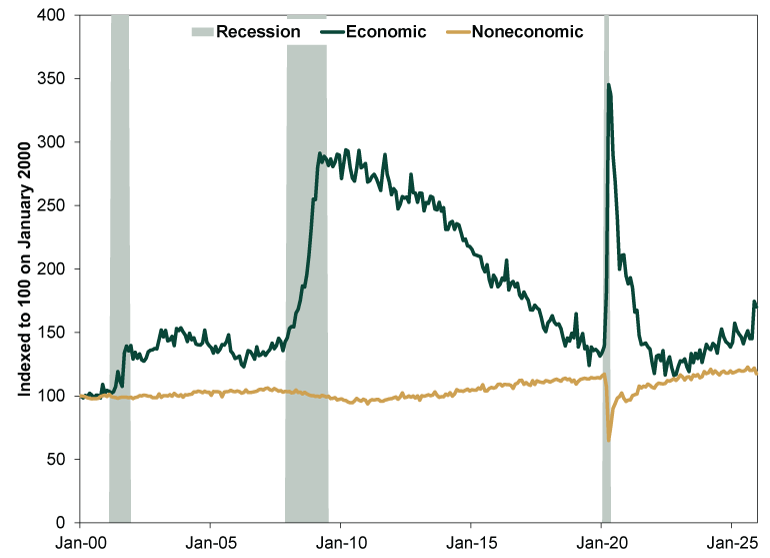
Source: St. Louis Federal Reserve, as of 1/14/2026.
Some pundits think the rise in involuntary part-time work may reflect some anomalies tied to the pandemic. According to a recent San Francisco Federal Reserve Bank study, government-mandated shutdowns led to layoffs and reduced hours, and when restrictions eased, consumer demand surged—prompting businesses to hire accordingly.[viii] But as things returned to normal and demand cooled to prepandemic levels, businesses correspondingly pared back on some full-time positions. The rise in involuntary part-time work has also coincided with an increase in the unemployment rate—perhaps another reflection of the long-running return to postpandemic norms.[ix]
It is important to scale. For all the focus on involuntary part-time workers, they are a minority of the total part-time working population: approximately 5.3 million compared to the 21.8 million who work part-time for noneconomic reasons (e.g., older people who work part-time retail jobs for social reasons, to bolster their budgets or those who have family obligations).[x]
To us, the fretting over part-time work relates to a broader concern: a focus on job “quality.” This type of worry also isn’t new. Back in the 1980s, economic commentators worried about the rise of “McJobs,” which some characterized as “highly routinized” jobs with ... no room for initiative, creativity or even elementary rearrangements.”[xi] This type of work would supposedly imperil young workers in particular, dooming them to a world of “low-skill” jobs. (Never mind that these jobs were always a key source of mad money, tuition and work experience for teens and students, giving them an edge over competitors as they sought entry-level jobs in their chosen fields.)
But “quality” is subjective—and also a sociological conversation, not a market driver. Consider this vastly oversimplified reality: Did the McJobs of the 1980s prevent America’s 1990s expansion—and all the jobs that came with it, including in the burgeoning Internet industry? Clearly not. Jobs in general reflect broader trends (e.g., the industries in favor, the economic cycle, etc.). Said another way, they follow economic growth rather than drive it.
To the extent growth isn’t lifting as many people into full-time employment as would like to be, consider that 2025’s GDP growth wasn’t always as solid as headline numbers implied. It isn’t shocking a slower labor market would follow that. We get many workers may be frustrated with their current situation and we don’t dismiss the personal hardship many face. But from a strictly market perspective, jobs don’t reveal much about the current state of the economy, let alone where it is going. They are backward-looking indicators, reflecting past economic activity (or lack thereof).
Debates over a slowing labor market and the type of work people are doing matter less to markets than the broader backdrop and whether companies are making money. Cold-hearted but true. To us, the negative takes on a still-growing (albeit, slowly) labor market says more about moods toward the economy—a reminder that while sentiment has warmed, it isn’t at euphoric levels yet.
[i] And for those of you on certain social media platforms, you may have even got the news earlier.
[ii] Source: Bureau of Labor Statistics, as of 1/13/2026.
[iii] Source: BLS and FactSet, as of 1/13/2026.
[iv] Ibid.
[v] Ibid.
[vi] Ibid.
[vii] “More Workers Are Stuck in Part-Time Jobs in Warning for the Economy,” Abha Bhattarai, Washington Post, 1/8/2026.
[viii] “Signs of Cyclical Weakness in Part-Time Employment?” Greeshma Avaradi, Stephie Fried, Toby Graf, Marianna Kudlyak and Brandon Miskanic, San Francisco Federal Reserve Bank, 11/3/2025.
[ix] Ibid.
[x] Source: BLS, as of 1/15/2026.
[xi] “The Fast-Food Factories: McJobs Are Bad for Kids,” Amitai Etzioni, Washington Post, 8/24/1986.
If you would like to contact the editors responsible for this article, please message MarketMinder directly.
*The content contained in this article represents only the opinions and viewpoints of the Fisher Investments editorial staff.
Get a weekly roundup of our market insights
Sign up for our weekly e-mail newsletter.

You Imagine Your Future. We Help You Get There.
Are you ready to start your journey to a better financial future?

Where Might the Market Go Next?
Confidently tackle the market’s ups and downs with independent research and analysis that tells you where we think stocks are headed—and why.
Related Resources
-
Expert Commentary This Week in Review | Bull Market Birthday, Q3 Earnings, US Inflation
 2026-10-16
 -
Market Analysis Gradually Then Suddenly, UK Budget Clarity Is Coming2026-10-15
-
Market Analysis On September Inflation, Look Beyond the Headlines2026-10-14
-
Politics Is Canada Building a Stronger Bull Market?2026-10-13




Learn More
Learn why 210,000 clients trust us to manage their money and how Fisher Investments and its affiliates may be able to help you achieve your financial goals.
As of 9/30/2026
New to Fisher? Call Us.
Contact Us Today