


Personal Wealth Management / Market Analysis
How to Better View the Dollar’s Droop? Zoom Out
The dollar isn’t as weak as headlines imply.

Every now and then, something comes along that seemingly everyone is wrong about regardless of whether they think it is good or bad for markets. That something is quite often the US dollar (or currency swings broadly), and it is happening today as headlines shout about it hitting a four-year low versus a basket of major currencies. One camp says it is a sign markets are losing faith in the greenback and US markets in general, threatening the US economy and the dollar’s (totally overhyped) reserve currency status. Another camp says it is a very good thing sure to boost US exports and slash the trade deficit. We think a quick look at recent history shows both camps are wrong, with the dollar’s swings largely irrelevant for stocks.
For one, despite some headlines’ liberal use of words like freefall, the dollar is not actually tanking or excessively weak. Calling today’s level a “four-year low” is both meaningless and telling, considering four years is not a long time. If the dollar is at a four-year low, it means there is some point in recent history when it was even lower.
Instead of arbitrary comparison points, we suggest looking at history to get a more accurate sense of whether the dollar is truly weak. We do so in Exhibit 1, which takes the US Dollar Index back 40 years. As you will see, the dollar has spent a lot of time below today’s levels. A lot of that time was prosperous for the economy and markets alike. Do you remember the great weak dollar crisis of the 1990s? Neither do we—just a rollicking expansion and Tech boom.
Exhibit 1: The Dollar’s Slide in Context

Source: FactSet, as of 1/28/2026. US Dollar Index, 1/27/1986 – 1/27/2026.
If your eyeballs tell you the dollar’s current level looks pretty average, you have good peepers. It is presently a shade higher than the arithmetic mean over this 40-year stretch (96.217 current level versus 93.210 average, if you are curious).[i]
So is this “weak”? Such things are always in the eye of the beholder. So let us look back to Q3 2016, when the dollar was mostly at or below present levels, and see what people said back then. To do this, we can look at companies’ conference calls for the Q3 2016 earnings season to see how executives described currency effects at the time. We did so, and would you believe it, the narrative back then was that the dollar was strong! Several companies blamed the strong dollar for hitting earnings or revenues. Some credited the strong dollar for positive results. Some called it neutral. FactSet has a tool letting us keyword search earnings call transcripts, so we did that for the period October 1, 2016 – December 31, 2016—basically Q3 earnings season. In this span, 118 calls mentioned a strong dollar. Of the 22 hits we got for weak dollar, all were about the Canadian dollar. Loonie!
We are tempted to call the dollar Schrödinger’s cat and be done with it, but all analogies are bad analogies, and we still have some data for you. Because some would say it isn’t the dollar’s level that matters, but the speed of its decline. Thing is, this isn’t unprecedented, either. Sorry to bring up politics, but it is pretty normal for the dollar to decline early in a Republican president’s term. And the dollar this time around is tracking eerily close to its trajectory during President Donald Trump’s first term. You can see this for yourself in Exhibit 2.
Exhibit 2: Dollar Déjà Vu
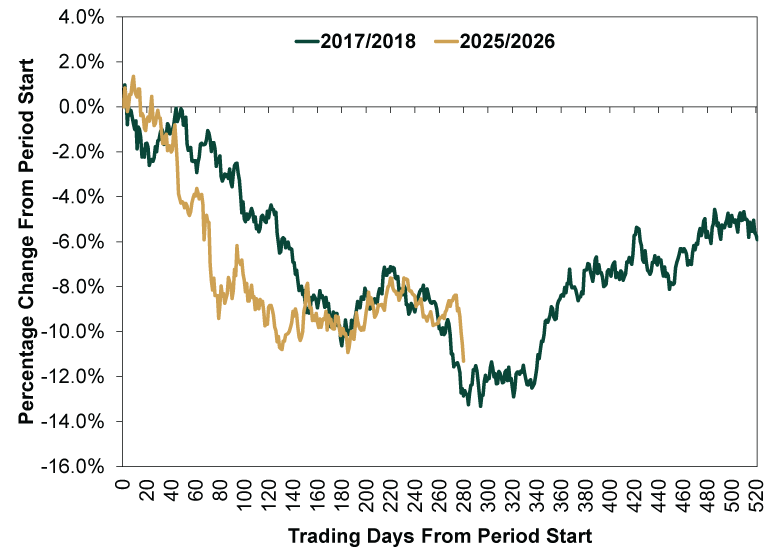
Source: FactSet, as of 1/28/2026. Periods covered are 12/31/2016 – 12/31/2018 and 12/31/2024 – 1/27/2026.
The dollar’s movement did get some attention then, but not with the hyperbolic tone it attracts now, which tells us today’s handwringing is much more about the sociopolitical backdrop than the dollar’s actual movement. That is a sentiment issue, one laced with bias, which risks blinding investors into knee-jerk reactions and bad decisions. We think it is an impulse to check, not an actual sign that the financial environment is uniquely bad today.
Not that the dollar’s weakening is some whopping positive, mind you. We saw some headlines noting Trump and others have heralded the dollar’s decline, calling it a boon for exports and a surefire ticket to a smaller trade deficit. Now, we think the trade gap is a sideshow, as the US economy has done fine for decades with a trade deficit. We understand there are very real concerns about the sociological implications of the country’s overall economic shift from manufacturing to services. It is a painful adjustment for the affected people and communities. But from a pure macroeconomic standpoint, which is what stocks care about, rising trade deficits coincided with rising prosperity, while narrowing trade deficits often coincided with recession and very bad times. The smaller trade deficit was a symptom of recession (declining demand), not a cause. But the trend defies conventional wisdom all the same.
Setting all that aside, though, the question remains: Does a weaker dollar boost exports and reduce the trade deficit? People believe it does since, all else equal, a weak dollar means US exports are cheaper overseas and imports are more expensive, so you should get more exports and fewer imports. But that often doesn’t pan out in real life. Sometimes exporters opt not to cut prices abroad, instead using the exchange rate to boost profits. Sometimes they rely on that extra revenue to offset higher costs of imported parts and labor, which are a weak dollar’s side effects. And a lot of the time they hedge for currency swings, making a lot of these theoretical points moot.
Whatever the reason, Exhibit 3 makes it clear the dollar and trade deficit lack a set relationship. Since modern monthly trade data start in 1992, the trade deficit has grown through long stretches of dollar weakening and strengthening. Looks to us like it is a non-factor.
Exhibit 3: The Dollar and the Trade Deficit
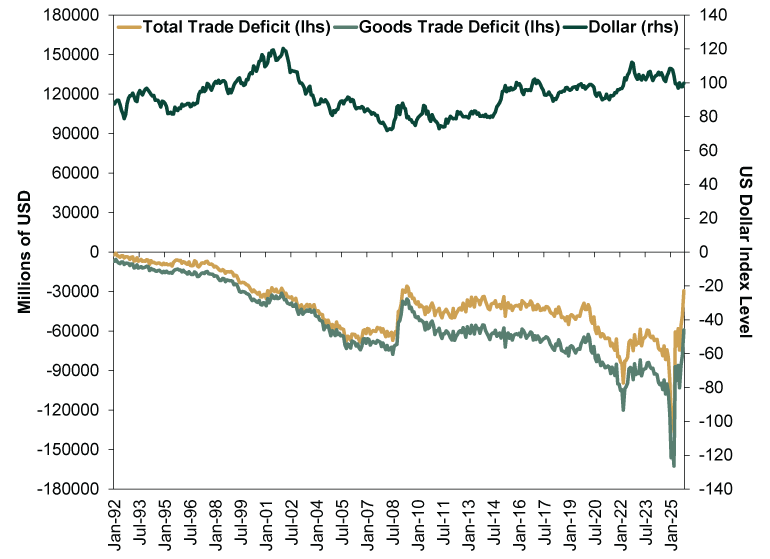
Source: FactSet, as of 1/28/2026.
We think the dollar is most significant as a kind of Rorschach test—a way to gauge sentiment. Normally, people fear the dollar regardless of whether it is strengthening or weakening. A weaker dollar generates headlines like the fearful ones today, with a side dose of warnings that the US will import inflation. A strong dollar tends to generate fear of weak exports hitting the economy and stocks. Today, with some dollar optimism blending with fear, it is another sign of sentiment having warmed considerably. The latent dollar fear is a sign it hasn’t warmed all the way to euphoria, but the growing optimism looks pretty consistent with a maturing bull market—still a backdrop for fine returns.
If you would like to contact the editors responsible for this article, please message MarketMinder directly.
*The content contained in this article represents only the opinions and viewpoints of the Fisher Investments editorial staff.
Get a weekly roundup of our market insights
Sign up for our weekly e-mail newsletter.

You Imagine Your Future. We Help You Get There.
Are you ready to start your journey to a better financial future?
Where Might the Market Go Next?
Confidently tackle the market’s ups and downs with independent research and analysis that tells you where we think stocks are headed—and why.
Related Resources
-
Politics Context for the Noisy Congress to Come2026-10-09
-
Expert Commentary This Week in Review | S&P 500 Record High, Fed Minutes, Spain Election
 2026-10-09
 -
Interesting Market History Notes on a Bear Market Anniversary2026-10-09
-
Economics Checking in on US Consumers2026-10-08



Learn More
Learn why 210,000 clients trust us to manage their money and how Fisher Investments and its affiliates may be able to help you achieve your financial goals.
As of 9/30/2026
New to Fisher? Call Us.
Contact Us Today