


Personal Wealth Management / Market Analysis
On Sentiment and Bond Spreads
Friendly reminder: Sentiment affects bond markets, too.

As we have noted, sentiment has warmed. There are myriad ways to see this, but one ummm … emerged … in financial coverage this week that we think is worth highlighting. Emerging Markets (EM) bonds are generating heaps of praise after a strong 2025. Analysts see strong fund flows boosting returns as investors rotate away from the developed world with its trade deficits and slow growth and toward faster-growing EM with current account surpluses. While there are rational reasons for this good past performance, we think it is worth weighing where things stand before projecting them forward—and some risks for individual investors in forgetting fixed income’s primary portfolio role.
Bond markets have long had this quirk where people forget they, like stocks, move on supply and demand, with sentiment factoring prominently into demand. They also price in widely known information, including fund flows, economic growth rates, current account deficits or surpluses and all the rest. To the extent that any of these moved EM bonds over the past year (and we think the case is overstated and based largely on industry myths about how markets work), they are likely priced to a very great degree. Mind you, we aren’t saying this sets up EM bonds to start underperforming or falling tomorrow, but it is a point to keep in mind.
Here is another one: No bond category moves in a vacuum. Bond markets are diverse and global, just like stocks. There are EM and developed-world sovereign bonds. Investment-grade and junk. Corporate bonds—and within that, investment-grade and high-yield. EM bonds might not be special. They might just be participating in a broader fixed income bull market.
There is an easy way to tell, and it is called credit spreads. Bond yields and prices move in opposite directions, so rallying bond markets correspond with falling yields. At the same time, yields don’t tell you much in absolute terms—you need a reference point. The best one is the 10-year US Treasury yield. Not because Treasurys are perfect, but because the US Treasury market is the world’s deepest and most liquid, making Treasury yields the preferred reference rate. Some call it the “risk-free” rate, which we think goes too far (risk-free doesn’t exist), but you get the drift. If you subtract Treasury yields from whatever category you are assessing and track that over time, you can see whether the market is currently assigning higher or lower risk to that category on a relative basis. A wider spread means a higher risk premium. A lower spread means a lower risk premium, which means you may not be getting compensated well for the higher risk and volatility that comes with non-Treasury assets.
With that out of the way, consider Exhibits 1 – 3, which show spreads of EM, US investment-grade corporate and US high-yield versus 10-year US Treasury yields. All three have fallen substantially since 2022, when recession fears boosted risk premiums dramatically. This is a strong indication this isn’t about EM specifically, but about the bond market in general. Across the board, the more volatile bond types aren’t paying much extra. Spreads are very close to historical lows, which indicates sentiment is rather warm.
Exhibit 1: Emerging Markets Credit Spreads
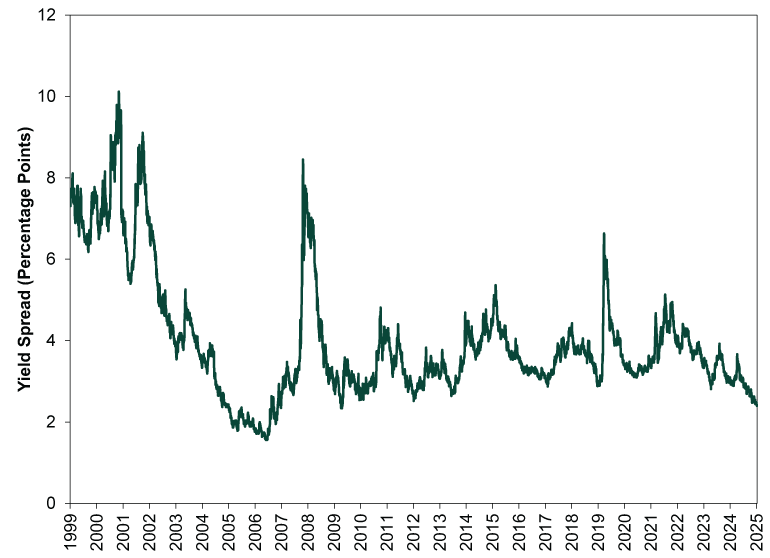
Source: FactSet, as of 1/8/2025. JPMorgan EMBI Global Index yield to maturity and 10-year US Treasury yield (constant maturity), 12/31/1999 – 1/7/2026.
Exhibit 2: US Investment-Grade Corporate Credit Spreads
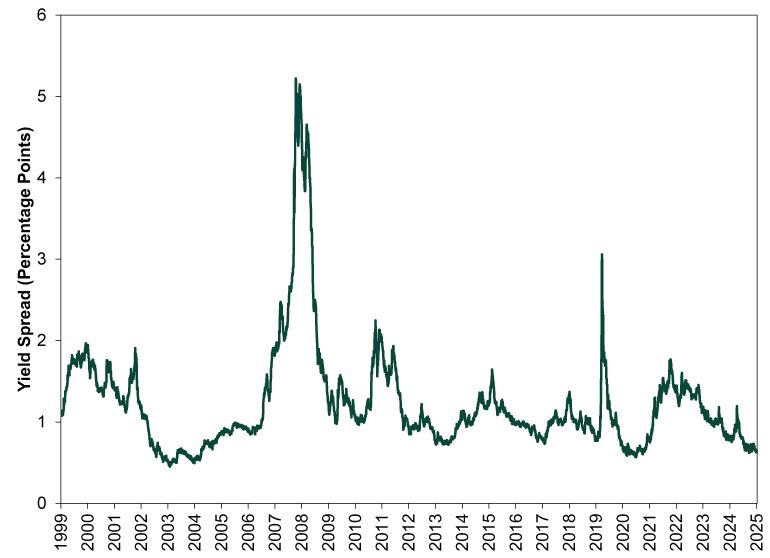
Source: FactSet, as of 1/8/2025. ICE Bofa US Corporate 7-10 Year (AAA-A) Index yield to maturity and 10-year US Treasury yield (constant maturity), 12/31/1999 – 1/7/2026.
Exhibit 3: US High-Yield Credit Spreads
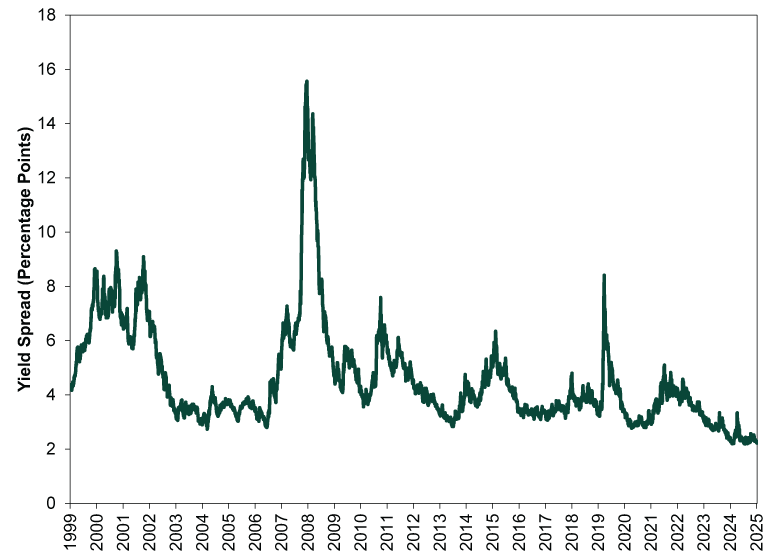
Source: FactSet, as of 1/8/2025. ICE Bofa US Cash Pay High Yield 7-10 Year Index yield to maturity and 10-year US Treasury yield (constant maturity), 12/31/1999 – 1/7/2026.
Again, we aren’t saying this to pooh-pooh any of these bond types. Corporate bonds can benefit from some of the same drivers that propel stocks during an equity bull market. Some exposure in that space may be beneficial to keep a fixed income portfolio diversified. But, for most individual investors, there is a big difference between diversification and heat chasing, which the EM enthusiasm smacks of. While we are bullish today, whenever the next stock bear market does eventually strike, there is a high likelihood it comes with a reset of the business cycle—in other words, a recession. Credit spreads tend to widen when that happens, as investors demand more yield on assets they see as riskier. Again, when yields rise, bond prices fall, which means these previously hot bond types start underperforming. Investors often flock to quality issues like US Treasurys, shunning other types as risky. EM bonds and other lower-quality fixed income instruments may get hit hard in this environment, especially if the snazzy growth rates and current account surpluses attracting so much attention now go poof. Sentiment may be lifting them now, and again, we don’t see that changing in the immediate future. But it is clearly pretty warm, and it can flip fast.
Which brings us to our last critical reminder: If you have some fixed income exposure, remember why. We think bonds’ primary purpose is to reduce expected volatility relative to an all-stock portfolio. More simply, it is to make a portfolio swing less overall, which benefits investors with shorter time horizons and/or higher cash flow needs by reducing the risk of having to sell in down markets to raise cash. Chasing heat in EM or other niche bond types may accomplish the opposite of this.
If you would like to contact the editors responsible for this article, please message MarketMinder directly.
*The content contained in this article represents only the opinions and viewpoints of the Fisher Investments editorial staff.
Get a weekly roundup of our market insights
Sign up for our weekly e-mail newsletter.

You Imagine Your Future. We Help You Get There.
Are you ready to start your journey to a better financial future?
Where Might the Market Go Next?
Confidently tackle the market’s ups and downs with independent research and analysis that tells you where we think stocks are headed—and why.
Related Resources
-
Politics Context for the Noisy Congress to Come2026-10-09
-
Expert Commentary This Week in Review | S&P 500 Record High, Fed Minutes, Spain Election
 2026-10-09
 -
Interesting Market History Notes on a Bear Market Anniversary2026-10-09
-
Economics Checking in on US Consumers2026-10-08




Learn More
Learn why 210,000 clients trust us to manage their money and how Fisher Investments and its affiliates may be able to help you achieve your financial goals.
As of 9/30/2026
New to Fisher? Call Us.
Contact Us Today