


Personal Wealth Management / Market Analysis
Precious Speculations
About those wild moves in gold and silver …

Less than a week after gold and silver soared to fresh highs, all that glitters is now going haywire. Steep plunges on Friday and Monday gave way to big rebounds Tuesday. Headlines now debate whether this is a buying opportunity or a dead-cat bounce, which is weird financespeak for a false rally. We think it all misses the point entirely. Gold and silver have been caught in a bizarre speculative boom, and such things are always impossible to time. If you are in the market for long-term growth, we think you are best off sitting out speculation entirely and focusing on investing.
Here is a cold, hard dose of reality: We have seen this movie before. Gold and silver occasionally go on massive runs together, soar to big spike tops … and then crash. That doesn’t necessarily mean the final crash is underway now. But twice now, we have seen both flip fast and punish late buyers with agonizingly long fallow stretches. Exhibits 1 and 2 show you the full history. Normally, for such long time series, we would show you returns on a logarithmic scale, which shows percentage changes. But in this case, linear returns (price movement in dollars) better capture the mania and aftermath.
Exhibit 1: Gold’s Long History of Boom and Bust
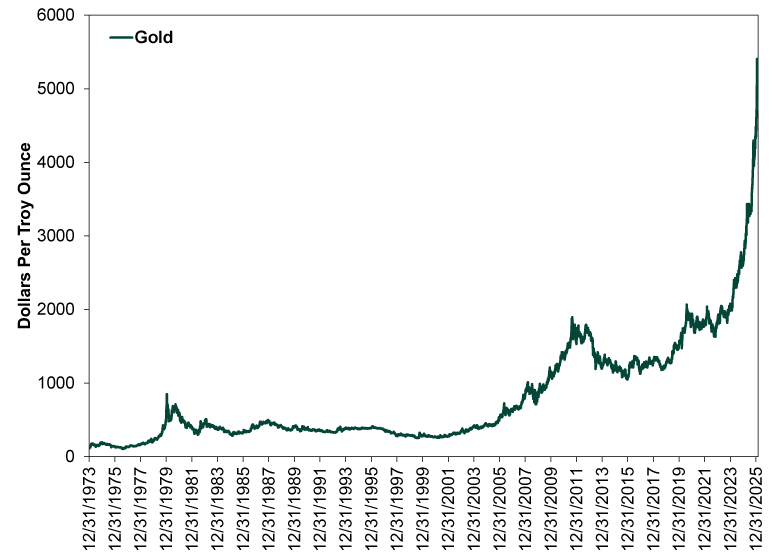
Source: FactSet, as of 2/3/2026. Gold spot price, 12/31/1973 – 2/2/2026.
Exhibit 2: Silver’s Long History of Boom and Bust
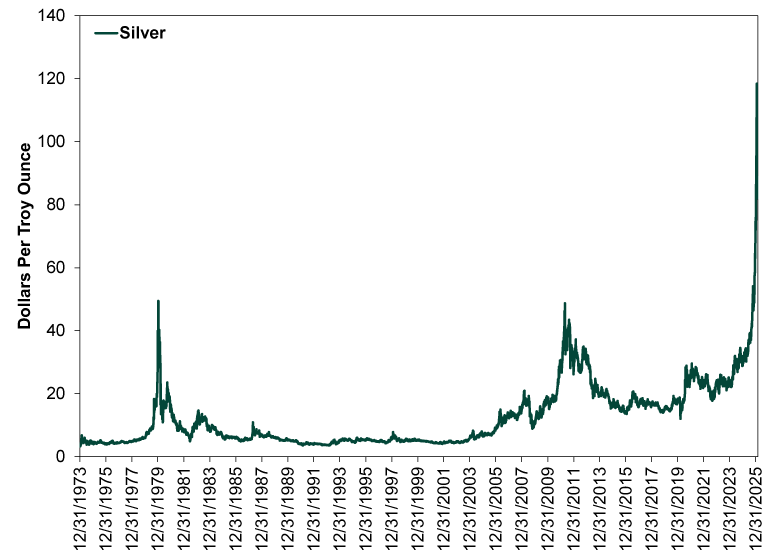
Source: FactSet, as of 2/3/2026. Silver spot price, 12/31/1973 – 2/2/2026.
Those are so zoomed out that you can’t really see the latest price movement, so here are some close-ups. Note that we aren’t intentionally omitting today’s intraday rebounds. We just made these charts before the trading day ended, so there is no official pricing yet.
Exhibit 3: Gold’s Latest Wild Ride
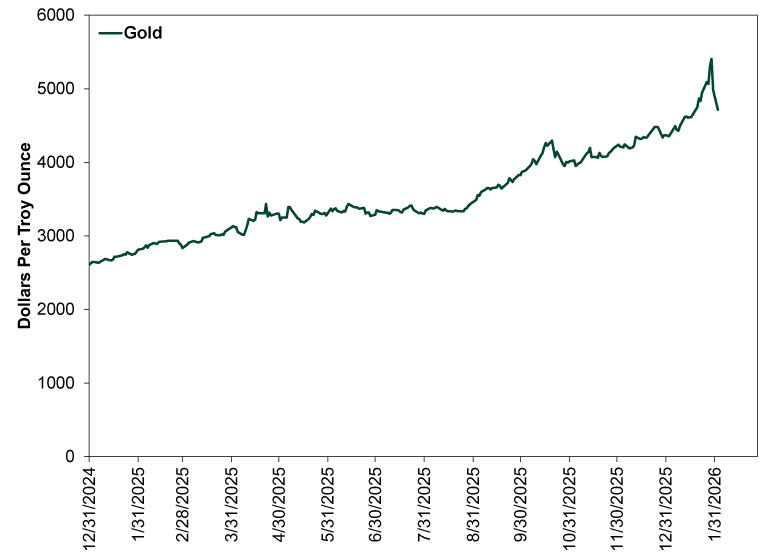
Source: FactSet, as of 2/3/2026. Gold spot price, 12/31/2024 – 2/2/2026.
Exhibit 4: Silver’s Latest Wild Ride
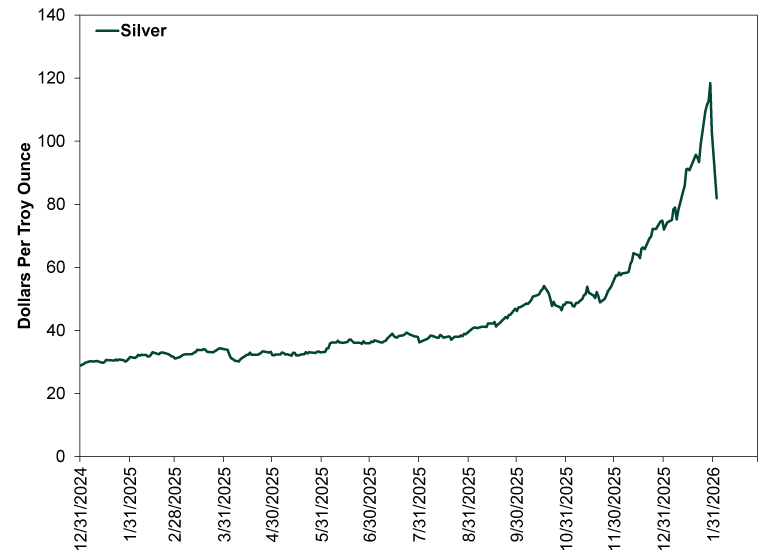
Source: FactSet, as of 2/3/2026. Silver spot price, 12/31/2024 – 2/2/2026.
Anyway, today basically looks like 1980 and 2011 on steroids. These are huge price moves driven by sentiment—pure, frenzied speculation.
But these are different beasts than your garden-variety speculative frenzies. Usually, in an asset bubble, you get a runaway supply increase to match unwarranted demand surges. It happened with dot-com stocks in 2000 and Dutch tulips back in the day. Gold and silver supply is relatively fixed in the short term, given the high investment and long lead times new mines require. So you don’t have surging supply to point to as bubble evidence. You can look only at feelings, visible today in the things people say about gold and silver.
Today’s narrative is simple: The world is a wild, chaotic, unstable place where the dollar is reeling and the only solid, sure foundation is shiny precious metals that will hold their value come what may. It is fear-driven speculation, not greed. Greedy, euphoric people buy stocks, with the only fear a fear of missing out. Fearful people buy metals, fearing currency collapse and hoping their precious metals will be left standing when the old order implodes.[i]
Consider what people are widely crediting for pricking prices Friday: the nomination of Kevin Warsh as Fed head. Until then, people were operating on the expectation that President Donald Trump would pick an aggressively rate-cutting lackey, and they were penciling in runaway inflation—with precious metals the presumed bulwark. (Never mind that the preceding charts show gold and silver aren’t actually inflation hedges—feelings often don’t care about facts.) Instead, Trump picked a guy who focused much more often on inflation risk during his time on the Fed’s governing board and rhetorically shredded Fed asset purchases for their inflation risk and enabling government profligacy.[ii] And as the story goes, this inflation hawk sank his talons in metals prices. Awkward metaphor, but you get the drift. If gold and silver’s run was so flimsy that it depended on widespread Fed fears coming true, that just isn’t a solid foundation.[iii]
And this is the difference between stocks and metals. When stocks enjoy a bull market, the old proverb says they climb a wall of worry. False fears are bricks in the wall, with stocks climbing gradually as investors get over them or realize they were powerless ghost stories. But with silver and gold, when the underlying fear proves false, it destroys the thesis to own. And since it is all feelings-based, it is impossible to time. Worse, silver and gold have much more volatility than stocks—they aren’t a safe haven. They are the opposite: A speculation.
This is why we suggest staying away. Speculating, whether or not you use leverage (but really don’t ever invest with borrowed money), is all about trying to time short-term moves. That means timing ever-fickle feelings. Investing is about having a long-term thesis, like, even though the economy is cyclical, humanity keeps innovating and companies keep finding ways to grow profits, and stocks are the best way to capture that over the decades I need my money to work for me. Within that long-term, there will be bull and bear markets. But unlike the precious metals frenzies, they aren’t purely sentiment-based. Market fundamentals come into play, making it possible to assess conditions and make rational moves based on the probabilities that stocks are in a bull or bear market. Success doesn’t require expert timing of fear and greed’s shifts, as gold and silver do.
So whether or not gold and silver’s peaks have passed, that isn’t the point. If you are investing, it doesn’t matter, because you are focused on your long-term goals and the asset allocation with the highest likelihood of reaching them. Keep your eye there and don’t get distracted by shiny sideshows.
[i] HT: Fisher Investments Research Analyst Luke Puetz.
[ii] We also had beef with this policy, known as “quantitative easing” or “QE,” though our reasoning was different. QE flattened the yield curve and slowed bank lending, making it a deflationary and contractionary policy, not inflationary. So we caution against presuming Warsh’s dislike of QE is a sign he will shepherd sensible monetary policy that correctly accounts for banks’ role in money supply creation.
[iii] Same goes for a Greenland military takeover, a dollar death spiral and all the other heightened fears that allegedly made gold an attractive choice in recent months.
If you would like to contact the editors responsible for this article, please message MarketMinder directly.
*The content contained in this article represents only the opinions and viewpoints of the Fisher Investments editorial staff.
Get a weekly roundup of our market insights
Sign up for our weekly e-mail newsletter.

You Imagine Your Future. We Help You Get There.
Are you ready to start your journey to a better financial future?
Where Might the Market Go Next?
Confidently tackle the market’s ups and downs with independent research and analysis that tells you where we think stocks are headed—and why.
Related Resources
-
In The News Will France’s Protests Disrupt Growth?2026-10-26
-
Market Analysis The Sentiment Cooldown Unfolding2026-10-26
-
Market Analysis Earnings Ghost Stories2026-10-26
-
Weekly Wrap-Up Fisher Investments Reviews: Last Week in Markets — October 19 - October 232026-10-26





Learn More
Learn why 210,000 clients trust us to manage their money and how Fisher Investments and its affiliates may be able to help you achieve your financial goals.
As of 9/30/2026
New to Fisher? Call Us.
Contact Us Today