


Personal Wealth Management / Economics
Putting Choppy Labor Data in Proper Perspective
Job markets may be choppy and hiring has slowed, but it is a mistake to overrate the economic consequences for growth and stocks.

The Bureau of Labor Statistics (BLS) reported -92,000 February job losses last Friday, spurring worry the economy’s employment engine is sputtering—and triggering concerns consumption will slow and hit markets. But there are two problems with this narrative: One, while jobs data have been rocky, the income work generates continues growing at a healthy clip. Two, none of this says much about where the economy is heading.
As Exhibit 1 shows, job growth has been rather erratic over the last year. This is due to a series of unrelated one-offs. In revised data, January 2025 payrolls fell by -48,000. Hiring stabilized over the ensuing four months but began alternating between losses and gains in June—flip-flopping that persisted through February.
Exhibit 1: Employment Hit Some Turbulence Since Summer
Source: Federal Reserve Bank of St. Louis, as of 3/6/2026.
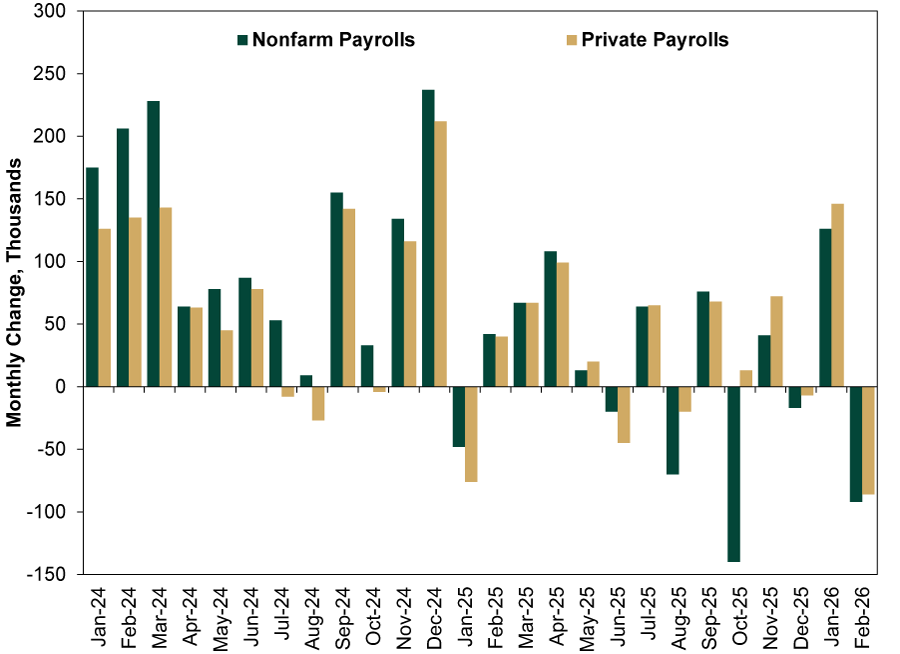
The most consistent drag? Federal employment. October illustrates this best, with its overall -140,000 payroll decline fanning some fear. But the culprit was delayed federal workforce reductions hitting en masse—while private payrolls rose 13,000. Although that was the most negative month, federal payrolls fell all year—a widely known, intentional factor. In the 12 months through February, federal layoffs total -314,000.
February 2026 saw -10,000 of those. But it wasn’t the month’s main source of weakness. February’s fall included a -31,000 decrease from striking healthcare workers. Blizzards blanketing much of the country also appeared to freeze hiring, resulting in payroll declines in construction and transportation. Private education services also shed some -16,000 positions, although this follows a large jump in January and may be little more than a seasonal adjustment quirk.
In sum, private-sector employment dropped -86,000 last month, the most since 2020’s pandemic lockdowns and 2008 – 2009’s global financial crisis before that. But with the strike since resolved and unusually severe winter weather abating, factors contributing to this private-sector drop don’t appear to be a durable trend. We shall see.
Many contend, though, that once you average out the chop, the trend shows weakening job growth. Fair enough. Over the last 12 months, monthly job growth averages 13,000 (33,000 private). Not great, compared to 2024’s 122,000 per month average (85,000 private) or, say, 2019’s prepandemic 165,000 (148,000 private).
Part of this is likely a reversal of big hiring trends in 2021 and 2022. Tariff uncertainty may also play a role, with manufacturing jobs still going downhill despite reshoring chatter. Others blame AI, but the data aren’t clear. Information services saw -11,000 job losses last month, continuing a 12-month slide averaging -5,000 per month. But that broad category isn’t all software—some is in publishing, motion pictures, telecom and more. We will need to wait for next month’s revision to see data at that level. Besides, although many companies hype AI as behind layoffs, some appear to be doing so as an excuse for other decisions that haven’t worked out.
At a higher level, though, this won’t tell you much about where the economy heads. While those trends may or may not persist, they hold little relevance for investors. Employment doesn’t dictate growth. Consider: 2025’s average monthly job growth of 10,000 last year was far lower than 2024’s 122,000. Yet annual GDP grew 2.5% in 2025, just a tick slower than 2024’s 2.6%.[i]
Why? What matters for consumption—the bulk of US GDP—isn’t employment, which is backward looking, but households’ overall income. A big part of that is their take-home pay, which the BLS tallies in aggregate payrolls, counting up all hours worked and multiplying that by their average hourly earnings. Aggregate payrolls rose 4.7% y/y in February, above its 4.5% 12-month average and 2011 – 2020’s (prepandemic) 4.4% decade-long monthly average.[ii]
Consumption isn’t growth’s swing factor though. The bulk of it is nondiscretionary. Think rent, utilities, insurance, healthcare, food and commuting expenses. Spending on these items doesn’t tend to waver much whether the economy is expanding or contracting. So then, what is the economic hinge between growth and recession? Business investment. Capital expenditures power economic cycles, with recession typically starting as tighter credit forces overextended businesses to cancel projects and slash spending. Headcount typically doesn’t start falling until after recession begins, once businesses have exhausted other ways to cut costs without losing the good people they spent so much time and money training (and whose eventual replacements in a recovery will also be costly). With credit and investment humming along for now, recession doesn’t look nigh.
If you would like to contact the editors responsible for this article, please message MarketMinder directly.
*The content contained in this article represents only the opinions and viewpoints of the Fisher Investments editorial staff.
Get a weekly roundup of our market insights
Sign up for our weekly e-mail newsletter.

You Imagine Your Future. We Help You Get There.
Are you ready to start your journey to a better financial future?

Where Might the Market Go Next?
Confidently tackle the market’s ups and downs with independent research and analysis that tells you where we think stocks are headed—and why.
Related Resources
-
Market Analysis On September Inflation, Look Beyond the Headlines2026-10-14
-
Politics Is Canada Building a Stronger Bull Market?2026-10-13
-
Market Analysis Don’t Overstate AI’s Threat to Bank Profits2026-10-13
-
Weekly Wrap-Up Fisher Investments Reviews: Last Week in Markets — October 5 - October 92026-10-12





Learn More
Learn why 210,000 clients trust us to manage their money and how Fisher Investments and its affiliates may be able to help you achieve your financial goals.
As of 9/30/2026
New to Fisher? Call Us.
Contact Us Today