


Personal Wealth Management / Market Analysis
Putting the Latest Private Credit Implosion in Perspective
Why another private-credit lender’s collapse isn’t a canary in the coal mine.

Editors’ Note: MarketMinder doesn’t make individual security recommendations. Those mentioned here merely represent the broader theme we wish to highlight.
Last Friday, before the Iran war stole every headline, bank stock volatility was the news du jour. At issue: London-based specialized private lender Market Financial Solutions (MFS) collapsed into default, stinging financial firms that lent to it. The news renewed broader concerns of a private credit washout, tying it back to two defaults last year. We think this case is an isolated issue rather than a sign of contagion risk or broadly deteriorating economic conditions—more of a false fear than threat to the global bull market.
MFS specialized in a niche form of lending: making short-term bridge loans for time-sensitive property purchases. Creditors accused the lender of fraud and “double-pledging” assets, i.e., using the same asset as collateral for multiple loans. Court administrators suspect a collateral shortfall of £930 million ($1.3 billion).[i] MFS’s collapse follows two small US firms (Tricolor and First Brands) that declared bankruptcy late last year for similar reasons.
Some experts claim bank stock volatility signals broader trouble. Several onlookers warn conditions look similar to the run-up before the 2008 financial crisis, and news of MFS’s implosion did weigh on its creditor banks and contributed to broader industry volatility. US banks fell -3.8% last Friday, much sharper than the US Financials sector (-2.1%) or headline MSCI USA index (-0.4%).[ii] Similarly, global banks (-1.9%) dropped much more than global stocks (-0.2%).[iii] However, while fear can drive a short-term selloff, recent history and scaling can help put potential fallout in perspective.
First, concerns about failing private credit lenders aren’t new—a major bank boss called out supposed “cockroaches” last year after First Brands and Tricolor collapsed. For all the worries about private credit, the market doesn’t appear to indicate major, systemic trouble. Banks large and small are outperforming both the Financials sector and global stocks over the past nine months despite recent private-credit casualties. (Exhibit 1) Said another way, the businesses with exposure to the supposedly problematic part of the market are doing pretty well. So perhaps the latest fears are a bit overwrought?
Exhibit 1: Private Credit Troubles Aren’t Scaring Markets
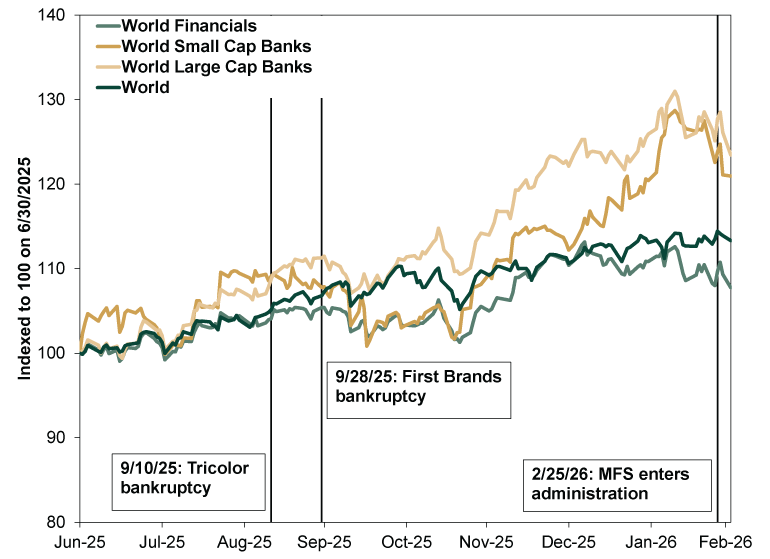
Source: FactSet, as of 3/3/2026. MSCI World Financials sector, MSCI World Large Cap Banks, MSCI World Small Cap Banks and MSCI World Index returns with net dividends, 6/30/2025 – 3/2/2026. Indexed to 100 on 6/30/2025.
More broadly, fears a private credit wipeout will spill into global markets are misplaced today. While estimates of the market’s size vary—one financial services firm estimates the addressable market for private credit is over $40 trillion (including investment-grade credit)—the more important consideration is a transmission mechanism (or lack thereof).[iv] During the 2007 – 2009 financial crisis, mark-to-market accounting rule FAS 157 forced banks to treat assets equally for accounting purposes, no matter how thinly traded or hard to value they were. It became a problem when banks had to take a writedown whenever another firm sold a comparable illiquid asset at a firesale price—even if they had no plans to ever sell them. That selling rippled across banks’ balance sheets worldwide.
Private credit trouble doesn’t currently appear to have a similar direct way to enter traditional markets. Moreover, the point of private lending is that the lender’s time horizon is long, matching the loan’s duration. If credit issues arise, it is unclear it would do much other than maybe pause or slow future private loan access. Now, there are other risks to be aware of, e.g., investors selling their liquid securities because they can’t exit their illiquid private investments. But that is only a possibility, not something occurring right now.
Concerns about the financial system’s health—especially when headlines tie this volatility to other, unrelated areas (e.g., the software industry’s selloff or AI fears at large)—are the latest example of fearful sentiment overshadowing greed this year. To be clear, we don’t dismiss the possibility of a private credit blowup. But it would likely require vast deterioration or a major regulatory shift, neither of which has manifested yet.
H/T: Fisher Investments Research Analysts Isaiah Wahlstrom and Tom Cole
[i] “Wall Street Hit by UK Mortgage Lender Collapse, Raising Fears of More Credit 'Cockroaches,’” Staff, Reuters, 2/27/2026.
[ii] Source: FactSet, as of 3/3/2026. MSCI USA – Banks, MSCI USA – Financials and MSCI USA Index return with gross dividends on 2/27/2026.
[iii] Source: FactSet, as of 3/4/2026. MSCI World Banks and MSCI World Index return with net dividends on 2/27/2026.
[iv] “Blue Owl Turmoil Adds to Strain in $2 Trillion US Private Credit Sector,” Saeed Azhar, Saqib Iqbal Ahmed and Matt Tracy, Reuters, 2/27/2026.
If you would like to contact the editors responsible for this article, please message MarketMinder directly.
*The content contained in this article represents only the opinions and viewpoints of the Fisher Investments editorial staff.
Get a weekly roundup of our market insights
Sign up for our weekly e-mail newsletter.

You Imagine Your Future. We Help You Get There.
Are you ready to start your journey to a better financial future?

Where Might the Market Go Next?
Confidently tackle the market’s ups and downs with independent research and analysis that tells you where we think stocks are headed—and why.
Related Resources
-
In The News Will France’s Protests Disrupt Growth?2026-10-26
-
Market Analysis The Sentiment Cooldown Unfolding2026-10-26
-
Market Analysis Earnings Ghost Stories2026-10-26
-
Weekly Wrap-Up Fisher Investments Reviews: Last Week in Markets — October 19 - October 232026-10-26





Learn More
Learn why 210,000 clients trust us to manage their money and how Fisher Investments and its affiliates may be able to help you achieve your financial goals.
As of 9/30/2026
New to Fisher? Call Us.
Contact Us Today