


Personal Wealth Management / Market Analysis
Stay Calm Amid the Middle East Storm
Stocks don’t run on timetables, and volatility can end as quickly as it starts.

Markets’ panic over Middle East conflict continued Tuesday, with European and Asian stocks taking it on the chin again as oil and European and Asian natural gas jumped a second day. The S&P 500 opened down, as it did Monday, then spent most of the day paring losses to finish down -0.9%.[i] Our views haven’t changed since yesterday: We still think this is a sentiment reaction, not markets pricing a suddenly higher likelihood of a long energy shortage and economic catastrophe. Staying calm through the swings is key.
While regional conflict’s market impact is usually fleeting, the wobbles have no preset time or magnitude. In 2022, after Russia invaded Ukraine, volatility lingered a while as investors grappled with the potential for a wider-ranging war on European soil (remember all the “who’s next” talk involving Moldova, Finland and the Baltic states?) and the risk of a nuclear attack. Some of those fears might seem quaint now, four years after the fact, but the sense of doom was palpable. European stocks sank, falling -12.0% between their pre-invasion close and March 8.[ii] That was a rough two-plus weeks of dread as markets priced the conflict, escalation fears and the economic blowback from sanctions, including a potential oil shock. In that same window, Brent crude skyrocketed from $99.29 per barrel to $133.18.[iii]
But then both reversed. Oil was back below pre-invasion levels by mid-April. European stocks regained pre-invasion levels by late March. That wasn’t the end of fear and volatility, but it shows the initial shock didn’t last—it took further, separate fears to drive markets down into bear market territory from there.
When conflict escalates quickly, it is a scramble. Markets continually get new information, fast and furious, and the fog of war is thick. They digest all of this real-time, initially with a lot of emotion, and often leap to worst-case scenarios. So it isn’t terribly surprising stocks’ negativity escalated Tuesday. Ditto oil and natural gas’s surge. Just think of all the developments over the last 24 hours: British and French ships mobilizing; air strikes on a base in Cyprus, taking the fighting from the Middle East to the Eastern edge of the European Mediterranean; attacks on the US embassy in Saudi Arabia; reports of horrific destruction in Tehran; warnings that Gulf nations’ air defenses will be exhausted in a week; more natural gas production sidelined in Qatar; and reports of tanker traffic in the Strait of Hormuz slowing to a trickle. It is a lot for markets to deal with at once.
That kind of snowballing can easily lead to panic selling as investors envision wider war erupting. But for now, much as the conflict has spread, the nations taking fire presently combine to about 3.4% of global GDP.[iv] And artillery fire and drones aren’t wiping out all of it. As the shock wears off, this is what markets should see.
Plus, the fog is starting to clear. Shipping trackers reported a few cargo ships and tankers made it through the Strait of Hormuz Monday and Tuesday.[v] Some were attacked but carried on. The implication: For all Iran’s talk of the Strait being “closed,” it looks more like a voluntary decision by the ships themselves to wait. We see a simple purpose and logic to this: Several leading maritime insurance providers canceled their war risk coverage Monday, stranding ships financially. Now the calculus is changing: On Tuesday, President Donald Trump announced the US Development Finance Corporation will provide insurance and guarantees to all shipping lines operating in the region, filling the void left by private insurers.[vi] He also stated the US Navy will begin escorting tankers and cargo ships through the Strait, echoing the naval response to Yemen’s Houthi rebels attacking ships in the Red Sea in 2023. This isn’t everyone’s first rodeo. There is a blueprint.
Meanwhile, on the natural gas front, while European and Asian prices jumped again, US prices merely inched higher for the second day in a row. This, despite abundant talk of US exports being the solution to any lasting shortages from Qatar or other Middle Eastern producers. Now, that talk is probably true. Ten years after the US began exporting liquefied natural gas from the terminal at Sabine Pass, LA, it is a top international supplier. There are now seven operational export terminals along the Gulf of Mexico and eastern seaboard, plus an eighth in Alaska.[vii] The US is a major international player in gas exports.
But as we noted yesterday, if there were going to be a sudden, huge competition for US supply, prices would probably jump to reflect that. But Henry Hub futures settled at $3.04 per million British thermal units Tuesday, remaining at pre-January Snowmageddon levels. For all the fear ripping through European and Asian natural gas benchmarks, US prices aren’t presently registering a demand surge. (Exhibit 1) And European and Asian prices, though up, remain well short of 2022’s panic-driven highs.
Ultimately, we think patience and time are called for now. Short-term volatility after conflict breaks out is common. But with a little time, we suspect markets will look past excess fears of wider war and worst-case scenarios and start seeing that, economically, the world didn’t change overnight.
Exhibit 1: Global Natural Gas at a Glance
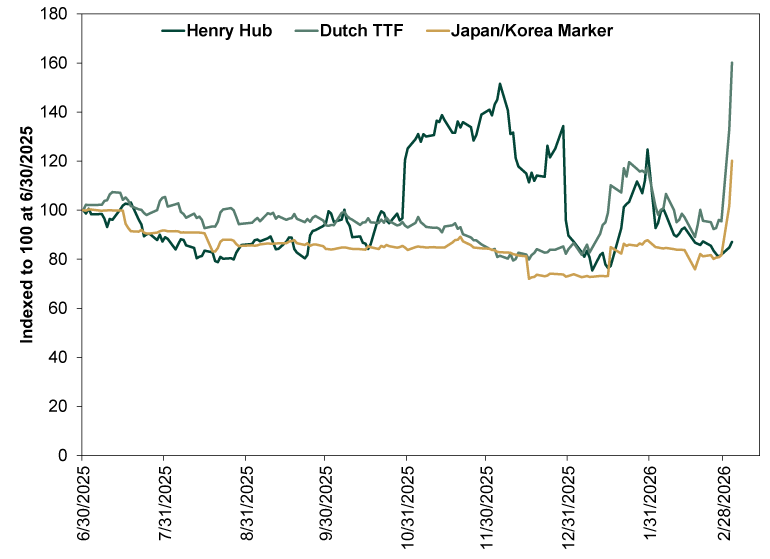
Source: FactSet, as of 3/3/2026. Henry Hub, Dutch TTF and Japan/Korea Marker natural gas prices, 6/30/2025 – 3/3/2026. Indexed to 100 at 6/30/2025 to account for currency and measurement unit differences.
[i] Source: FactSet, as of 3/3/2026. S&P 500 price return on 3/2/2026.
[ii] Ibid. MSCI Europe return in USD with net dividends, 2/23/2022 – 3/8/2022.
[iii] Ibid. Brent crude oil price, 2/23/2022 – 3/8/2022.
[iv] Source: World Bank, as of 3/3/2026. Based on 2023 nominal GDP in USD, the most recent year with complete data for all affected countries (Bahrain, UAE, Cyprus, Iran, Iraq, Israel, Jordan, Kuwait, Lebanon, Oman, Qatar and Saudi Arabia).
[v] “China Calls for Vessels in Strait of Hormuz to Be Protected Amid Soaring Shipping Costs,” Joanna Partridge, The Guardian, 3/3/2026.
[vi] “Trump: US Navy May Escort Tankers Through Strait of Hormuz, More European Warships en Route to Med,” US Naval Institute, 3/3/2026.
[vii] Source: US Federal Energy Regulatory Commission, as of 3/3/2026.
If you would like to contact the editors responsible for this article, please message MarketMinder directly.
*The content contained in this article represents only the opinions and viewpoints of the Fisher Investments editorial staff.
Get a weekly roundup of our market insights
Sign up for our weekly e-mail newsletter.

You Imagine Your Future. We Help You Get There.
Are you ready to start your journey to a better financial future?
Where Might the Market Go Next?
Confidently tackle the market’s ups and downs with independent research and analysis that tells you where we think stocks are headed—and why.
Related Resources
-
Market Analysis On September Inflation, Look Beyond the Headlines2026-10-14
-
Politics Is Canada Building a Stronger Bull Market?2026-10-13
-
Market Analysis Don’t Overstate AI’s Threat to Bank Profits2026-10-13
-
Weekly Wrap-Up Fisher Investments Reviews: Last Week in Markets — October 5 - October 92026-10-12





Learn More
Learn why 210,000 clients trust us to manage their money and how Fisher Investments and its affiliates may be able to help you achieve your financial goals.
As of 9/30/2026
New to Fisher? Call Us.
Contact Us Today