


Personal Wealth Management / Politics
Takaichi Completes Japan’s LDP Turnaround
What does Japan’s election surprise mean for stocks?

Editors’ Note: MarketMinder is politically agnostic. We prefer no politician nor any party and assess developments for their economic and market implications only.
Every now and then, an election reminds the world polling isn’t predictive. So it went in Japan Sunday, where the ruling Liberal Democratic Party (LDP) pulled off the improbable, translating its weak polling figures to its largest-ever majority in the lower house. Prime Minister Sanae Takaichi now has a supermajority in the body, enabling her to override gridlock in the upper house. Japanese stocks soared, as did the predictable rumblings about debt troubles. On both fronts, sentiment seems overdone. We are bullish on Japan, but “fiscal stimulus” isn’t why.
Throughout the campaign, gridlock looked like the probable outcome. The LDP’s poll numbers had recovered from recent lows but remained down from polling ahead of 2024’s election, when voters punished the party for its fundraising scandal by relegating it to a minority government. Overcoming this hinged on two wildcards: Takaichi’s high personal popularity overriding voters’ feelings about the LDP and the opposition failing to catch fire during the short campaign. Both happened. Takaichi’s style and substance won people over, while the newly organized Centrist Reform Alliance (CRA)—a marriage of the traditional opposition Constitutional Democratic Party for Japan and the LDP’s former longtime coalition partner, Komeito—flopped. It lost a whopping 118 seats, the exact amount the LDP gained, and its co-leaders resigned Monday.
The LDP now has 316 seats in the 465-seat lower house. Its coalition partner, the Japan Innovation Party (Ishin) gained 2, winning 36 total. Takaichi wants to continue the coalition, which would have 352 seats, but Ishin is presently sizing up the situation.
Either way, Takaichi has a big mandate, putting her fiscal policy proposals in the spotlight. She has touted suspending Japan’s consumption tax on food and beverages for two years, and her pledge to do so without raising the deficit is fueling speculation that she will dip into Japan’s $1.4 trillion foreign currency reserve stockpile.[i] Higher public investment is also on the agenda, as is constitutional revision. Several of the stocks soaring Monday are presumptive beneficiaries of forthcoming government largesse as well as perceived winners from a weak yen.
We have seen this movie before. When the late Shinzo Abe won a supermajority in 2012 (and again in 2017), investors cheered his “three arrows” economic agenda—fiscal stimulus, monetary easing and deep economic reforms. All happened, to varying degrees. But the weak yen didn’t create a virtuous cycle of exports and investment. Instead, exports rose in value terms but slumped in volume terms, indicating businesses were profiting off currency translation instead of raising output and market share. As Exhibit 1 shows, whenever the yen entered a sustained slide, export values would diverge wildly from volumes—a trend continuing under Abe’s successors.
Exhibit 1: Japanese Trade and the Weak Yen
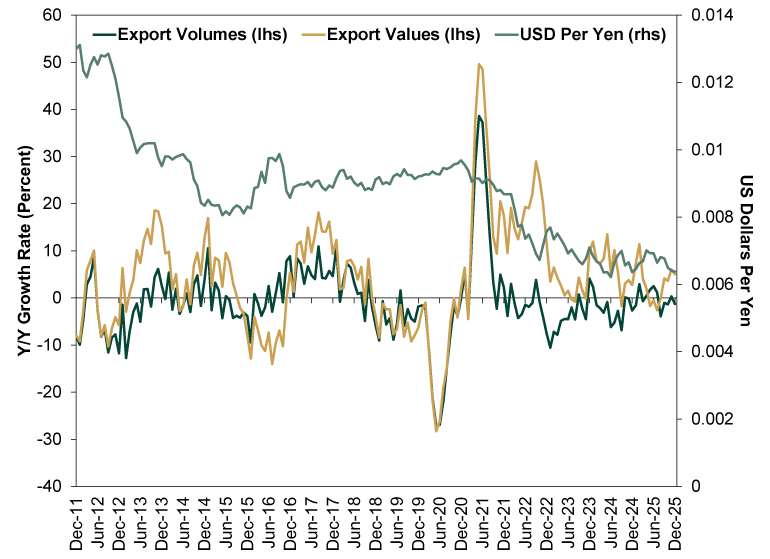
Source: FactSet, as of 2/9/2026. Japan export values and volumes (quantum index) and month-end Japanese Yen/US Dollar exchange rate, December 2011 – December 2025.
Some beneficial reforms went through, including corporate tax cuts, corporate governance reforms and the completion of Japan Post’s privatization, but even a supermajority wasn’t enough to get labor market reform across the finish line. Instead, constitutional amendment—which was and remains contentious—occupied an ever-larger share of the government’s attention, denting its political capital and stalling reforms.
For Abe, constitutional amendment meant altering Article 9, which renounces Japan’s sovereign right to warfare. Takaichi has not directly said which provisions she wants to amend, but some analysts see Article 9 when reading between the lines of her various comments. Regardless, any amendment would require a two-thirds majority in both houses and a majority in a public referendum. The LDP lacks an upper-house majority, so this is a very tall order. Focusing on it could create gridlock, much as it did under Abe at times. This is one source of uncertainty to watch.
Beyond that, we don’t see much benefit from fiscal stimulus. Many, many past governments have tried to jumpstart growth through higher spending and investment. Mostly, it amounted to short sugar highs. Businesses would pull forward planned investments to take advantage of new government programs, then activity would level off. Repeated stimulus did nothing to bust Japan out of its infamous lost decade(s). As for suspending the consumption tax, if prior hikes didn’t quash spending beyond short-term effects that pulled and pushed demand around, we doubt a temporary cut does much. So arguing stimulus is suddenly a long-term stock market positive seems a stretch.
Yet we also don’t think Japan needs stimulus. Its economy is doing pretty well on its own. The yield curve is steep, helping money supply growth reaccelerate late last year. Loan growth is also up, hitting 4.5% in January.[ii] Reopening nuclear power plants is helping reduce reliance on liquefied natural gas (LNG) imports, making Japanese electricity prices less sensitive to currency swings. Yes, there were weak patches last year, but that stemmed from tariff-induced trade disruptions and a change to the permitting code, which hammered real estate investment in Q3. Private domestic demand looks overall fine. Household spending and business investment have the occasional hiccup, but Japan is in line with the rest of the world on that front. The pockets of strength generally outweigh the pockets of weakness.
Japanese stocks have done just fine without aggressive fiscal stimulus, too. Abe’s reforms are starting to bear fruit: The MSCI Japan’s return on equity surged from 5.8% at 2012’s end to 10.1% in December 2025, a bigger increase in this measure of constituent firms’ profitability than the rest of the world enjoyed in that span.[iii] Reform is a slow burn—a structural factor, not a cyclical driver. But in past decades, Japan had a lot of structural headwinds. There are far fewer now, which should help Japanese stocks continue participating in this global bull market.
Helpfully, the wall of worry is also high. Rampant debt concerns help counterbalance “Takaichi Trade” enthusiasm (fears that remain false, as we have discussed). So do foreign policy jitters amid speculation Takaichi’s victory could lead to more Chinese tourism boycotts. Repurposing forex reserve profits to fund tax cuts, should that happen, would probably touch some nerves. So while we do think the initial enthusiasm for Takaichi’s victory may be overoptimistic, there is plenty of skepticism to keep stocks from getting too far out over their skis as the year rolls on.
If you would like to contact the editors responsible for this article, please message MarketMinder directly.
*The content contained in this article represents only the opinions and viewpoints of the Fisher Investments editorial staff.
Get a weekly roundup of our market insights
Sign up for our weekly e-mail newsletter.

You Imagine Your Future. We Help You Get There.
Are you ready to start your journey to a better financial future?

Where Might the Market Go Next?
Confidently tackle the market’s ups and downs with independent research and analysis that tells you where we think stocks are headed—and why.
Related Resources
-
Market Analysis On September Inflation, Look Beyond the Headlines2026-10-14
-
Politics Is Canada Building a Stronger Bull Market?2026-10-13
-
Market Analysis Don’t Overstate AI’s Threat to Bank Profits2026-10-13
-
Weekly Wrap-Up Fisher Investments Reviews: Last Week in Markets — October 5 - October 92026-10-12





Learn More
Learn why 210,000 clients trust us to manage their money and how Fisher Investments and its affiliates may be able to help you achieve your financial goals.
As of 9/30/2026
New to Fisher? Call Us.
Contact Us Today