


Personal Wealth Management / Market Analysis
The Swift Recovery Isn’t Special
Stocks are following their standard regional conflict playbook.

Is the market wrong? The MSCI World Index hit all-time highs midmonth, then barely blinked as chaos continued in the Strait of Hormuz. Ditto the S&P 500, closing Friday at new highs. Headlines worldwide say the quick round trip, completed as conflict continues, is unusual, a sign complacent investors are unwisely shrugging off risk. Yet this ignores history. Rallying sharply before clarity comes is how markets normally behave in regional conflicts. Today isn’t different.
Exhibit 1 shows you this with returns during selected regional conflicts. To keep like with like, we focused on those centered in energy hubs. As you will see, stocks’ recovery during today’s conflict is an outlier in its relative slowness, not its speed.
Exhibit 1: Stocks Bounce Quickly in Regional Conflicts—Even Oil-Related Ones
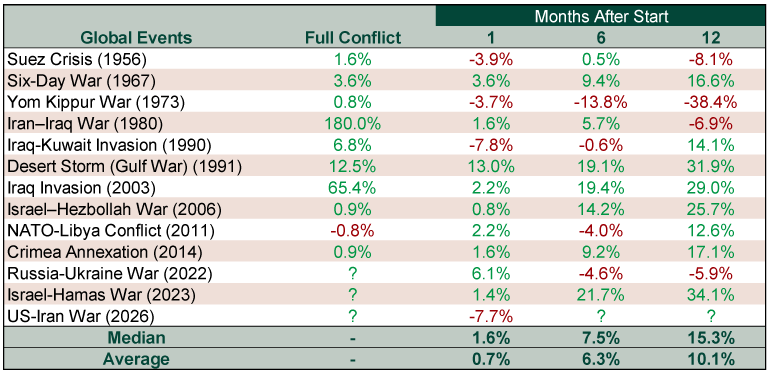
Source: Finaeon, Inc., as of 4/22/2026. S&P 500 daily total returns, 12/31/1959 – 3/31/2026. Returns before 1988 are interpolated from price returns due to data availability.
Markets are forward-looking and efficient. Accordingly, they fathom a regional war’s implications much faster than individual people generally will. Which means they move on faster than headlines do. The news world’s job is to present daily developments for public dissection. But markets’ job is to weigh how corporate profits are likely to shape up over the next 3 – 30 months, based on how economic and political drivers will likely evolve relative to expectations in that window. They are looking at a broad picture of the future, not at a single thing happening now. Humans focus on daily news. Markets aren’t so myopic once a regional conflict’s initial uncertainty wears off.
Stocks’ efficiency is why regional conflicts can bring such a sharp sentiment shock initially, as this one did. It usually unfolds in three steps. First, volatility escalates as tensions flare and saber rattling erupts. When energy is a factor, oil usually starts rising at this point, too. Then, when conflict breaks out and uncertainty seems highest, stocks register that panic and all the worst-case scenarios. You often get a sharp shock, as we got in March. (And in energy-centric conflicts, oil will usually spike.) This usually happens well before any economic data start hinting at how the conflict actually affected commerce. It is a sentiment reaction to fear and worst-case scenario projections.
But then comes the third step, often well before a path to peace materializes: Stocks fathom that the conflict will stay localized, affecting a small piece of global GDP, and that its second-order effects (like energy supply effects) are manageable. Even if there will be some speedbumps along the way, markets fathom reality in that 3 – 30 month window will be better than the dire projections hogging headlines. That positive surprise potential sparks a relief rally. Stocks price in the worst-case scenarios, then price them out as they start looking too far-fetched.
So yes, stocks are looking past the seemingly bad news that continues hogging headlines, like Russia’s decision to close a pipeline transmitting oil from Kazakhstan to Europe Wednesday. That isn’t complacency—it is markets’ doing their normal thing of weighing the entirety of the next 3 – 30 months and rationally considering whether one pipeline’s closure will have a material effect on corporate profits in that timeframe. And investors, in their collective wisdom, seem to fathom (however subconsciously) that oil markets are global and very good at getting oil from those who produce it to those who consume it. Supply lines adjust to infrastructure snafus. They did in 2022 and are starting to do so now.
When stocks do things that seemingly defy conventional wisdom, it is tempting to call the market wrong. Don’t. Conventional wisdom is usually what is wrong, based more on bias and feelings than reality. Stocks price that wisdom—and all widely known information—then do what few expect. The rebound doesn’t look wrong. It looks to us like a rational assessment of the future.
If you would like to contact the editors responsible for this article, please message MarketMinder directly.
*The content contained in this article represents only the opinions and viewpoints of the Fisher Investments editorial staff.
Get a weekly roundup of our market insights
Sign up for our weekly e-mail newsletter.

You Imagine Your Future. We Help You Get There.
Are you ready to start your journey to a better financial future?
Where Might the Market Go Next?
Confidently tackle the market’s ups and downs with independent research and analysis that tells you where we think stocks are headed—and why.
Related Resources
-
In The News October ScamWatch2026-10-21
-
Market Analysis A Mid-October US Economic Scorecard2026-10-20
-
Weekly Wrap-Up Fisher Investments Reviews: Last Week in Markets — October 12 - October 162026-10-19
-
Expert Commentary This Week in Review | Bull Market Birthday, Q3 Earnings, US Inflation
 2026-10-16




Learn More
Learn why 210,000 clients trust us to manage their money and how Fisher Investments and its affiliates may be able to help you achieve your financial goals.
As of 9/30/2026
New to Fisher? Call Us.
Contact Us Today