


Personal Wealth Management / Market Analysis
Global Bond Calamity Calls for Calm Perspective
Today’s fears lack scale and context.

Are rising government bond yields signaling economic trouble ahead? Pundits say so, arguing multi-decade-high 10- and 30-year yields across the developed world foretell hot inflation and government debt troubles, making bonds (and probably eventually stocks) an iffy prospect. But hold on. We think these fears lack context and perspective. Long-term bond yields’ recent “spike” is benign historically, and bonds—like stocks—are prone to wobble on false fears. Nothing about this suggests bonds will fail to serve their primary roles of mitigating volatility and supporting cash flow needs.
Long-term bond yields are up globally and, in some cases, hover near levels unseen in years. Exhibit 1 shows today’s 30- and 10-year yields in the US, UK, Germany and Japan (headlines’ main focuses) and the last time they notched these levels.
Exhibit 1: Global Long Yields Are Up

Source: FactSet, as of 5/19/2026. 30- and 10-year benchmark bond yields in the US, UK, Germany and Japan, 12/31/1979 – 5/18/2026. *Notes: Continuous UK 30-year Gilt data begin in April 1998. Japan 30-year yields are at all-time highs in data through 1999. Both Japan and the UK issued 20-year bonds more heavily historically.
Bond yields move opposite prices, so jumpy yields indicate a selloff. And as they do when stocks sell off, pundits race to find an explanation. This time, they claim investors are dumping government debt fearing high deficits will knock bond prices further as the market struggles to absorb increased supply and hot inflation will erode future interest payments’ purchasing power. Perhaps those fears are affecting investor behavior, but nothing here looks like a crisis to us.
For one, long-term bond yields aren’t “spiking” like many claim. In most cases, they are up somewhat—but not markedly over the range seen since 2022. Instead, they are returning to normal as the last decade and a half’s monetary experiments fade further into the rearview. (Exhibit 2)
Exhibit 2: Bond Yields Are Benign
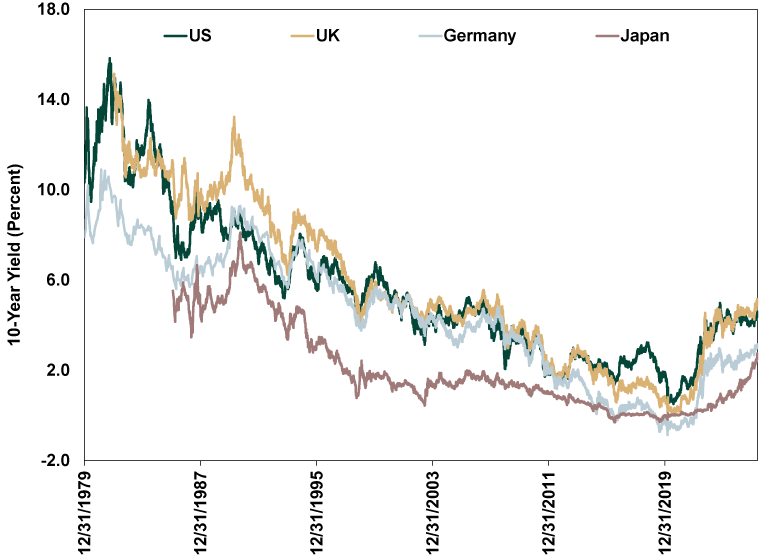
Source: FactSet, as of 5/19/2026. 10-year benchmark bond yields in the US, UK, Germany and Japan, 12/31/1979 – 5/18/2026.
US 30-year yields are also well below levels seen in the 1980s and early 1990s.[i] At roughly 5.1%, they are floating near where they sat for much of the early- to mid-2000s, before the Fed responded to 2007 – 2009’s global financial crisis by deliberately quashing long rates via its “quantitative easing” (QE) program of long-term bond purchases.
The Fed, Bank of England, European Central Bank and Bank of Japan all had long-running QE programs, with the BoJ pioneering the practice in 2001 and the others following years later. The theory was such action would reduce long-term yields, making credit cheaper and more abundant, boosting growth. It didn’t achieve the economic goal, which is a topic for another day, but it resulted in historically low long-term bond yields throughout the 2010s and early 2020s. The recent rise coincides with central banks’ winding down and in some cases reversing these programs, reverting to more normal monetary policy and, therefore, rates.
That people see today’s rates as high, rather than a return to normal, smacks of recency bias. People are seemingly anchoring to the last decade’s low rates as the new normal, forgetting they are a historical aberration caused by central bank meddling, not market forces. Now market forces have more sway—which we think is an overall positive development. When markets can accurately price risk, they allocate capital more efficiently.
Note, too, those pre-QE yields didn’t accompany hot inflation. US CPI inflation averaged 2.8% y/y in the decade leading up to the Fed’s initial QE foray in November 2008, as yields hovered near present levels.[ii] That is below its roughly 3.3% average since data start in 1914 (3.5% in the postwar era).[iii] If normal yields coexisted with normal inflation then, why would a return to normal yields now suddenly mean hot inflation looms?
We would be remiss not to mention Japanese yields’ rise, which is more spiky than the others. But as we wrote in December, much of this is linked with the Bank of Japan’s first steps toward normalizing monetary policy by tapering QE bond purchases in March 2024. Japan Post also plays less of a role in Japanese bond markets now that its privatization is complete. Thus, Japanese yields’ rise—while sharper than its developed world peers—is also a reversion to more traditional developed world conditions.
As for the latest wiggles, bond market volatility is normal. In both stocks and bonds, swinging sentiment—for any or no reason—can spur short-term choppiness. But today’s swings are benign historically, and they don’t mean inflation and high government debt are set to send yields spiraling higher for longer from here.
Bond prices move on supply and demand, and right now, data suggest headlines are wildly overstating pressures on both fronts. On the demand side, inflation doesn’t look set to spike from here. Consider: Inflation is a monetary phenomenon of too much money chasing too few goods and services, as Nobel laureate Milton Friedman taught decades ago. Yet money supply across the developed world is growing at prepandemic rates, when inflation was tame.[iv] Businesses struggle to pass higher costs onto customers without broad money supply rising to boost consumer demand. Today’s tepid money growth drives many businesses worldwide to report weak pricing power, likely keeping inflation at bay despite higher energy costs.
As for supply allegedly overwhelming demand as governments finance burgeoning deficits, one handy way to assess this is bond auctions’ bid-to-cover ratios, or the dollar value of bids to the face value of debt sold. Higher ratios generally signal stronger demand. As Exhibit 3 shows, recent auctions saw fine demand—some even nicely above average.
Exhibit 3: Bond Auction Demand Remains Solid
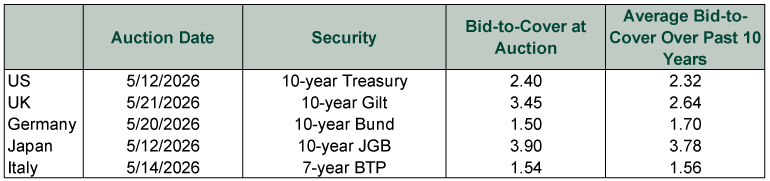
Source: US Treasury, UK Debt Management Office, Germany Finance Agency, Japan Ministry of Finance and Italy Ministry of Economy and Finance, as of 5/21/2026. Note: Italy hasn’t yet auctioned 10-year bonds this month.
If government debt demand were really sinking, we would expect these ratios to be much lower. Bid-to-covers around their decade-long averages isn’t what we would expect if investors were fleeing in terror.
Most importantly for long-term investors, bonds are still playing their primary role in portfolios—helping mitigate stocks’ short-term bumpiness while supporting cash flows. Fearful headlines today omit the fact that bonds have experienced lower volatility than stocks this year. Not only is the S&P 500’s 9.3% year-to-date return sharper than the ICE BofA 7 – 10 year US Corporate and Government bond index’s -2.6%, but stocks’ ride has been much bumpier tied to war-related energy concerns—March’s correction-like drop is proof of this, a much bigger drawdown than anything bonds have experienced year to date.[v] Keep in mind that volatility cuts both ways, and low volatility doesn’t always mean positive low volatility.
But even if yields did look likely to rise and stay there, dumping bond holdings isn’t your only option. It is just a matter of managing a bond portfolio for interest rate risk, as shorter maturities tend to be less sensitive to interest rate moves. As with stocks, it is critical to look forward and not react to short-term volatility, which suggests to us this isn’t a time to do so. Rushing into short-term securities after yields tick up risks leaving you flat-footed if the volatility proves temporary and yields fall again.
Nonetheless, our broader point stands: If you need bonds as part of your long-term portfolio strategy, a yield uptick doesn’t negate that, especially when it looks so sentiment-driven.
[i] Source: FactSet, as of 5/19/2026. US 30-year benchmark bond yield, 12/31/1979 – 5/18/2026.
[ii] Ibid. US monthly CPI, year-over-year growth, October 1998 – October 2008.
[iii] Ibid. US monthly CPI, year-over-year growth, January 1914 – April 2026.
[iv] Ibid.
[v] Ibid. S&P 500 and ICE BofA 7 – 10 year US Corporate and Government bond index price return, 12/31/2026 – 5/21/2026.
If you would like to contact the editors responsible for this article, please message MarketMinder directly.
*The content contained in this article represents only the opinions and viewpoints of the Fisher Investments editorial staff.
Get a weekly roundup of our market insights
Sign up for our weekly e-mail newsletter.

You Imagine Your Future. We Help You Get There.
Are you ready to start your journey to a better financial future?
Where Might the Market Go Next?
Confidently tackle the market’s ups and downs with independent research and analysis that tells you where we think stocks are headed—and why.
Related Resources
-
Economics Checking in on US Consumers2026-10-08
-
Politics Two Elections in the Americas—and Spain’s Coming Snap Vote2026-10-06
-
Weekly Wrap-Up Fisher Investments Reviews: Last Week in Markets — September 28 - October 22026-10-05
-
Market Analysis Budgeting for French Debt Fears2026-10-05





Learn More
Learn why 210,000 clients trust us to manage their money and how Fisher Investments and its affiliates may be able to help you achieve your financial goals.
As of 9/30/2026
New to Fisher? Call Us.
Contact Us Today