


Personal Wealth Management / Market Analysis
Viewing Venezuela Through a Market Lens
Major headlines don’t mean major market impact.

Editors’ Note: MarketMinder is nonpartisan, favoring no politician nor any party. We assess developments for their economic and market implications only.
With regional conflict flaring in the Western hemisphere and headlines globally making big statements about the potential implications, it seems time for a key, timeless reminder: Markets look only at what is relevant to them. Not sweeping political issues, soundbites, theories or anything in the vast realm of general sociology. Markets look through all that to the simple truth of supply and demand. When assessing the market effects of any event, so should you.
So, then, about Venezuela. At the core, we have a small military flareup that started decades ago with sanctions, escalated in 2025 with a US naval blockade and culminated with the removal of President Nicolas Maduro, who now awaits trial on drug trafficking charges in the US. Replacing him is Vice President Delcy Rodríguez, a longtime member of the far-left regime founded by late President Hugo Chavez. The longer-term implications aren’t clear, but for now the new boss seems a lot like the old boss—a hardcore socialist under US and European sanctions. Similarly, the army and police, which constitute the government’s chief source of “legitimacy,” remain on side with Rodríguez. The faces have changed, but the regime hasn’t, at least for now. So looking at this from markets’ standpoint, we see a brief armed skirmish resulted in a surface-level leadership change in a country whose GDP is about 0.07% of the world’s.[i]
We have seen some headlines pointing to the S&P 500’s 0.6% rise Monday as markets “cheering” the action and outcome.[ii] To us, that seems a stretch. Markets generally move past regional conflict very quickly. Sometimes, fear of conflict erupting hits sentiment and sparks volatility in the run-up to the first shots. But that uncertainty generally fades quickly as investors do the math, see the risk is confined to a tiny sliver of world GDP and rightfully realize life and commerce will continue as normal in the rest of the globe. It seems to us markets did that math at warp speed this time. Higher or lower, the short-term wobbles surrounding regional conflict likely reflect sentiment, nothing more.
Given Venezuela has big oil reserves, most of the market-related discussion surrounds the Energy sector, where the sentiment moves are more mixed. Some US Energy firms seemingly got a boost Monday on hopes they will soon have more access to Venezuela’s heavy crude, which most US refineries are equipped to process (the light, sweet crude that gushed from America’s shale boom is a better fit for Europe and Asia to refine). Canadian Energy firms got the opposite, a sharp hit on fear US refineries will buy less from heavy oil producers in Western Canada’s oil sands.
Both reactions seem very far out over their skis. Yes, there has been a lot of talk about returning a private sector presence to Venezuelan oil production, which has been state-run and badly mangled since Chavez expropriated private oil interests over 20 years ago. But nothing will happen overnight. When these situations arise, private firms tend to move slowly, taking a fool me once, shame on you, fool me twice … approach. They tend to wait a while to minimize the risk that they lose out again.
Consider Argentina, which renationalized local producer YPF under former President Cristina Fernández de Kirchner in 2012, effectively expropriating it from Spanish Energy firm Repsol. It took several years of expensive legal wrangling for Repsol to get compensation that turned out to be below market-value. When free market-oriented Mauricio Macri replaced Kirchner in 2015, attracting foreign energy investment topped his agenda. But the deals were slow, partly because local regulations made oil more expensive to tap, and partly because firms chose to wait for more evidence they wouldn’t get burned again, should the government’s position flip again. (In this sense, the situation in Venezuela is even less clear, since the regime is still technically in power.)
Even as the money did come in, it took years for the investments to bear fruit. Argentine oil production declined during Macri’s term. It didn’t start recovering meaningfully until his successor, Peronist President Alberto Fernández, was in office. When he largely extended Macri’s energy policies rather than reverting to Kirchnerism, it gave more US producers the confidence to invest in underdeveloped resources like the vast Vaca Muerta shale field, which led to surging output under Fernández and his successor, the free market-championing current president, Javier Milei.
Exhibit 1: Argentine Oil Production’s Slow Recovery
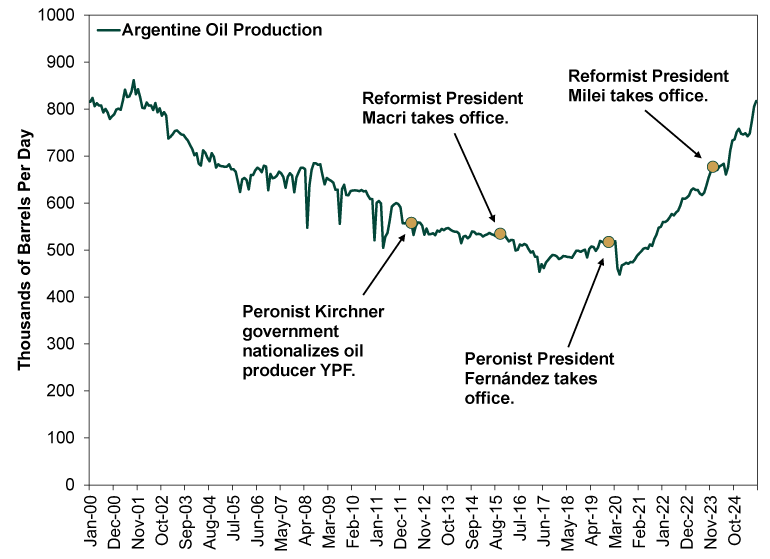
Source: FactSet, as of 1/5/2026. Monthly Argentine oil production, January 2000 – August 2025 (latest available).
All of this took far longer to play out than markets would generally have cared about when Kirchner left office. Stocks look only about 3 – 30 months out and tend not to price in the fruit of far-flung investments.
Also. When markets do price investments, they look at the entire picture through the lens of corporate earnings. Those cheering the effects of a Venezuelan leadership change seem to have their rose-tinted revenue goggles on. But generating revenue from an oil well means generating, well, oil, and that is a costly endeavor. To call Venezuela’s oil infrastructure dilapidated is an understatement, as Chavez and Maduro chose to live large off oil’s proceeds rather than reinvest them. The more credible estimates we have seen peg the up-front costs of reviving and modernizing the industry at about $100 billion, with the fruit perhaps a decade out.[iii] So even if big global Energy firms do return to Venezuela, in the near term it is all going in the cost column. Any earnings boost is a long way out (which means any meaningful competition for Canada is also likely a ways out).
Near-term, we doubt the oil market changes much. Venezuela generates less than 1% of global oil supply. Most of that goes to teapot refiners in China. Maybe it gets redirected now, much as Russian oil redirected after Vladimir Putin invaded Ukraine four years ago. But oil prices are generally set globally, on total worldwide supply and demand. If, say, the US gets a little more from Venezuela and China sops up some of that Russian seaborne supply glut making headlines, we doubt it means much for prices overall. Supply and demand in that scenario aren’t meaningfully changing, just rerouting. And as for fears centering on Canada, Venezuela’s entire daily production is only about one-fourth of what the US imports from Canada daily. Canada is also in the process of building infrastructure to export more crude for Asia. So in the long run, if Venezuela ramps up and sells more oil to the US, we doubt Canada will be starving for business. The global market is a wonderfully adaptive machine.
So if you will pardon a hackneyed colloquialism, the weekend’s events seem to us like a nothingburger for markets. In the short term, some chop may be attributable to it. However, we doubt these events have any material effect on markets in 2026. Yes, the downstream uncertainty the move creates about US foreign policy is worth bearing in mind. The flood of headlines makes sense on that front. But markets have already known history doesn’t stop, and stocks have dealt with saber rattling since the dawn of trading.
If you would like to contact the editors responsible for this article, please message MarketMinder directly.
*The content contained in this article represents only the opinions and viewpoints of the Fisher Investments editorial staff.
Get a weekly roundup of our market insights
Sign up for our weekly e-mail newsletter.

You Imagine Your Future. We Help You Get There.
Are you ready to start your journey to a better financial future?

Where Might the Market Go Next?
Confidently tackle the market’s ups and downs with independent research and analysis that tells you where we think stocks are headed—and why.
Related Resources
-
Expert Commentary This Week in Review | Bull Market Birthday, Q3 Earnings, US Inflation
 2026-10-16
 -
Market Analysis Gradually Then Suddenly, UK Budget Clarity Is Coming2026-10-15
-
Market Analysis On September Inflation, Look Beyond the Headlines2026-10-14
-
Politics Is Canada Building a Stronger Bull Market?2026-10-13




Learn More
Learn why 210,000 clients trust us to manage their money and how Fisher Investments and its affiliates may be able to help you achieve your financial goals.
As of 9/30/2026
New to Fisher? Call Us.
Contact Us Today