


Personal Wealth Management / Economics
What 2017 Teaches About Eclipses’ Economic Impact
One town’s tourist gains are another’s lost spending.

Given it is all anyone can talk about, you probably know a total solar eclipse dazzled Americans in several states Monday—and you may have seen the unending chatter about how this boosts economic activity in prime viewing areas as tourists descended to watch the moon black out the sun for a few minutes. Indeed, it probably does! But don’t mistake it for a big national economic boost.
We know, because we have seen this movie before. In August 2017, a total solar eclipse was visible across several states, cutting a path from Oregon to South Carolina. Then, as now, many folks traveled to the path of totality, giving a boost to hotels and restaurants in the many towns and cities along it. If quarterly state-level GDP data from the BEA went back that far, we would now show you a chart of quarterly GDP throughout 2017 in the states with the most viewing territory. But they don’t, so instead, here is a chart of national GDP. As you will see, there was a slowdown in the period leading up to the eclipse. A reacceleration did indeed start in Q3—coinciding with the eclipse—but growth that quarter was hardly gangbusters even with a relatively weak Q2 comp. And Q4 grew much faster, with no eclipse. This is true for total GDP as well as consumer spending on services, which is where most eclipse-related activity would show up.
Exhibit 1: No Eclipse Boom
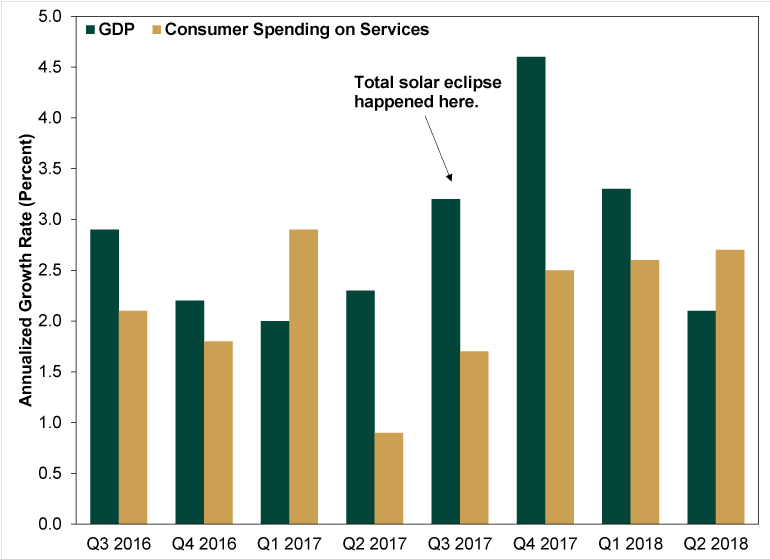
Source: US Bureau of Economic Analysis, as of 4/9/2024.
We don’t doubt that a few days of abnormally high tourist traffic is a shot in the arm for several ZIP codes and the small businesses in them. But when you zoom out both nationally and to a longer timeframe, these things tend to be a wash. Tourist money spent in Indianapolis, for example, is money not spent in these folks’ hometowns. Geographically, it cancels out. It is also one day out of 90-ish in a quarter and 366 in the year, and those traveling probably saved in advance to fund their trip—which also cancels out.
Don’t get us wrong, we love these celestial events! And the associated national cheer! But that is all this was. A fun thing that many people were able to enjoy. But probably not a Q2 GDP swing factor.
If you would like to contact the editors responsible for this article, please message MarketMinder directly.
*The content contained in this article represents only the opinions and viewpoints of the Fisher Investments editorial staff.
Get a weekly roundup of our market insights
Sign up for our weekly e-mail newsletter.

You Imagine Your Future. We Help You Get There.
Are you ready to start your journey to a better financial future?

Where Might the Market Go Next?
Confidently tackle the market’s ups and downs with independent research and analysis that tells you where we think stocks are headed—and why.
Related Resources
-
Market Analysis New Tax Year, More British Business Tax Fear2026-04-08
-
Market Volatility How Investors Should Think About the Ceasefire2026-04-08
-
Market Analysis Quick Hit: What to Make of Jobs Data’s Persistent Swings2026-04-07
-
Weekly Wrap-Up Fisher Investments Reviews: Last Week in Markets—March 30 - April 32026-04-06



Learn More
Learn why 200,000 clients trust us to manage their money and how Fisher Investments and its affiliates may be able to help you achieve your financial goals.
As of 3/31/2026
New to Fisher? Call Us.
Contact Us Today