


Personal Wealth Management / Market Analysis
Why Treasurys Aren’t in Trouble
Don’t buy fears of higher rates triggering a US debt calamity.

Is the US skating on ever thinner fiscal ice after adding $2.5 trillion—and counting—to its debt pile over the last year?[i] Many think so, especially as 30-year Treasury yields punctured 5%, hitting their highest levels since 2007. The narrative gained more steam after the Treasury joined Japan in intervening to prop up the yen—a move some say was really motivated by US officials’ push to keep Japan from selling its Treasury bonds. But seeing this clearly requires zooming out to put current yields—and actions involving foreign holdings of Treasurys—in better context.
Following the yen’s fall to four-decade lows against the dollar in late July, Japan and America conducted a joint intervention to bolster the currency—their first since 1998. Interventions to support a weak currency typically involve a government selling foreign bonds and currencies it owns and using the proceeds to buy its own currency. Japan is the world’s top holder of US Treasurys and, since it is seemingly targeting the yen versus the dollar exchange rate, it makes sense Japan’s Ministry of Finance would sell US bonds to buy yen.
Some fear this pressure would drive US Treasury prices down—ergo, rates up, making America’s federal debt less affordable. Unusually, the New York Fed (at Treasury’s behest) sold euro-denominated reserves to buy yen rather than dollars for its part in the joint operation. Reports also indicate Treasury Secretary Scott Bessent is advocating the Fed expand a program permiting Japan to borrow dollars to buy yen—and avoid selling down its world’s-largest $1.1 trillion Treasury pile.
To many onlookers, this behavior proves Bessent really, really doesn’t want Japan reducing its US debt holdings. Yet with the yen (predictably) weakening again following joint intervention, some see it as a failure. Allegedly, this means it is only a matter of time before Japan liquidates a block of its Treasurys. It all feeds into the narrative America is facing a fiscal crisis of its own.
We see several problems with this, though. First, consider: For every dollar or Treasury sold there is a buyer, so the notion Japan’s selling means auto-higher rates is off. If US finances were in such dire straits (which they aren’t!), the global pool of Treasury buyers—who know the narrative like everyone else—would likely evaporate. It isn’t.
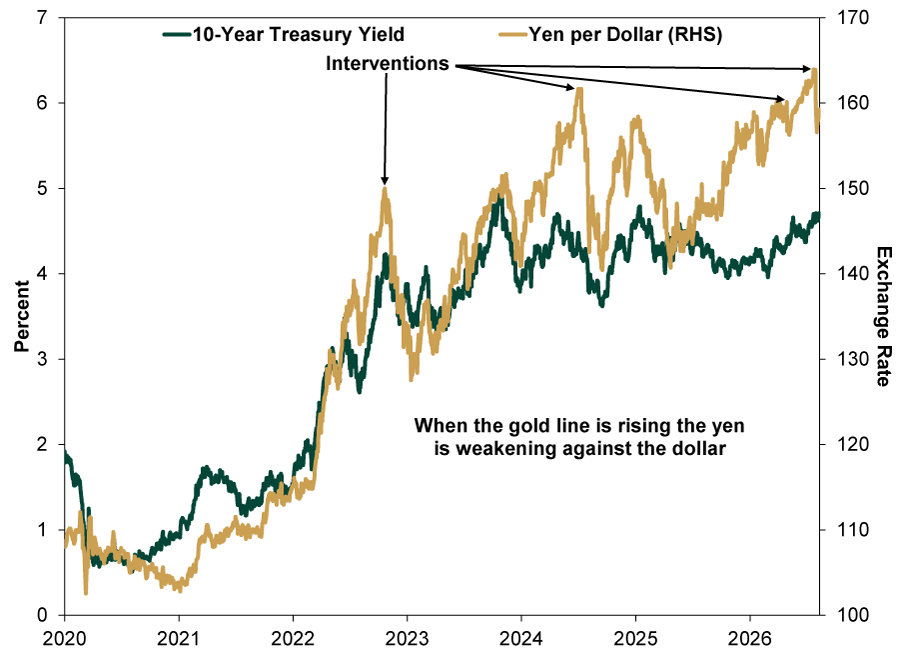
Then, too, in the context of Japan’s US Treasury sales specifically, this is hardly its first rodeo. Reportedly, Japan spent around $96 billion at July’s end—potentially its largest-ever yen-buying intervention.[ii] Meanwhile, the US may have bought $5 – $10 billion (or equivalent euros) worth of yen.[iii] But in April and May, Japan spent about $73 billion defending the yen. In July 2024? $35 billion. September – October 2022, $64 billion. While 10-year Treasury yields (green line, Exhibit 1) are near the upper-end of their multi-year range, there is no debt doom to speak of—Japan’s US Treasury sales haven’t sent America’s rates skyrocketing.
Exhibit 1: Benchmark Treasury Rates Rangebound Despite Japanese Selling
Source: FactSet, as of 8/12/2026.
Furthermore, fear of a foreign government selling bonds is nothing new. After all, Japan may be US Treasurys’ largest foreign holder, but that wasn’t always the case. China (red area, Exhibit 2) used to be the biggest, and fear over what it may or may not do with those bonds was near-omnipresent. But its share shrank steadily since 2013—Japan (dark green) took over in June 2019. In 2011, China’s peak share of foreign Treasury holdings hit 28%, while its level maxed out at $1.3 trillion in 2013. As of May, the latest available data, it is less than $660 billion—7% of Treasury ownership outside America.
Exhibit 2: Foreign Holders of US Treasurys Over Time
Source: US Treasury, as of 8/12/2026.
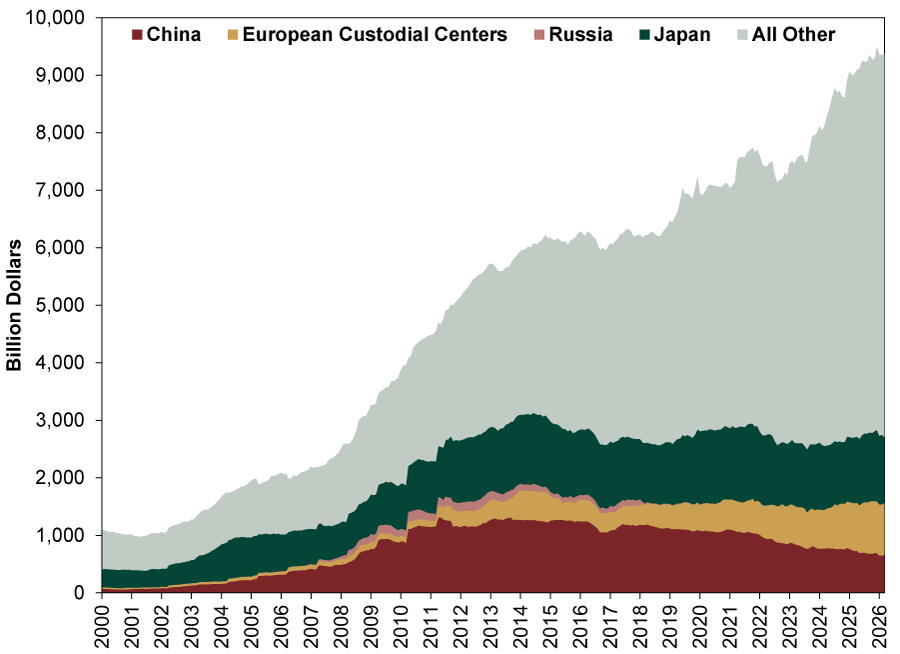
Many, however, think European custodial centers (gold)—like Belgium and Luxembourg—include China’s US Treasury holdings.[iv] Adding them (red plus gold) paints a somewhat different picture. But even here, beneficial Chinese ownership dropped -$416 billion in nearly three years from its March 2014 peak. US 30-year Treasury yields fell from 3.7% in March 2014 to 2.2% in January 2015 before settling into a 2.2% – 3.2% range over the next two years at historically low rates.[v] Or consider Russia’s peak 4% share in 2010 (the middle pink sliver), around $170 billion then. It is now effectively zero—with nary a market ripple.
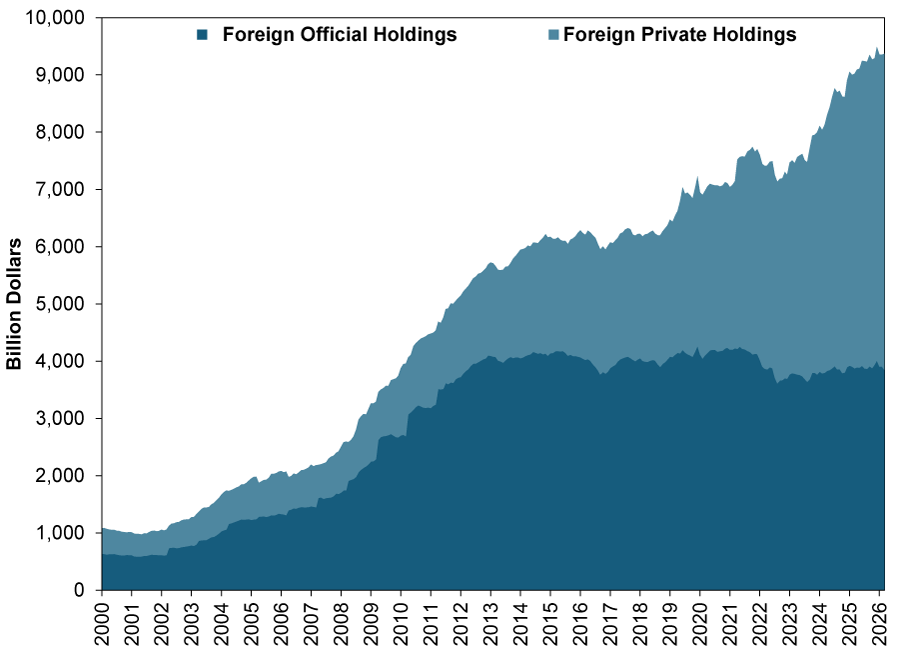
Why weren’t global markets bothered? As Exhibit 2 shows, other buyers emerged. A growing share of them are private sector purchasers. Exhibit 3 shows they are now the majority of Treasurys’ foreign ownership, hitting the 50% mark in 2023 and hovering around 59% currently. Presumably, they are just as—if not more—discerning than central banks and governments, who often buy for non-market reasons.
Exhibit 3: Foreign-Owned Treasurys Held Increasingly by Private Sector
Source: US Treasury, as of 8/12/2026.
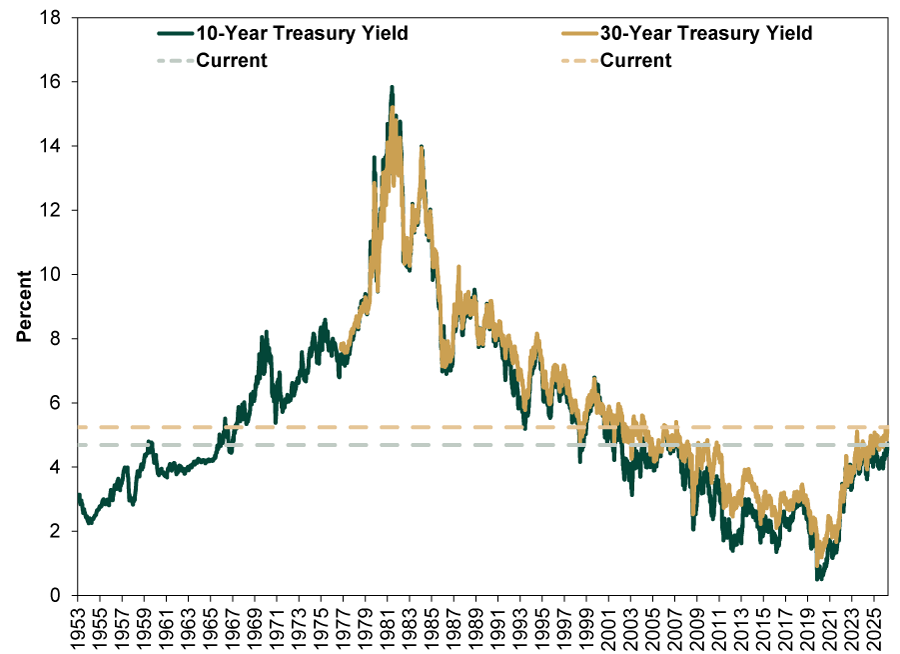
Moreover, the idea that current, roughly 4.7% 10-year and 5.2% 30-year Treasury yields are astronomical, unaffordable or problematic seems like a function of recency bias to us. The period from 2008 to 2021 was an extremely low rate environment by historical standards. People anchoring to that as normal miss the bigger picture. As Exhibit 4 shows, there is nothing very abnormal about long rates (10- and 30-year yields) hovering around 5%. And, note: Long rates exceeded today’s throughout the 1980s and 1990s, two booming periods for the US economy and stocks. There was no debt calamity.
Exhibit 4: Long Rates’ Return to Normal
Source: FactSet, as of 8/12/2026.
And one isn’t likely now either. The US government’s internal revenue (chiefly taxes) covers its debt service costs more than five times over. No wonder global investors keep buying Treasurys—as dollars conduct the commerce that makes the economic world go ’round.
Looking ahead, rates may be at the upper end of the multi-year range since 2022, but that is largely a function of false inflation fear tied to the war. Data are increasingly confirming that the uptick earlier this year was limited to energy—a factor that seems to be abating.
Inflation expectations are a key factor swaying long rates. Hence, we wouldn’t expect hotter inflation or materially higher rates. Broad money supply (M4) is tame. When inflation spiked in the 1970s—and 2022—M4 surged double digits beforehand. Today’s 6.8% y/y M4 growth is consistent with historical averages.[vi]
Without hotter inflation ahead, we think it is quite unlikely factors like Japan maybe selling some Treasurys will send rates up materially.
[i] Source: US Treasury, as of 8/12/2026.
[ii] “Japan’s April Yen Intervention Set Daily Record as Pressure Persists,” Makiko Yamazaki, Reuters, 8/6/2026.
[iii] “Bessent’s ‘To Do’ List: Buy $5-10 Billion Worth of Japanese Yen, Reuters Photo Shows,” Daniel Heuer and David Lawder, Reuters, 8/1/2026.
[iv] “Finding China in the US TIC Data,” Brad Setser, Council on Foreign Relations, 5/18/2026.
[v] Source: FactSet, as of 8/12/2026.
[vi] Source: Center for Financial Stability, as of 8/3/2026.
If you would like to contact the editors responsible for this article, please message MarketMinder directly.
*The content contained in this article represents only the opinions and viewpoints of the Fisher Investments editorial staff.
Get a weekly roundup of our market insights
Sign up for our weekly e-mail newsletter.

You Imagine Your Future. We Help You Get There.
Are you ready to start your journey to a better financial future?

Where Might the Market Go Next?
Confidently tackle the market’s ups and downs with independent research and analysis that tells you where we think stocks are headed—and why.
Related Resources
-
In The News Will France’s Protests Disrupt Growth?2026-10-26
-
Market Analysis The Sentiment Cooldown Unfolding2026-10-26
-
Market Analysis Earnings Ghost Stories2026-10-26
-
Weekly Wrap-Up Fisher Investments Reviews: Last Week in Markets — October 19 - October 232026-10-26





Learn More
Learn why 210,000 clients trust us to manage their money and how Fisher Investments and its affiliates may be able to help you achieve your financial goals.
As of 9/30/2026
New to Fisher? Call Us.
Contact Us Today