


Personal Wealth Management / Market Analysis
Global Treasury Demand Isn’t Letting Up
Foreigners keep buying US Treasurys.

Back in February, ahead of the US’s Iran attack, headlines ran wild alleging a foreign investor rotation out of US assets (especially Treasurys) was afoot. This “Sell America” trade narrative only ramped up more after the war, triggering renewed rumblings about Treasurys losing their safe-haven role and driving up US debt service costs. Yet interest rates and Treasury International Capital System (TICS) holdings data show such narratives are broadly false.
The pervasive underlying fear: Sooner or later, global investors will have enough of ballooning US budget deficits’ adding trillions to America’s debt load, just as twists in foreign and economic policy stir uncertainty. In the second half of 2025, foreign investors’ holdings of US Treasurys overall wobbled before hitting the year’s high in November ahead of outflows in December and small inflows in January. Meanwhile, 10-year Treasury yields rose from under 4% in November to 4.3% in January.[i] Pundits declared the short-term dots were aligning: The end was nigh.
Just as interest rates reversed to below 4% near February’s end, the US and Israel struck Iran.[ii] The Pentagon’s budget costs started racking up with a $500 billion price tag as it seeks a roughly 50% spending surge next year.[iii] 10-year Treasury yields spiked to 4.4% in March as the Middle East conflict eclipsed all other narratives.[iv] Supposedly, the rising yields combined with talk of shunning US assets meant America could no longer rely on the kindness of strangers to fund Uncle Sam’s tab.
But as Exhibit 1 shows, TICS data released last Wednesday argue rather sharply to the contrary. Foreigners’ Treasury holdings rose 6.6% from a year ago to February’s record high $9.49 trillion—surpassing November’s $9.35 trillion prior high.[v] So the early narrative pretty clearly didn’t hold. The two largest foreign holders of US debt led the charge, as Japan (biggest at $1.24 trillion) and the UK (second-biggest with $897 billion) added to their troves. Japanese institutions continued pursuing higher yields overseas, while the UK—a major international custody hub—saw ongoing demand from global investors. Once biggest, but now third-largest-holder China pared slightly (to $693 billion), but that has been a long-running trend for over a decade. Others besides Japan and the UK have taken up the slack, too, and in February they contributed to aggregate net TICS inflows of $184.5 billion.
Exhibit 1: Global Investors Keep Adding to Their Treasury Piles
Source: FactSet, as of 4/22/2026.
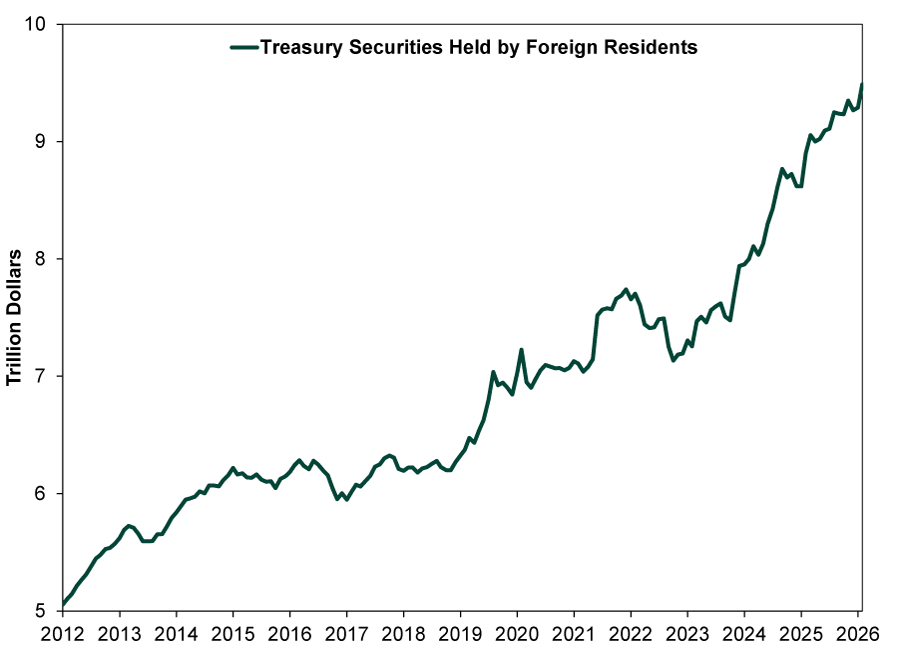
Now, of course, February’s TICS data still predate the war. But markets are already showing you there isn’t a buyers’ strike on Treasurys. 10-year Treasury yields have been bouncing around 3.5% to 5.0% for more than three years. They started this year at 4.17%, peaked at 4.43% and sit at 4.25% now.[vi] So between the year’s start and today, yields are up eight basis points (a 0.08 percentage point increase). This is ... not a big move. Moreover, slight swings within a range are mostly sentiment-driven with inflation fundamentals broadly benign.
Then, too, foreign Treasury holdings’ long-term trend is also up, not only since 2012—when monthly TICS data begin—but since the 1970s, when Treasury began tracking foreign ownership quarterly. Yes, yes, this is because there is more debt (and more bonds) outstanding. But foreigners’ share of US Treasury ownership peaked at 49% in 2008 and has gradually trended down since. (Exhibit 2) And there is no apparent relationship between this and yields. Focus on the two-month dip from November misses this broader reality.
Exhibit 2: Foreigners’ US Debt Ownership Percent Doesn’t Sway Treasury Yields
Source: Federal Reserve Bank of St. Louis, Treasury and FactSet, as of 4/22/2026.
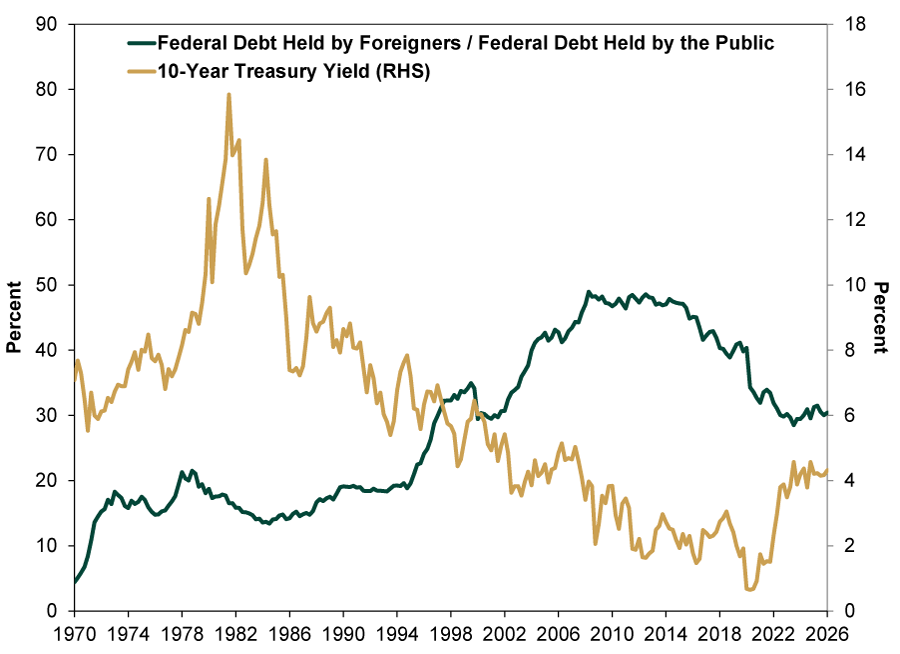
Since the 1980s, 10-year Treasury yields fell throughout foreigners’ rising proportion of US debt and its shrinking since 2014—until 2020. Yields’ jump since 2022 wasn’t due to any changes in foreign Treasury holdings’ relative weight, which has remained steady around 30%, slightly above its 28% average since 1970. Rather, inflation’s surge caused yields’ spike—which has since leveled off with price pressures. Without any correlation with Treasury yields (or the dollar), you can’t say foreign holdings’ levels or relative weights have causation.
Yes, rates have risen over the past few months. But 10-year yields’ current 4.3%—below their 5.9% average since 1970—doesn’t support the narrative that anyone is broadly losing interest in Treasurys.[vii] For investors, that is bullish, as false fears mean reality remains underappreciated.
[i] Source: FactSet, as of 4/22/2026.
[ii] Source: FactSet, as of 4/22/2026.
[iii] “Trump’s $1.5 Trillion Defense Budget Includes $750 Billion for Ships, Jets and Golden Dome,” Mike Stone, Reuters, 4/21/2026.
[iv] Source: FactSet, as of 4/22/2026.
[v] “Foreigners Boost US Treasury Holdings to Record Highs in February,” Gertrude Chavez-Dreyfuss, Reuters, 4/15/2026.
[vi] Source: FactSet, as of 4/22/2026.
[vii] Source: FactSet, as of 4/22/2026.
If you would like to contact the editors responsible for this article, please message MarketMinder directly.
*The content contained in this article represents only the opinions and viewpoints of the Fisher Investments editorial staff.
Get a weekly roundup of our market insights
Sign up for our weekly e-mail newsletter.

You Imagine Your Future. We Help You Get There.
Are you ready to start your journey to a better financial future?

Where Might the Market Go Next?
Confidently tackle the market’s ups and downs with independent research and analysis that tells you where we think stocks are headed—and why.
Related Resources
-
Politics Is Canada Building a Stronger Bull Market?2026-10-13
-
Weekly Wrap-Up Fisher Investments Reviews: Last Week in Markets — October 5 - October 92026-10-12
-
Politics Context for the Noisy Congress to Come2026-10-09
-
Expert Commentary This Week in Review | S&P 500 Record High, Fed Minutes, Spain Election
 2026-10-09




Learn More
Learn why 210,000 clients trust us to manage their money and how Fisher Investments and its affiliates may be able to help you achieve your financial goals.
As of 9/30/2026
New to Fisher? Call Us.
Contact Us Today