


Personal Wealth Management / Market Volatility
What the Latest Global Flash PMIs Reveal
In our view, early signs point to a better-than-expected economic environment.

For weeks now, commentators we follow have warned the Middle East conflict and its resulting economic disruptions could slow the global economy similar to pandemic-era lockdowns. We found that narrative overwrought and, last week, investors finally got a first batch of war-affected economic data: S&P Global’s flash (preliminary) purchasing managers’ indexes (PMIs, surveys tallying the breadth of growth). Whilst March’s reports didn’t reflect rapid growth, they point to a still-growing global economy holding up better than most negative speculation we saw at the war’s outset—an early indication hinting at reality going better than expected.
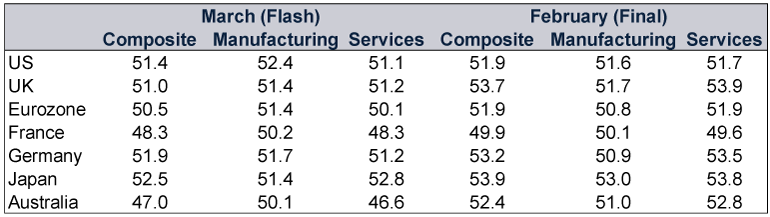
Let us start with the data: Exhibit 1 runs through major developed economies’ March flash PMIs and how they compare with February’s final data. For context, readings above 50.0 indicate more firms reporting expansion than contraction. Whilst this doesn’t indicate how much firms or overall activity grew, we find a majority of firms reporting growth generally translates to rising activity.
Exhibit 1: March Flash PMIs
Source: S&P Global, as of 24/3/2026.
March’s results appear mixed to us. Most composite PMIs—which combine services and manufacturing—moderated from February but remained in expansion, indicating the majority of respondents in the developed world kept growing amidst the chaos. Only France and Australia contracted, with the former’s weak patch predating the war.[i]
Conventional wisdom holds that manufacturing is more vulnerable to wartime disruptions than services, given it is more energy-intensive and relies on global shipping and supply chains. Our research finds services are generally less affected. Yet services fared worse than manufacturing in every country but Japan. Yes, new manufacturing orders and output fell slightly in Australia, and both measures cooled in Japan.[ii] But March’s flash manufacturing PMIs topped 50 across the board.
A key reason, in our view, is the war pulling demand forward. Consider: New manufacturing orders grew in the US, UK and Germany, with all three reports citing companies loading up inventories ahead of potential price pressures and supply constraints.[iii] Germany’s report outright suggests the war’s outbreak boosted demand, highlighting spiking new orders and the country’s fastest production growth in four years.[iv] Likewise, US respondents reported that, whilst tariffs weighed less on new orders, companies chiefly added to their input inventories—the first rise in seven months—to ensure supply availability and lock in prices.[v]
Interestingly, though the UK reported similarly expansionary results, most analysis we saw focussed heavily on accelerating cost pressures.[vi] This aligns with publications we follow recently fixating on the UK’s relatively warmer inflation than other developed nations, suggesting sentiment toward Britain remains sceptical.[vii] We think it also suggests many in Britain, still stung by 2022, are fighting the last war from a sentiment perspective.
In our view, manufacturers’ stocking warehouses to meet future demand is a sign of their adapting. We have long said anticipation is mitigation, helping shield against the possibility of shortages. To be clear, we don’t think one month’s data is a trend. But in our view, these reports suggest manufacturing demand wasn’t uniformly negative, which is a positive sign.
Meanwhile, other bits of data suggest firms are already adapting to wartime challenges. The UK’s report, for instance, noted longer shipping times as cargo ships re-routed around Africa’s Cape of Good Hope.[viii] Some commentators we follow couched this as a negative as manufacturers had to wait a bit longer for their deliveries, which we think has some merit. But we also see this as an underappreciated positive—it signals logistics companies are already adapting to widely discussed blockages, just weeks in. From an economic standpoint, a modestly longer delivery time is far better than shortages, in our view.
Relatedly, in the eurozone, longer delivery times coincided with manufacturers’ first purchasing growth in 44 months.[ix] Rather than reacting to disruptions, European manufacturers opted to preemptively restock their shelves and reroute their imported inputs. Again, it seems they acted in anticipation of the looming war potentially blocking key shipping lanes and sending prices skyward.
It appears global manufacturers aren’t taking this situation lying down. As we find is typical, they are responding to incentives and getting ahead of the curve—a positive reminder of global trade’s underrated adaptability. This is a crucial departure from the pandemic, when our research found sudden global lockdowns confounded planning.
To us, services’ relative weakness seems more about sentiment and uncertainty than a fundamental changes in business conditions. For instance, Australia, France and Germany’s reports all noted falling new business in the service sector as customers delayed purchases whilst awaiting clarity in the Middle East.[x] Or take the US and UK, where purchasing managers reported customers were hesitant to commit to additional projects and orders due to geopolitical uncertainty (amongst other factors, including concerns over federal spending).[xi]
We find this uncertainty is quite normal early in geopolitical conflicts, coinciding with the broader shock factor as people step back to assess what is going on. Our research suggests stocks often price this at the outset, falling in the immediate aftermath as sentiment sinks—as seen in widely watched sentiment gauges like the University of Michigan (U-Mich) Index of Consumer Sentiment or American Association of Individual Investors (AAII) Investor Sentiment survey. [xii] For example, both fell at the start of 2006’s Israel-Hezbollah conflict and 1990’s Operation Desert Storm as negative speculation about the war’s effects swirled in publications we follow.[xiii] Yet stocks typically recover quickly as businesses and individuals get clarity on what the mid-war economy looks like and corporate investment—growth’s driver—resumes.
Looking forward, we will continue monitoring the global services sector as it is responsible for the bulk of developed economies’ economic output.[xiv] Yet as uncertainty begins falling among businesses and individuals, we think markets should receive a boost. Otherwise, our reading of March’s release suggests global manufacturing was resilient in March—in our view, a bit more bullish proof of a better-than-expected global economy.
[i] Source: S&P Global, as of 25/3/2026. France composite PMI, December 2024 – February 2026.
[ii] Ibid.
[iii] Ibid.
[iv] Ibid.
[v] Ibid.
[vi] “UK Businesses Show Growth and Inflation Hit from Iran War,” David Milliken and William Schomberg, Reuters, 24/3/2026. Accessed via MSN.
[vii] Source: FactSet, as of 24/3/2026. Statement based on monthly Consumer Price Index readings in the UK and US and eurozone Harmonised Consumer Index of Prices, December 2024 – February 2026. The Consumer Price Index, or CPI, and the Harmonised Consumer Index of Prices, or HICP, are government-produced indexes tracking prices of commonly consumed goods and services. Inflation refers to broadly rising prices across the economy.
[viii] See note i.
[ix] Ibid.
[x] Ibid.
[xi] Ibid.
[xii] Source: University of Michigan and American Association of Individual Investors, as of 25/3/2026.
[xiii] Ibid.
[xiv] Source: World Bank, as of 25/3/2026. Statement based on services sectors’ value added to gross domestic product in the US, UK, eurozone, Japan and Australia. Gross domestic product, or GDP, is a government-produced measure of economic output.
Get a weekly roundup of our market insights.
Sign up for our weekly e-mail newsletter.

You Imagine Your Future. We Help You Get There.
Are you ready to start your journey to a better financial future?

Markets Are Always Changing—What Can You Do About It?
Get tips for enhancing your strategy, advice for buying and selling and see where we think the market is headed next.
Related Resources
-
Market Analysis On Oil’s Latest Vicissitudes2026-09-16
-
Market Analysis By the Numbers: A Japanese Growth Check In2026-09-16
-
Macro Insights Benefits of Active Top-Down Investing2026-09-08
-
Market Analysis About Those ‘Spiking’ French Yields2026-09-04




Contact Us
Learn why 210,000 clients trust Fisher Investments and its affiliates to manage their money and find out how we may be able to help you achieve your financial goals.
As of 30/06/2026. Includes Fisher Investments and its affiliates.
New to Fisher? Call Us.
Contact Us Today