


Personal Wealth Management / Market Analysis
2025 by Sector
Below the surface, sectors rose across the board.

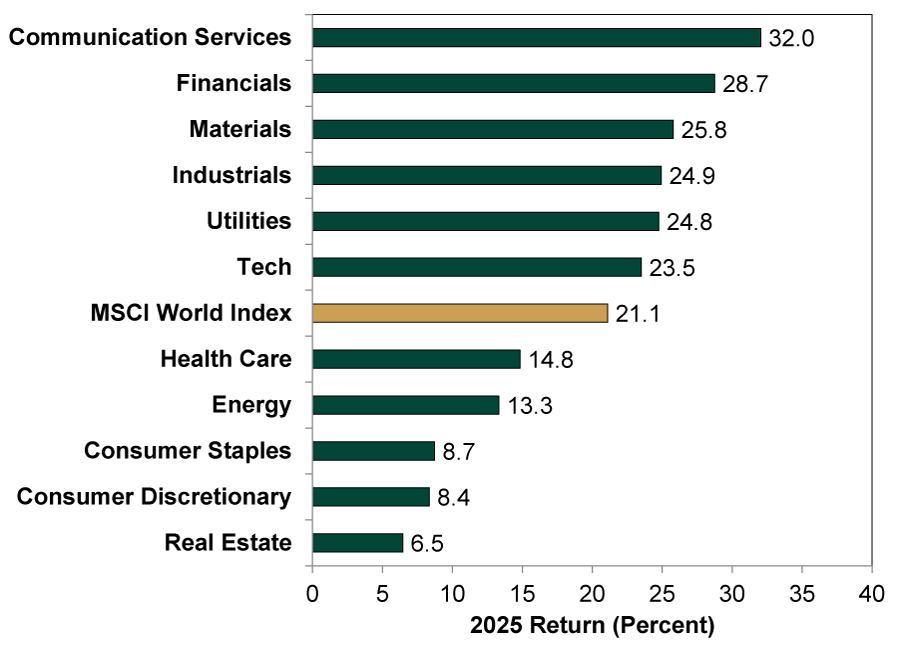
With the MSCI World Index up 21.1% in 2025, how did its sectors perform under the hood?[i] As Exhibit 1 shows, six sectors outperformed. No surprise supposedly AI-fueled Communication Services and Information Technology (Tech) soared.
Exhibit 1: All Sectors Up
Source: FactSet, as of 1/7/2026. MSCI World Index and sector returns with net dividends, 12/31/2024 – 12/31/2025.
But mostly this wasn’t due to America’s “Magnificent Seven” as five of them lagged. And it wasn’t all about AI: In Communication Services outside the Tech-like Interactive Media & Services industry group, more traditional Media, Entertainment and Telecommunication groups also shined, including many non-US firms. Now, dollar weakness helped boost their results, but that wasn’t the primary driver. While MSCI World Ex. USA Communication Services rose 26.1% last year in dollars, using local currencies (the currency each company is domiciled in to remove foreign exchange effects), it still gained 19.8%, topping the MSCI World’s 18.4% in local currency terms.[ii]
Another thing to note about Communication Services’ leadership: It occurred even as its earnings growth lagged through Q3. The global sector’s Q3 earnings rose only 6.8% y/y, among the slowest of all sectors (Tech’s was 30.8%).[iii] US Communication Services’ earnings fell -7.8% y/y—the worst American sector. Does this mean Communication Services’ returns are out of whack with their underlying fundamentals? No. Markets look forward. The current consensus expects world Communication Services earnings acceleration to 11.3% in 2026.[iv] Stocks generally look about 3 – 30 months out, making 2025’s returns a natural response to a likely earnings acceleration.
Meanwhile, Financials, Materials, Industrials and Utilities also outperformed, underscoring the bull market’s underappreciated breadth. Financials’ 2024 tailwind of a steepening global yield curve continued as its effects started showing up in data like accelerating loan growth and widening net interest margins. More profits—and profitability on new loans—are an obvious benefit for bank stocks (as well as economic fuel). This is the MSCI World’s second-largest sector by market capitalization after Tech. Strong returns got plenty of notice in Europe, where several nations outperformed wildly due to their high Financials concentrations, but it got less ink globally.
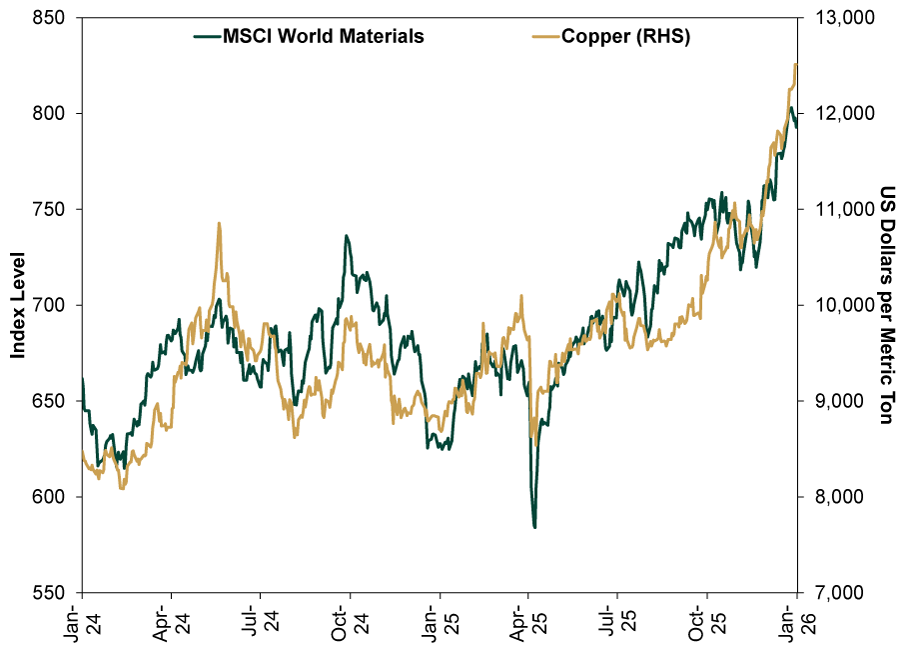
The Materials sector was also less heralded. Traditionally, Materials benefits from underlying commodity strength. As Exhibit 2 shows, its returns happen to be closely connected to copper prices. Not because copper is uniquely indicative per se, but because it is usually correlated with metals prices in general—while Metals & Mining companies form the largest group within the sector.
Exhibit 2: Commodity Prices Drive Materials Returns
Source: FactSet, as of 1/7/2026.
There is a common myth that because Materials earnings are commodity price-sensitive, fast expected global economic growth is critical to returns. But commodity prices move on supply and demand, and GDP growth rates are but one determinant of the latter. Huge Emerging Markets infrastructure buildouts aren’t necessary, either. Sometimes, modest GDP growth, alongside constrained supply growth, is enough.
Industrials also did well despite another year of purported global manufacturing weakness, a reminder stocks aren’t the economy. Interestingly, 19.5% US returns here are well behind non-US Industrials’ 35.1%.[v] Fine absolute US Industrials returns are a counterpoint to the notion that manufacturing job losses this year indicate a sector in serious trouble, but the relative returns are worth digging into.
We suspect tariffs have a role to play with this. While many consider the sector a beneficiary of Trump administration tariffs, which aim ostensibly at reshoring American manufacturing, markets are taking a different view. Tariffs don’t seem to be helping US manufacturers relative to non-US. Rather, they appear to be somewhat of a headwind, hence US Industrials’ underperformance. There are numerous reports that tariffs raise manufacturers’ input costs, making it harder on factories already located here. This also complicates potential reshoring efforts, as do obstacles like red tape and local opposition.
But internationally, these headwinds aren’t such a factor. Although tariffs affect around 15% of world trade—that is, trade involving America—they leave 85% of its non-US trade untouched; global markets are keying off that reality, with Industrials outside America pinched less by tariff uncertainty.[vi] And increased trade deals between nations and regions abroad are freeing trade more, a positive surprise few foresaw last April.
Utilities are allegedly another AI winner but, here too, US versus non-US returns belie this narrative. American Utilities’ 15.7% pales next to non-US’s 45.1% (again aided by currency translation, though excluding that, it is still up a hefty 32.5%).[vii] This is as AI hype in the US has cooled some and reality is looking less likely to match elevated expectations in the sector. Taking a step back to see the bigger picture, all this just goes to show how the bull market is broader than many imagine it to be.
At the lower end of the leaderboard: Health Care, Energy, Consumer Staples, Consumer Discretionary and Real Estate lagged but still sported positive returns. Here again, there are some interesting nuggets.
Energy is largely driven by oil price swings. But while oil has been trending lower on perceptions of oversupply, which has weighed on Equipment & Services firms, Integrated Oil & Gas majors are holding up somewhat better below the surface. We think this is because demand is proving more buoyant than expected as global growth chugs along, mitigating fears over a developing glut.
Consumer Discretionary and Staples were buffeted by tariff and affordability concerns all year. Squeezed by a constant barrage of top and bottom-line margin pressures (e.g., wary consumers and import costs, respectively) it isn’t a secret they face a challenging operating environment to grow earnings, with high-end luxury brands in particular feeling the pinch. Their weaker returns are a formidable counterpoint to the notion markets are overlooking headwinds.
Overall though? Sector returns rose across the board as reality turned out better than expected, especially after April’s Liberation Day correction.
If you would like to contact the editors responsible for this article, please message MarketMinder directly.
*The content contained in this article represents only the opinions and viewpoints of the Fisher Investments editorial staff.
Get a weekly roundup of our market insights
Sign up for our weekly e-mail newsletter.

You Imagine Your Future. We Help You Get There.
Are you ready to start your journey to a better financial future?

Where Might the Market Go Next?
Confidently tackle the market’s ups and downs with independent research and analysis that tells you where we think stocks are headed—and why.
Related Resources
-
Expert Commentary This Week in Review | Bull Market Birthday, Q3 Earnings, US Inflation
 2026-10-16
 -
Market Analysis Gradually Then Suddenly, UK Budget Clarity Is Coming2026-10-15
-
Market Analysis On September Inflation, Look Beyond the Headlines2026-10-14
-
Politics Is Canada Building a Stronger Bull Market?2026-10-13




Learn More
Learn why 210,000 clients trust us to manage their money and how Fisher Investments and its affiliates may be able to help you achieve your financial goals.
As of 9/30/2026
New to Fisher? Call Us.
Contact Us Today