


Personal Wealth Management / Market Analysis
A Cool-Headed Take on the NY Fed’s Tariff Research
Tariffs aren’t an economic positive, but they won’t reignite hot inflation.

The New York Federal Reserve kicked off a bit of a firestorm recently after publishing research exploring who is paying for last year’s tariffs. Now, we won’t wade into the political waters—our interest is in the economic implications only, and namely, in a concept some seem incapable of getting their arms around. Tariffs are economically negative—government meddling in the economy normally is. But they also aren’t inflationary, and those enacted last year have proven much smaller than feared. The NY Fed’s writeup adds more evidence of all that.
Most of the political chatter surrounds the branch’s finding that US consumers paid 90% of tariffs levied last year. Put that aside, though, and the New York Federal Reserve’s research adds some useful perspective on tariffs. For instance, the average statutory tariff rate rose from 2.6% at the start of 2025 before spiking in April and May, when levies on Chinese goods soared by 125 percentage points.[i] By yearend, the average statutory rate was 13%.[ii]
But this doesn’t mean Americans were broadly paying 13% more on all imported goods. In practice, aggregate tariffs paid were lower. As the New York Fed details—and we have also pointed out—headline tariff rates don’t reveal what people actually pay. For instance, due to exemptions, the NY Fed found that, “Although the US levies a 35 percent tariff on Canadian imports, 83 percent of those imports are exempt from US duties under the US-Mexico-Canada Agreement (USMCA).” Businesses also employed tactics like transshipping to pay lower tariffs and/or substituted and shifted away from high-tariffed goods. So although the NY Fed found Americans are responsible for shouldering around 90% of tariffs’ burden, that is 90% of a far smaller increase than many thought likely early on—and only on products hit.[iii] So whatever businesses did with these (eat them, pass them to consumers, try to negotiate discounts with suppliers), the bite wasn’t huge in most cases.
Now, we don’t dismiss tariffs’ burden on consumers and businesses. But worries these trade duties will stoke inflation again are off base. Inflation is a monetary phenomenon, the case of too much money chasing too few goods and services, driving a broad rise in prices across the whole economy. Tariffs may have led to somewhat higher costs for certain goods, including autos, clothing, foodstuffs (like coffee and seafood) and household maintenance items.[iv] But to whatever extent businesses are passing them to consumers, prices’ rising in some specific categories doesn’t affect the entire economy because they don’t sway the money supply portion of the inflation equation. Tariffs encourage substitution.
Getting hot inflation requires rapid money supply growth. That isn’t the case right now. The broadest measure of US money supply, M4, gradually picked up in 2025, speeding from January’s 3.3% y/y to December’s 5.2%.[v] That rate is similar to what we saw in the second half of the 2010s—a generally benign inflation environment.
For all the misperceptions about the Fed’s powers, many miss how central banks are generally the ones responsible for true inflation because they can influence money supply. 2020 is an extreme case. The Fed and other central banks, in their efforts to “help” during the pandemic’s chaos, boomed money supply globally. (Exhibit 1)
Exhibit 1: Money Supply Spike Globally in 2020
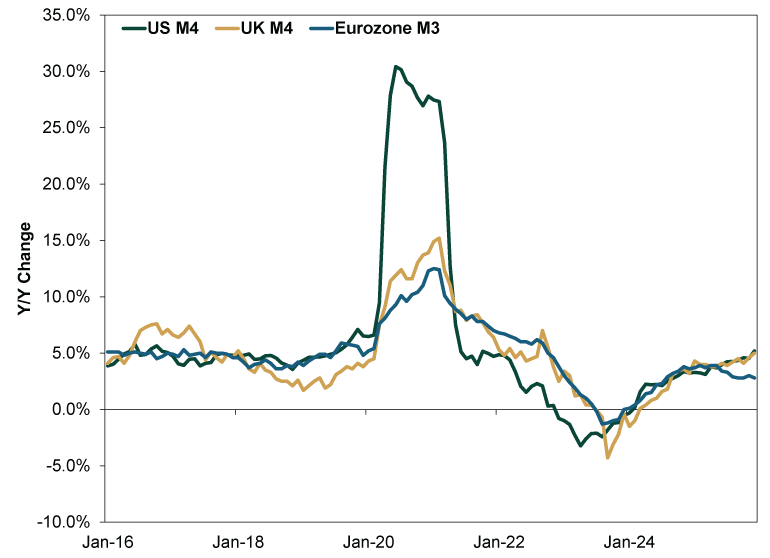
Source: Center for Financial Stability, Bank of England and European Central Bank, as of 2/18/2026. Year-over-year change in M4 including Treasuries, M4 (excluding intermediate OFCs) and M3 money aggregate, monthly, January 2016 – December 2025.
All this came as the economy was largely locked down. So you had vastly more money chasing far fewer goods and services. That is a textbook monetarist recipe for inflation. And that is what we got globally at a lag to money supply. (Exhibit 2)
Exhibit 2: Inflation Sped Up After the Money Supply Spike
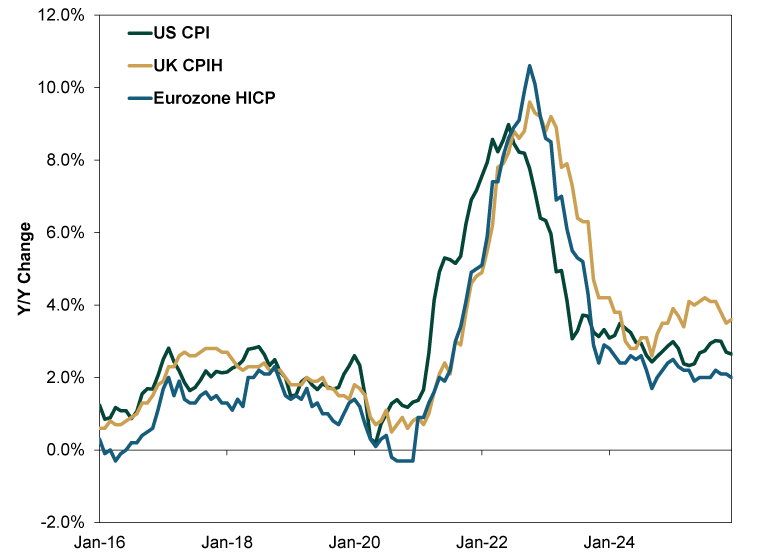
Source: FactSet and Office for National Statistics, as of 2/18/2026.
Beyond this, recent history also argues against tariffs being inherently inflationary. President Donald Trump levied tariffs during his first stint in office, targeting China in 2018 – 2019. The first salvo was a 30% tariff on solar panels and washing machines in February 2018, followed by additional duties that spring and summer—including a 25% tariff on Chinese imports in July. The NY Fed found those levies were passed on to US importers, too. Yet inflation didn’t skyrocket. After a brief acceleration to July 2018, price growth slowed for the rest of the year. (Exhibit 3) In our view, the primary reason is because money supply didn’t rocket like it did after the pandemic (see Exhibit 1 again).
Exhibit 3: 2018’s Tariffs Didn’t Lead to Faster Inflation
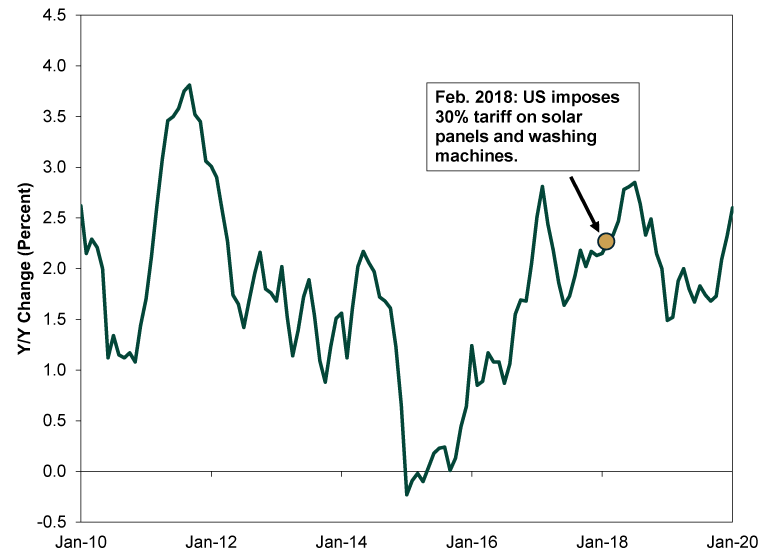
Source: FactSet, as of 2/18/2026.
To be clear, tariffs are economic negatives, hurting the imposer more than the recipient. They reduce competition, make the economy less efficient and can monkey with investment and expansion plans. Though a burden, it is one that in this case has proven to be less of a macroeconomic negative than many feared. That some worry tariffs will reignite inflation suggests a false fear continues to weigh on sentiment to a degree.
[i] “Who Is Paying for the 2025 US Tariffs?” Mary Amiti, Chris Flanagan, Sebastian Heise and David E. Weinstein, Liberty Street Economics, 2/12/2026.
[ii] Ibid.
[iii] Ibid.
[iv] “Tariff Tracker,” Staff, HBS Pricing Lab, as of 2/18/2026.
[v] Source: Center for Financial Stability, as of 2/18/2026. Year-over-year change in M4 money supply (including Treasuries), January 2025 – December 2025.
If you would like to contact the editors responsible for this article, please message MarketMinder directly.
*The content contained in this article represents only the opinions and viewpoints of the Fisher Investments editorial staff.
Get a weekly roundup of our market insights
Sign up for our weekly e-mail newsletter.

You Imagine Your Future. We Help You Get There.
Are you ready to start your journey to a better financial future?
Where Might the Market Go Next?
Confidently tackle the market’s ups and downs with independent research and analysis that tells you where we think stocks are headed—and why.
Related Resources
-
Market Analysis On September Inflation, Look Beyond the Headlines2026-10-14
-
Politics Is Canada Building a Stronger Bull Market?2026-10-13
-
Market Analysis Don’t Overstate AI’s Threat to Bank Profits2026-10-13
-
Weekly Wrap-Up Fisher Investments Reviews: Last Week in Markets — October 5 - October 92026-10-12





Learn More
Learn why 210,000 clients trust us to manage their money and how Fisher Investments and its affiliates may be able to help you achieve your financial goals.
As of 9/30/2026
New to Fisher? Call Us.
Contact Us Today